Knocking on Doors in Central Illinois Farm Country
Trying to find good hunting ground in central Illinois can feel like trying to crack a secret code. You see endless fields, woodlots, and creek bottoms, all screaming "deer!" or "turkey!", but almost all of it is privately owned and often tightly held. It's a real frustration, especially when public land access is limited or heavily pressured, leaving many hunters feeling like they're out of options. This guide is all about giving you the practical, respectful, and effective strategies for knocking on doors in central Illinois farm country and securing that coveted hunting permission.
Understanding the Landscape and Culture of Central Illinois Farm Country
Before you even think about pulling into a farmer's driveway, it's crucial to understand the unique landscape and the deeply rooted culture of central Illinois. This isn't big timber country where vast tracts might go unhunted. This is prime agricultural land, and how you approach it makes all the difference.
The "No Hunting" Sign Reality
You've probably seen them everywhere: the ubiquitous "No Hunting" or "Private Property" signs. It's easy to feel defeated before you even start. These signs are often a farmer's first line of defense, a blanket statement to deter casual trespassers and mitigate liability. They don't always mean that hunting is strictly forbidden on all parts of their land, or that they're entirely closed off to respectful requests. Many landowners have faced issues with irresponsible hunters in the past – gates left open, trash dumped, crops damaged, or even shots fired too close to homes or livestock. Their default stance is often "no" because it's easier than dealing with potential problems. Your job is to demonstrate that you are not one of "those" hunters and that you understand and respect their land and livelihood.
It's also important to remember that liability is a huge concern for landowners. In today's litigious society, the thought of someone getting injured on their property, even if they're there by permission, can be a major deterrent. Addressing this concern, perhaps by offering to sign a liability waiver, can sometimes open a door that was previously shut. Illinois state law does offer some protections for landowners who grant recreational access, but many farmers aren't fully aware of these nuances or simply prefer to err on the side of caution.
Farmer's Perspective and Concerns
Imagine you're a farmer. Your land is your livelihood, your home, and often, generations of your family's history. You're busy. Really busy. When someone shows up at your door, especially during planting or harvest season, they're interrupting your day. They might also be seen as an unknown variable, a potential risk to your property, livestock, or family. Farmers are often fiercely independent and have a strong sense of community. They might already have family members or close friends who hunt their land, or they might simply not want the hassle.
Their primary concerns often revolve around safety (their family, livestock, property), respect for their operations (not driving through fields, not disturbing crops or livestock), and trustworthiness. They want to know you're not going to be a nuisance, that you'll respect their rules, and that you understand the rhythms of farm life. Many farmers also have a deep appreciation for wildlife and might not want their land overhunted or managed poorly. Understanding these perspectives helps you tailor your approach to resonate with their values.
Building Local Trust
In central Illinois, especially in smaller rural communities, reputation is everything. Farmers talk. If you get permission from one farmer and conduct yourself admirably, word might spread positively. Conversely, a bad impression can close doors across an entire township. Building trust isn't a one-time transaction; it's an ongoing relationship. This means being consistently respectful, reliable, and thoughtful. It might mean starting with a request for small game hunting, like rabbit or squirrel, before asking about deer or turkey. It's about demonstrating your character and showing that you're not just looking for a place to hunt, but that you genuinely respect their land and their way of life.
The concept of community often plays a role. Many farmers are active in local churches, civic organizations, or agricultural groups. They know their neighbors, and they often look out for each other. Being a good steward of their land, even for a short hunting season, reflects positively on you and can lead to more opportunities down the road. Consider exploring how to gain permission on a small private tract in Illinois, as these smaller, often overlooked parcels can be great starting points for building trust.
Essential Preparation Before You Approach a Landowner
Showing up unprepared is almost guaranteed to lead to a "no." Just like you scout a piece of timber for deer sign, you need to scout the landowner and the property before you ever knock on their door.
Researching the Property and Area
Your preparation starts long before you leave home. Fire up your computer and a good mapping app, like GoHunt. This is where you can identify potential hunting areas that look promising, note access points, and, most importantly, find out who owns the land. Many counties in Illinois have online GIS mapping systems that show property lines and landowner names, which can be invaluable. You're looking for those hidden woodlots, creek drainages, fencerows, or unharvested fields that might hold deer or turkeys. Identify specific features that might be appealing to a hunter, such as a standing soybean field adjacent to timber or a funnel between two woodlots.
When you're doing your research, also consider the surrounding area. Is there public land nearby that might funnel deer onto private property? Are there any major roads or residential areas that would make hunting unsafe or undesirable? Understanding the property's context helps you speak intelligently about its potential and demonstrate that you've done your homework. A tool like GoHunt can often overlay public land boundaries and landowner information, giving you a comprehensive view. This will help you know exactly which property you are asking about and who to address it to.
What to Bring With You
When you make your approach, come prepared. This isn't just about having the right gear for the hunt, but the right presentation for the ask.
- Neat Appearance: Dress cleanly and respectfully. Avoid showing up in full camouflage or with a visible firearm. You want to look like a responsible, respectable individual, not someone who's already thinking about the kill. Business casual is often a safe bet.
- Identification: Have your driver's license and hunting license readily available. This shows you're legal and serious. You might even carry proof of your hunter education certificate.
- Written Request/Information: Consider typing up a simple, one-page letter introducing yourself, explaining your intentions (e.g., "I'm looking for a place to bowhunt deer this fall"), and including your contact information. This leaves something tangible behind if the landowner isn't home or needs time to think about it.
- Map of the Property: A printed aerial map of their specific property (which you obtained during your research, perhaps from GoHunt or a county GIS site) can be incredibly helpful. You can point to specific areas you're interested in, showing that you've scouted digitally and have a plan. This also allows you to discuss boundaries clearly.
- Liability Waiver (Optional but Recommended): While Illinois law offers some protection, bringing a simple liability waiver (easily found online or from a hunting organization) can show you're serious about protecting them and yourself. This often alleviates a major concern.
- Small Gift (Optional but thoughtfu): Sometimes a small, non-extravagant gift like a box of local chocolates, a gift certificate to a local diner, or even a small token of appreciation can make a positive impression. This isn't a bribe; it's a gesture of goodwill.
Timing Your Visit Right
Timing is everything in farming. Showing up at the wrong time can sour the interaction before it even begins.
- Avoid Busy Seasons: Never approach a farmer during planting season (typically spring) or harvest season (late summer/fall). Their focus is entirely on their crops, and you'll be seen as an interruption, not a respectful hunter.
- Optimal Times: Late morning or early afternoon on a weekday during the off-season (late winter, early spring before planting, or late fall after harvest) is often ideal. Avoid Sundays, as many farmers are at church or spending time with family.
- Weekends: If weekdays aren't possible, try a Saturday mid-morning.
- Weather: Don't show up in the middle of a rainstorm or when it's extremely cold. Choose a pleasant day when they might be more inclined to chat.
- Don't Be a Surprise: It's generally best to approach them at their home, not out in a field where they might be operating heavy machinery. Pull into their driveway respectfully, park in a logical spot that doesn't block anything, and approach the door.
For example, asking for deer permission during October when they are running combines is almost certainly going to get you a quick "no." Conversely, a visit in late February or early March, when field work is slow and they're planning for the coming year, offers a much better window. This is also a good time to discuss the rules of Illinois trespass and permission law if they have any concerns.
The Art of the Conversation: Making Your Pitch
Once you've done your homework and chosen the right time, the actual conversation is where you either win or lose. This isn't a negotiation; it's about building a connection.
First Impressions and Respectful Engagement
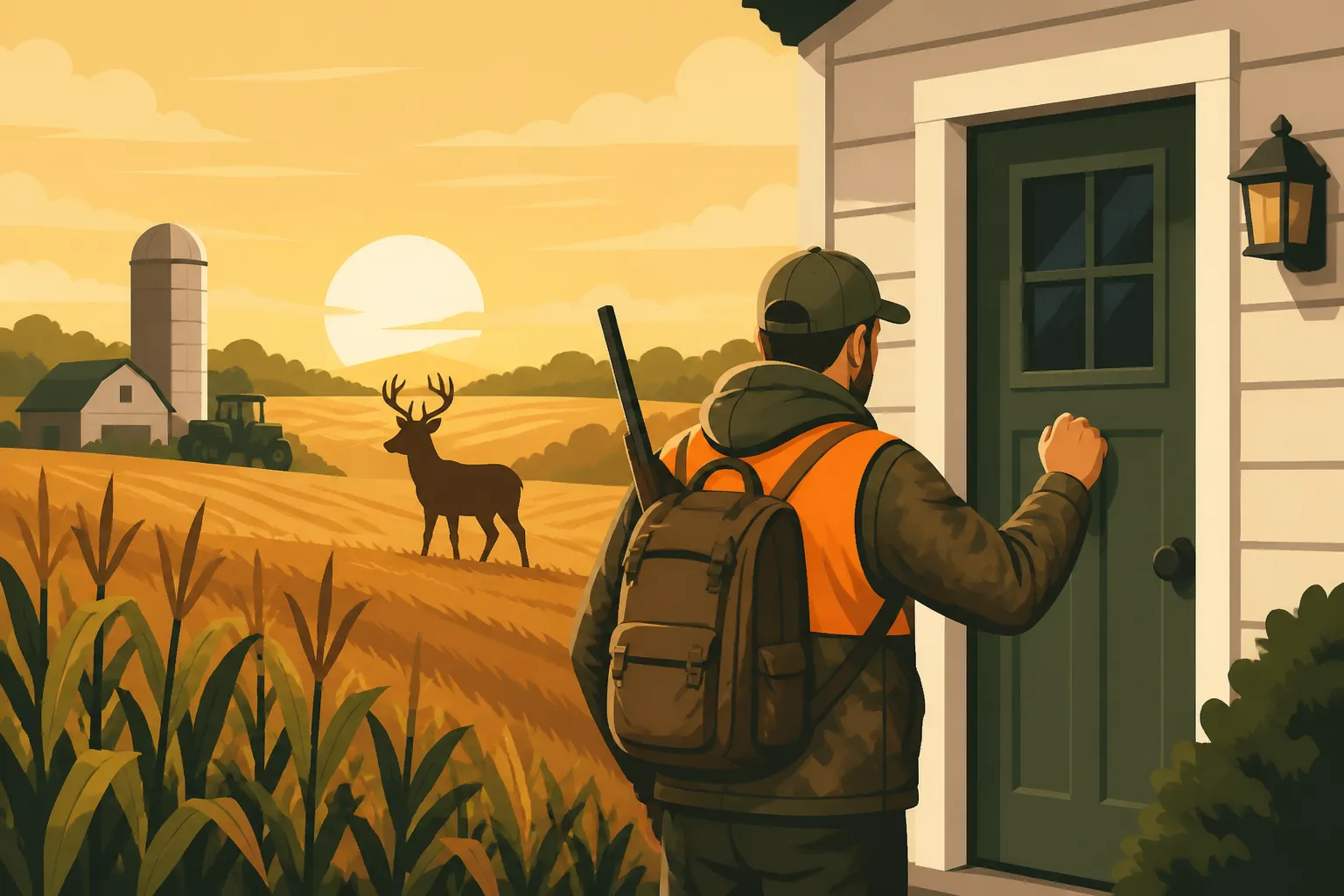
When you step out of your vehicle, take a deep breath. Your demeanor speaks volumes before you even say a word. Walk up to the door confidently but not aggressively.
- Knock, Don't Ring and Run: Give a firm, clear knock on the door. Wait patiently. If no one answers after a reasonable time, leave your written note with your contact information. Don't snoop around or peer into windows.
- Introduce Yourself Clearly: When someone answers, start with a polite introduction. "Hello, my name is [Your Name], and I'm a hunter from [Your Town]. I apologize if I'm interrupting your day, but I was hoping to speak with you for a few minutes about the possibility of hunting on your land."
- Eye Contact and Body Language: Maintain respectful eye contact. Stand with open body language, not with your hands in your pockets or arms crossed. Show genuine respect for their time and property.
- Listen More Than You Talk: Be prepared to listen to their concerns, their stories, and their rules. This isn't about you selling yourself; it's about understanding their needs and showing that you can be trusted.
Remember, you are a guest from the moment you pull into their driveway. Your goal is to establish rapport and demonstrate that you are a responsible, trustworthy individual.
What to Say and What to Avoid
Your words are crucial. Be clear, concise, and honest about your intentions.
- Be Specific About Your Request: Don't just ask if you can "hunt." Specify what you want to hunt. "I'm primarily interested in bowhunting deer," or "I was hoping to find a place to take my son squirrel hunting." Being specific shows you've thought about it and aren't looking for a free-for-all. For example, some farmers are happy for someone to help control the population of coyotes, so asking about Coyote Calling in Illinois Farm Country might open a door.
- Address Concerns Proactively: You can gently bring up common concerns. "I understand safety is a big concern, and I'm always extremely careful, especially near homes or livestock." Or, "I'm very mindful of crops and would never drive or walk through a field, only stick to the edges or fencerows."
- Offer to Help: This is huge in farm country. "If you ever need an extra hand with anything around the farm, I'd be happy to help out. I'm capable of [list a skill: fixing fence, stacking hay, etc.]." Even if they decline, the offer itself shows your character and willingness to reciprocate.
- Highlight Your Responsibility: Mention your commitment to ethical hunting, conservation, and leaving no trace. "I always pack out everything I pack in and leave the land cleaner than I found it."
- What to Avoid:
- Complaining about public land pressure: While true, it doesn't endear you to them. Focus on why you would be a good hunter for their land.
- Making demands or acting entitled: You are asking for a privilege, not a right.
- Over-promising: Don't say you'll help with chores if you have no intention of following through.
- Talking about "trophy bucks": This can turn off landowners who see wildlife as more than just antlers. Focus on enjoying the outdoors and ethical harvesting.
- Asking about landowner deer permit rules right away: This can come across as you trying to exploit a loophole or special privilege. Save such discussions for when trust is established.
You might say, "I noticed you have a nice woodlot backing up to that standing cornfield, and it looks like prime deer habitat. I'd be really grateful for the chance to bowhunt deer in there, being extra careful around your fields and property." This shows you've done your research, specifically mentioning how to hunt a standing soybean field or how to hunt an entry route through standing corn.
Handling Different Responses
You'll get a variety of responses, and how you handle them is key.
- The Immediate "Yes": This is rare, but fantastic! Thank them profusely, ask about specific rules (where you can park, boundaries, gates, who else hunts, etc.), and clarify the duration of the permission. Offer to put it in writing for both your sakes.
- The "Let Me Think About It" / "Maybe Later": This is a positive sign! Offer to leave your written information and map, and ask if it would be okay to follow up in a week or two. "No problem at all, I completely understand. Would it be alright if I leave this card with my number, and perhaps I could call you next [Day of Week] if you've had a chance to consider it?"
- The Soft "No": Sometimes they'll say no but offer a reason ("My son hunts it," "Too many deer already," "Too busy"). Thank them for their time and politely ask if they know anyone else in the area who might be open to the idea. "I completely understand. Thanks for your time anyway. Do you happen to know any of your neighbors who might be looking for someone to help manage deer?" This keeps the door open and might lead you to another opportunity.
- The Hard "No": Occasionally, you'll encounter someone who is simply not interested, maybe even a bit gruff. Don't argue, don't press. Thank them politely for their time, wish them well, and leave. Your goal is to be remembered as polite and respectful, not persistent and annoying.
- No One Home: If no one is home, leave your written note with your contact information, a map, and a polite message indicating you stopped by and what you were hoping to discuss. "Sorry I missed you! I stopped by hoping to ask about hunting permission. My name is [Your Name] and my number is [Your Number]. Feel free to call me if you're open to discussing it."
| DOs | DON'Ts |
|---|---|
| Dress neatly and respectfully | Show up in full camo or with a visible firearm |
| Go during daylight hours, not too early/late | Interrupt during meal times or busy farm work |
| Introduce yourself clearly and politely | Be vague about your intentions or pushy |
| State your specific request (e.g., bowhunt deer) | Ask for "general hunting" or multiple species without clarity |
| Offer to help with chores | Expect immediate access without earning trust |
| Leave a written note if no one is home | Trespass or leave trash; don't snoop |
| Ask about specific rules and boundaries | Assume anything about access or conduct |
| Follow up politely if they say "maybe" | Harass them if they say "no" or don't respond |
After You Get Permission: Maintaining the Relationship
Getting permission is just the first step. The real work is maintaining that privilege and ensuring you're invited back year after year. This is about building a lasting relationship based on trust and mutual respect. This kind of diligent relationship management is what makes hunting small private tracts in Illinois so rewarding.
Adhering to the Rules and Exceeding Expectations
This might sound obvious, but it's where many hunters fall short. You must adhere strictly to every rule the landowner sets, no exceptions. If they say no guests, then no guests. If they say no hunting past noon, you're out of the woods by then.
- Clarify Everything: Before your first hunt, make sure you understand all the rules:
- Where can you park?
- What are the exact boundaries you can hunt? Use your map to confirm.
- Are there any areas that are off-limits (e.g., near the house, livestock pastures, specific fields)?
- What gates need to be closed behind you?
- What time can you arrive and must you leave?
- Can you put up a treestand? If so, does it need to be a climber or can it be a hang-on? Are screw-in steps allowed? (Remember, rules about hanging a stand on a southern Illinois ridge might differ slightly from central Illinois farmland.)
- Who should you contact if you get a deer, or if there's an emergency?
- Exceed Expectations: Go beyond the minimum. If they said to close the gate, make sure it's latched securely. If you see a piece of trash that isn't yours, pick it up. If you're hunting near a field edge, be extra careful not to damage any crops, even if they're harvested. Always communicate with them before you bring any equipment like ground blinds. For instance, if you plan on brushing in a blind on a field edge, ensure they are okay with any cutting of natural brush.
- No Surprises: Never introduce a new variable without asking. Don't bring a friend, scout a new area, or change your hunting method without prior discussion and explicit permission. This also applies to things like using trail cameras; always ask first where to hang a camera on a logging road or any other location.
Offering Help and Showing Gratitude
Demonstrating consistent gratitude and offering genuine help cements your relationship. This isn't just about the hunting season; it's year-round.
- The Post-Hunt Thank You: After your hunt, especially if you harvest an animal, make sure to stop by and thank them in person. Share a picture of the deer or turkey. Offer them some of the meat. This is a huge gesture of goodwill in farm country.
- Off-Season Check-ins: Don't just show up when you want to hunt. An occasional stop-by in the off-season, just to say hello and see how things are going, speaks volumes. A simple text message wishing them well during planting season, or asking if they need a hand, goes a long way.
- Offer Specific Help: "I've got some free time next Saturday, is there anything around the farm I could help you with?" This could be anything from mending a fence, clearing brush, helping with small repairs, or even just offering an extra set of hands during a busy period. Many hunters find that helping out with chores like this makes them feel more connected to the land and the landowner.
- Small Gestures: A holiday card, a gift basket at Christmas, or a small thank-you gift after the season are all ways to show continued appreciation. If you have some success deer hunting in Illinois, offering some fresh venison is always a thoughtful gesture.
Long-Term Stewardship
Think of yourself as a temporary steward of their land. Your actions should reflect a commitment to its health and productivity, both for wildlife and for farming. This long-term perspective is crucial for keeping hunting access.
- Respect the Wildlife: Don't overhunt or take more than you've been allowed. If the landowner has concerns about herd health or turkey populations, be mindful of their wishes. You might even talk about potential late-season food sources for Illinois whitetails or other habitat improvements that could benefit their land.
- Report Concerns: If you notice anything unusual on their property – a broken fence, suspicious activity, sick animals – report it to them immediately. You are their eyes and ears when they aren't around.
- Ask for Next Year's Permission: Don't assume permission carries over. Towards the end of the season, or in the off-season, politely ask about the following year. "I really enjoyed hunting here this season, and I appreciate your generosity. Would it be alright if I asked to hunt again next year?" This shows respect and gives them the opportunity to make adjustments if needed. It's much like how hunters approach hunting the second firearm season in December, where specific re-permissions might be necessary for different tracts.
- Be a Mentor: If you are granted the opportunity to take a youth hunter or a new hunter, make sure they understand and adhere to all the landowner's rules. This not only teaches them respect but also demonstrates to the landowner that you are responsible for those you bring onto their property.
By following these steps, you're not just asking for a place to hunt; you're building a relationship, earning trust, and demonstrating that you're a valuable asset to the landowner. That's the real secret to knocking on doors in central Illinois farm country and finding hunting success.
Disclaimer
Hunting is an inherently risky activity. Always prioritize safety, understand and adhere to all local, state, and federal hunting regulations, and respect private property. The information provided here is for educational purposes only and should not be considered legal advice. Always consult with the Illinois Department of Natural Resources (IDNR) for the most current rules and regulations. It is your responsibility to ensure you have proper permission before entering any private land for hunting or any other activity.