Timber Cuts and Where Deer Move After
It's incredibly frustrating when you've spent seasons, maybe even years, learning a piece of timber, only to arrive one day and find it's been clear-cut or heavily thinned. The familiar landmarks are gone, the canopy that once provided cool shade and predictable deer travel is open to the sky, and suddenly, all your hard-earned knowledge feels irrelevant. This guide is here to help you understand how these timber cuts actually influence deer behavior in Illinois, giving you the tools to adapt your scouting and hunting strategies to these changed landscapes.
Understanding the Impact of Timber Cuts on Deer Habitat
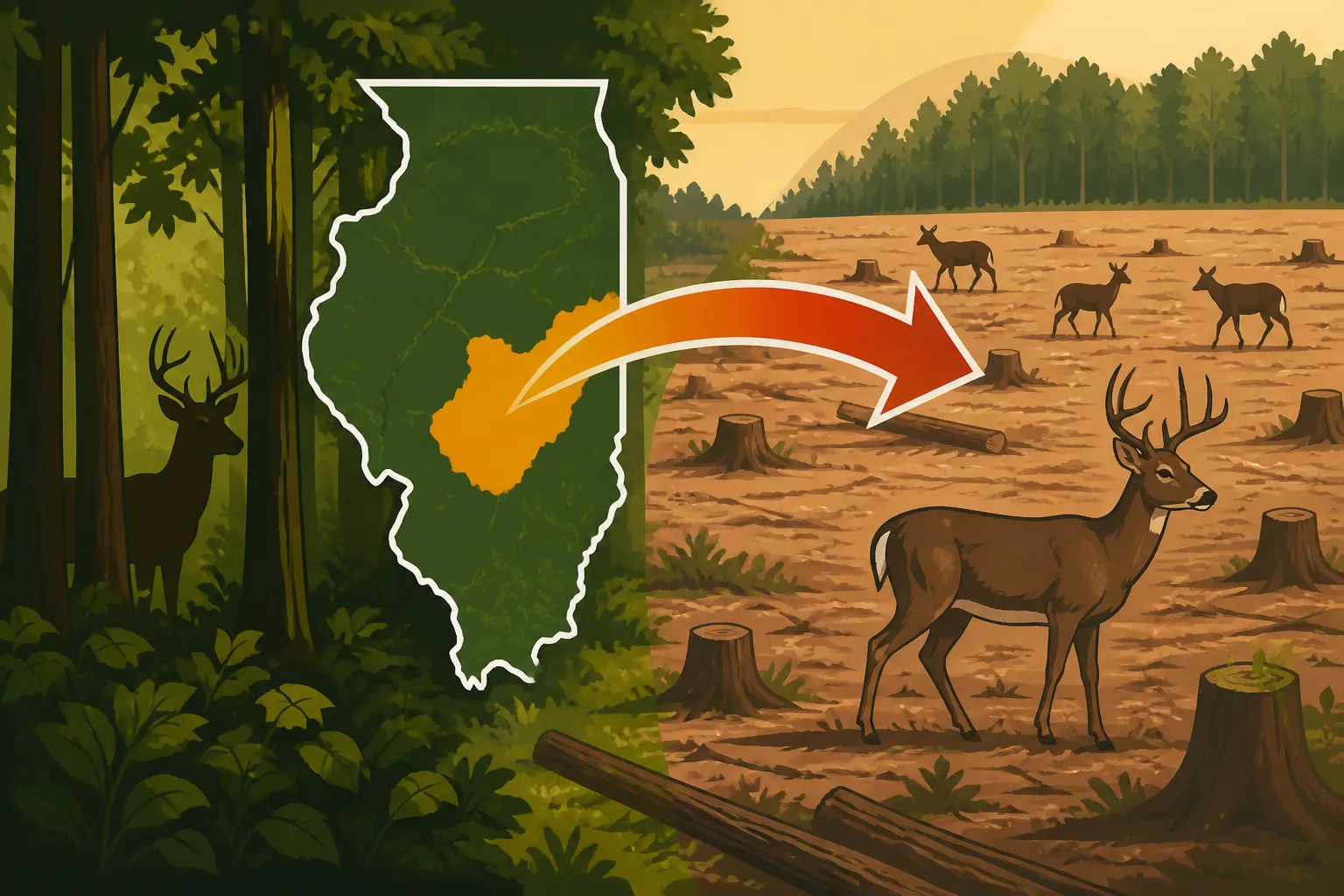
Timber harvesting, whether it’s a clear-cut, a selective cut, or a thinning operation, dramatically alters the environment. What might look like devastation to an untrained eye often initiates a cycle of habitat improvement that, in the long run, benefits wildlife, especially white-tailed deer. The initial shock can be jarring for both the deer and the hunter, but understanding the ecological changes will reveal new opportunities.
Immediate Habitat Changes
When a logging crew moves in, the immediate effect is a significant reduction in canopy cover. Sunlight, which was once filtered or blocked entirely, now floods the forest floor. This sudden influx of light stimulates the growth of a variety of understory plants, shrubs, and young trees. While the mature mast-producing trees might be gone, this new growth explosion provides an immediate, albeit temporary, buffet for deer. Think about all those tender shoots and leaves that quickly sprout from disturbed soil and stumps—they're highly palatable and nutritious. Additionally, the slash (tops, limbs, and other debris left behind) creates instant bedding cover and protection from predators, especially for fawns. It's not uncommon to find deer bedded right in the middle of dense, tangled logging debris, hidden from view.
However, the noise and activity during the cutting operation itself will inevitably push deer out of the immediate vicinity. They'll seek refuge in adjacent, undisturbed timber, thickets, or deep draws. This initial displacement can last for days or even weeks, depending on the intensity and duration of the logging. But once the machinery leaves, curious deer, and those drawn by the new browse, will begin to cautiously re-enter the area. Hunters should be mindful of this initial disruption and not expect immediate returns to normalcy.
Long-Term Benefits for Deer
While the initial scene might look barren, timber cuts are often crucial for creating diverse, healthy habitat in the long term. The dense regrowth that follows a cut, often dominated by species like briars, sumac, and young hardwoods, provides exceptional security cover and forage that was simply unavailable in a mature, closed-canopy forest. This low-growing, high-density vegetation acts as a nursery for fawns, a hideout for mature bucks, and a year-round food source. In regions like the Shawnee National Forest, where large tracts of mature timber can sometimes lack diverse understory, these cuts become critical pockets of high-quality habitat.
Over several years, the cut-over area will transition from dense browse to young pole timber, then eventually to mature forest again, creating a mosaic of habitats across the landscape if managed properly. This varied age structure is far more beneficial for deer than a uniform, single-age forest. It ensures a consistent supply of forage and cover at different stages of growth. Understanding this ecological succession can help hunters predict which areas will be productive in the coming seasons. For instance, a clear-cut from five years ago might now be a briar-choked sanctuary, while a two-year-old cut might still be a primary feeding area. You can often see these stages unfold right on your mapping app, like onX Hunt, showing different timber growth stages.
Identifying Key Deer Movement Patterns Post-Cut
Deer are creatures of habit, but they are also incredibly adaptable. When their familiar landscape is drastically altered, they don't just disappear; they adjust their routines. Understanding these adjustments is key to finding them in a freshly cut-over area.
Initial Dispersal and Security Cover
During active logging, deer will temporarily abandon the immediate area and retreat to the nearest available security cover. This could be an untouched block of timber, a dense cedar thicket, or even a gnarly river bottom that offers a sense of refuge. Their primary instinct is survival, and the sounds and smells of heavy machinery are certainly a threat. You might find higher concentrations of deer in these adjacent areas than usual, as they're temporarily displaced.
Once the logging operations cease, the deer will begin to filter back into the cut-over section, but cautiously. Their first priority is security. They'll gravitate towards the thickest piles of slash and the densest pockets of remaining vegetation for bedding. These areas, though seemingly chaotic, offer incredible concealment. Bucks, especially, will often seek out these impenetrable hidey-holes. When Where Shawnee National Forest Bucks Bed is discussed, these new thickets formed by timber cuts become prime candidates, offering seclusion that older growth lacked. Look for these dense zones, often along the edges of the cut or where piles of timber debris are particularly large.
New Food Source Exploitation
The surge of sunlight immediately after a timber cut sparks an explosion of new vegetative growth. This fresh browse—everything from young saplings to briars, forbs, and grasses—becomes a magnet for deer. They are expert browsers and will quickly home in on these nutrient-rich offerings. The deer's diet shifts to capitalize on this readily available, palatable vegetation. Instead of rooting around for acorns or browsing on less desirable mature leaves, they now have a smorgasbord of tender shoots.
This means you'll often find deer feeding more actively within the cut itself, particularly in the mornings and evenings. They might not have traveled far to get to these new food sources, having merely shifted from their old routines to exploit the fresh growth. Pay close attention to areas where new growth is most abundant, especially if it's mixed with some of the remaining understory or along the edges where the cut transitions into standing timber. These fresh food sources can be just as attractive as a standing soybean field, often drawing deer from a surprising distance.
Travel Corridors in Altered Landscapes
Even with significant changes, deer still need to move from bedding to feeding areas, and between different pockets of cover. Timber cuts, while disrupting old trails, often create new travel corridors or enhance existing ones. Natural funnels, previously obscured by dense canopy, might become more pronounced. Edges where the cut meets standing timber, or where a clear-cut abuts a thick creek bottom, often become highways for deer.
Look for lines of heavier cover, slight terrain breaks, or even subtle paths worn through the new growth as deer begin to establish new patterns. These new corridors might not be as obvious as the old, well-worn deer trails, but they will be there. Sometimes, a single standing tree, a brushy fence row, or a ditch line running through the cut will provide just enough cover for deer to feel safe traveling along it. Mapping tools like onX Hunt can be invaluable for identifying these potential new travel routes, allowing you to trace likely paths between dense bedding areas (newly created by the slash) and adjacent food sources or water. These areas can function much like a Hunting a Funnel Between Two Woodlots, just on a larger and more complex scale within the cut.
Effective Scouting and Hunting Strategies for Timber Cuts
Adjusting your approach to hunting timber cuts requires both pre-season preparation and on-the-fly adaptability. The rules of engagement change, and successful hunters are the ones who can quickly read the new landscape.
Pre-Season E-Scouting and Boots-on-the-Ground
Before you even step foot in the woods, your e-scouting game needs to be on point. Utilize satellite imagery to identify the extent and type of timber cut. Look for fresh aerial photos that show the bare ground, the slash piles, and the distinct edges where the logging stopped. These visual cues can help you pinpoint potential bedding areas (the thickest, darkest spots within the cut or adjacent to it) and new travel corridors (lines of cover or terrain features running through the cut). Tools like GoHunt or onX Hunt often provide various map layers that can reveal subtle changes in timber density and regrowth over time, helping you visualize the new deer highway.
Once you have a general idea, it’s time for boots-on-the-ground scouting. This is where you verify what you saw on the map. Walk the edges of the cut, looking for rub lines, scrape lines, and fresh tracks leading into and out of the new growth. Don’t be afraid to plunge into the thickest parts of the cut, as long as you're respectful of the growing vegetation and hunting pressure. You’re trying to find the primary entry and exit points, as well as the specific bedding pockets that bucks are using. This hands-on approach, like Scouting Illinois Public Land Before Season, is non-negotiable for understanding how deer are utilizing this newly opened habitat.
Adapting Stand Placements
Your old stand locations are likely useless in a freshly cut area. The canopy might be gone, the deer trails rerouted, and the wind dynamics completely altered. Now, you need to think about new strategies for concealment and shot opportunities. Ground blinds become an incredibly effective option in these environments because they allow you to set up directly in the thick cover of the slash piles or the dense regrowth without needing a mature tree. This is especially true if you are hunting on public land where permanent stands are often prohibited.
If you opt for a treestand, focus on the mature timber pockets that border the cut. Look for isolated trees or clumps of trees that still offer good height and cover along the newly formed transition lines. Deer will often skirt these edges, using the standing timber as a security buffer before entering the more open cut. Consider how Hanging a Stand on a Southern Illinois Ridge needs to adapt when that ridge now has a new clear-cut on its flank. Wind direction is even more critical in these open areas, as thermals can be less predictable. Always place your stand to take advantage of prevailing winds that carry your scent away from where you expect deer to approach or bed.
Hunting the Edges and Transition Zones
The most consistently productive areas in a timber cut are usually the edges and transition zones. This is where the dense new growth meets older, undisturbed timber, where different types of vegetation intermingle, or where a cut meets a creek bottom or agricultural field. Deer love edges because they offer a combination of food, cover, and travel routes. A mature buck might feel secure bedding deep in a slash pile, but he'll often stage just inside the adjacent standing timber before stepping out to feed in the cut, or vice-versa.
Focus your efforts on these convergence points. Think about how deer will move along the perimeter, picking their way through the fringes of the cut, perhaps paralleling a new logging road that now serves as a soft edge. During the rut, these edges can be exceptional cruising grounds for bucks scent-checking for does, as they offer both concealment and easy travel. Consider setting up between a known bedding thicket within the cut and a more open feeding area, or along a bottleneck created by the cut on a ridgeline. These transition areas often see more deer activity than either the deep woods or the wide-open cut on its own.
Long-Term Management and Future Hunt Planning
Hunting a timber cut isn't just a one-season affair. These areas evolve, and understanding that evolution can give you a significant advantage in planning your hunts for years to come.
Monitoring Regeneration
The timber cut you hunt this year will look vastly different in two, five, and ten years. In the first year or two, you’ll see an explosion of tender browse. This is prime feeding habitat. Deer will be in these areas regularly, especially during green-up and throughout the early fall. After about three to five years, that dense browse often starts to become too thick to walk through comfortably, forming an impenetrable jungle. This is when it transforms into a top-tier security and bedding area, providing unmatchable cover for mature deer. You might have a hard time seeing deer in it, but they'll be there, using it as a sanctuary.
As the years progress further, say seven to ten years post-cut, the young trees will begin to outcompete the browse, and the canopy will start to close in again, shading out the undergrowth. This reduces the food value but can still provide good thermal cover. Eventually, it reverts back to mature timber, potentially setting the stage for another cycle of cutting. By monitoring these stages, perhaps by using historical imagery on your mapping apps or simply by making regular scouting trips, you can anticipate how deer will use the area. A patch that was a feeding hotspot last year might be a bedding sanctuary this year, requiring a completely different approach.
Anticipating Future Changes
Successful hunting in timber-cut landscapes isn't just about reacting to current conditions; it's about anticipating future changes. If you know a timber company is planning a harvest in an adjacent block, you can start mentally preparing for how deer will react. Will they shift to the recently cut area you've been hunting? Will new travel corridors open up? This foresight allows you to adapt your scouting and Hunting the Late-Season December Lull strategies long before the changes actually occur.
Landowners or forest managers often have long-term plans for timber harvests, which might be publicly available for larger tracts like state forests or National Forest lands. Reading Aerial Photos for Southern Illinois Deer across different timeframes can reveal patterns of past cuts and regrowth, helping you predict future deer movement trends. Understanding these cycles helps you stay ahead of the curve, positioning yourself to take advantage of newly created opportunities instead of constantly playing catch-up.
| Timber Cut Age | Primary Deer Use | Hunting Strategy | Key Features to Look For |
|---|---|---|---|
| 0-2 Years | Intensive Feeding, Temporary Bedding | Hunt edges, new trails, ground blinds, spot & stalk | Fresh browse, thick slash piles, new tracks |
| 3-6 Years | Primary Bedding, Security Cover, Limited Feeding | Hunt fringes, transition zones, ambush points at access | Dense briars, young saplings, buck rubs on adjacent trees |
| 7-10+ Years | Transitional Cover, Some Browsing | Hunt new funnels, travel corridors, areas of remaining mast | Closing canopy, maturing saplings, old logging roads |
Ultimately, timber cuts in Illinois are a dynamic element of the landscape. While they can be frustrating initially, they represent an incredible opportunity for the observant and adaptable hunter. They force us to learn, to scout, and to think critically about deer behavior, making us better hunters in the process.
Disclaimer
This article is for general informational purposes only and does not constitute professional advice. Laws, prices and regulations vary by location and change over time. Consult a qualified professional for guidance on your specific situation.