Layout Blind Hunting Illinois Farm Fields
There's nothing quite like the sight of ducks and geese cupping their wings and committing to your spread, but if you've ever tried to hunt them in wide-open Illinois farm fields, you know the struggle of finding adequate cover. Hunting these intelligent birds requires an almost invisible presence, and without natural concealment, it feels like an impossible task. This comprehensive guide will walk you through everything you need to know about effectively using layout blinds in Illinois farm fields, turning barren ground into your most productive hunting spot.
Why Layout Blinds are Essential for Field Hunting in Illinois
Hunting waterfowl in Illinois often means setting up in vast agricultural landscapes. Whether it's a cut cornfield, a picked soybean field, or a winter wheat field, natural cover is almost non-existent. This is where layout blinds become not just an advantage, but an absolute necessity. Trying to hide in a ditch or under a sparse clump of weeds when a flock of sharp-eyed geese is circling at 500 feet just isn't going to cut it.
The Problem with Traditional Blinds in Open Fields
Imagine trying to set up a traditional box blind or even a pop-up hub blind in the middle of a freshly cut soybean field. It sticks out like a sore thumb. Ducks and geese have incredible eyesight, honed over generations to spot the slightest anomaly in their environment. A vertical structure, no matter how well camouflaged with a pattern, breaks up the natural horizon line and sends a clear warning signal. They've learned that anything tall and out of place often means danger. The open nature of many Illinois farm fields, especially those near major migration corridors like the Illinois River or Mississippi River, demands a different approach for successful hunts. It's not just about hiding; it's about blending in completely with the natural contours of the land.
The Unmatched Concealment of Layout Blinds
Layout blinds, by design, conform to the ground, mimicking a slight rise or clump of dirt, which is something waterfowl are accustomed to seeing. You're lying down, nearly flat on your back, which keeps your profile incredibly low. This minimal profile, combined with strategic brushing, makes you virtually disappear into the field. Think about it: a Canada goose flying high overhead sees a perfectly flat landscape with perhaps some stubble or a few dirt clods. Your layout blind, when properly brushed in, becomes just another one of those harmless irregularities. This superior concealment is critical when hunting Canada geese on Illinois farmland, where they are often wary and accustomed to hunting pressure. The ability to disappear completely gives you the edge you need to entice them into easy gunning range.
Choosing the Right Layout Blind for Illinois Conditions
Not all layout blinds are created equal, and the diverse conditions you'll encounter across Illinois farm fields mean you need to think carefully about your gear. From muddy fields after a rain to rock-hard frozen ground, your blind needs to be durable, comfortable, and easy to transport and conceal.
Key Features and Considerations
When picking out a layout blind, there are a few features that make a world of difference for Illinois hunters. First, consider the material and frame. You want something robust that can stand up to repeated use in tough conditions – think mud, frost, and rough stubble. Aluminum frames are often lighter and rust-resistant, which is a big plus for longevity. The fabric should be waterproof and tough, able to shed water and resist snags. Many blinds come with stubble straps or loops sewn directly onto the fabric, which are absolutely vital for adding natural vegetation. Don't underestimate the importance of these; they're what allow you to truly disappear. Also, look at the comfort factor. You'll be lying in this thing for hours, sometimes in bitter cold. A padded headrest and a comfortable back support can make or break your hunt. Some brands like Avery, Final Approach, and Rogers Sporting Goods offer a variety of models with different comfort and concealment features designed for serious waterfowl hunters.
Blind Size and Portability
Size is another important consideration. While larger blinds might offer a bit more comfort or storage space, they also present a larger profile to conceal and can be heavier to haul. If you're hunting public land or areas that require a bit of a hike, a lightweight, compact blind is a godsend. Conversely, if you're hunting private land with easy vehicle access, a larger blind with more features might be acceptable. Most modern layout blinds fold down for transport, often with shoulder straps, making them relatively easy to carry short distances. Think about the overall footprint when deployed too; you want to ensure it still allows for quick, comfortable shooting when the birds commit. It’s a balance between comfort, concealment, and the sheer physical effort of getting it to your spot. Remember, you might also be carrying decoys, your gun, and other essentials, so every pound counts.
Matching Blind Camo to Illinois Environments
The camouflage pattern on your blind needs to match the typical fields you hunt. Illinois offers a huge variety of agricultural landscapes, from the golden hues of standing soybeans to the grays and browns of cut corn or winter wheat. Most layout blinds come in popular patterns like Mossy Oak Shadow Grass Habitat, Realtree Max-7, or similar blends designed for agricultural settings. However, the factory pattern is just a starting point. The real magic happens when you add local vegetation to your blind. If you're hunting a cut cornfield, grab corn stalks. If it's a wheat field, use wheat stubble. The goal is to break up the outline of the blind and make it an extension of the field itself. Even if your blind's base pattern is a little off, proper brushing with local vegetation will make it disappear. This attention to detail is far more important than the exact factory camo pattern.
Mastering Blind Placement and Concealment
Even the best layout blind is useless if it's placed incorrectly or poorly concealed. This is where scouting, strategy, and a little elbow grease come into play. Your goal is to become an invisible part of the landscape, and that takes more than just laying down a sheet of camo.
Strategic Positioning within the Field
Where you put your blind in the field is paramount. You want to place it where birds will naturally want to land, usually into the wind. Ducks and geese almost always land and take off facing into the wind. So, position your blind downwind of your decoy spread, facing into the wind, to ensure the birds finish their approach directly over or in front of you. Pay attention to natural contours – a slight rise, a subtle ditch, or even a tractor rut can provide a valuable bit of natural cover to help break up your silhouette. Avoid placing your blind on the very top of a knoll, even a small one, as it will highlight your position. Instead, aim for the downwind side of a rise. Using tools like GoHunt or other mapping applications during your scouting phase can help you identify these subtle elevation changes and optimal wind-driven landing zones before you even set foot in the field. Scouting is crucial, not just for finding where the birds are, but for identifying the exact spot where you can vanish.
Brushing In for Ultimate Stealth
This is arguably the most critical step in layout blind hunting. Simply laying your blind down and hoping for the best is a recipe for busted birds. You need to gather natural material from the immediate vicinity of your hunting spot. If it's a cornfield, cut corn stalks. If it's beans, use bean stubble. Wheat, milo, grass – whatever the field provides, use it. Don't be shy; load up those stubble straps on your blind. The goal is not just to cover the blind but to break up its distinct, straight lines. Think about the sun and shadows. Birds coming in from different angles will see different things. Pile the vegetation on thickest on the edges, especially where the blind meets the ground, to eliminate hard lines. You can even use a small shovel to kick dirt or stubble over the edges, truly blending it into the field. This takes time, but it's an investment that pays off when the birds are locked up and coming in. This is especially true when setting up for early goose season tactics in Illinois, where birds may not have experienced heavy pressure yet but are still acutely aware of their surroundings.
Utilizing Natural Cover Features
Beyond just brushing your blind, look for opportunities to integrate your setup with any existing natural cover. Maybe there's a fencerow, a small drainage ditch, or a field edge with thicker vegetation. While you typically want to be out in the open to attract birds, using these features to your advantage can add another layer of concealment. For example, setting up your blind just a few yards in front of a fencerow can help break up your background, especially if the fence line has some tall weeds or brush. Just be mindful of shooting lanes and don't compromise your field of fire. If you are hunting near a wooded area, consider the tree line. Sometimes setting up your blind parallel to a treeline, a good distance away, can make your blind look like a natural shadow or anomaly rather than a foreign object. Remember, the birds have seen thousands of fields; they know what looks right and what doesn't.
Decoy Spreads and Calling Strategies for Field Hunting
Once your blinds are perfectly concealed, the next challenge is convincing those high-flying ducks and geese to commit to your spread. This involves thoughtful decoy placement and expert calling, all tailored to the specific behavior of waterfowl in Illinois farm fields.
Decoy Selection and Placement
For field hunting in Illinois, full-body decoys are generally preferred for geese because they offer a realistic three-dimensional profile that's visible from a distance. Silhouette or shell decoys can work, especially for larger spreads, but full bodies provide that extra touch of realism. For ducks, a mix of mallard and pintail full-body or sleeper shell decoys can be effective. Consider adding some "active" decoys, like those with spinning wings or head-turning movements, to create the illusion of a living, feeding flock.
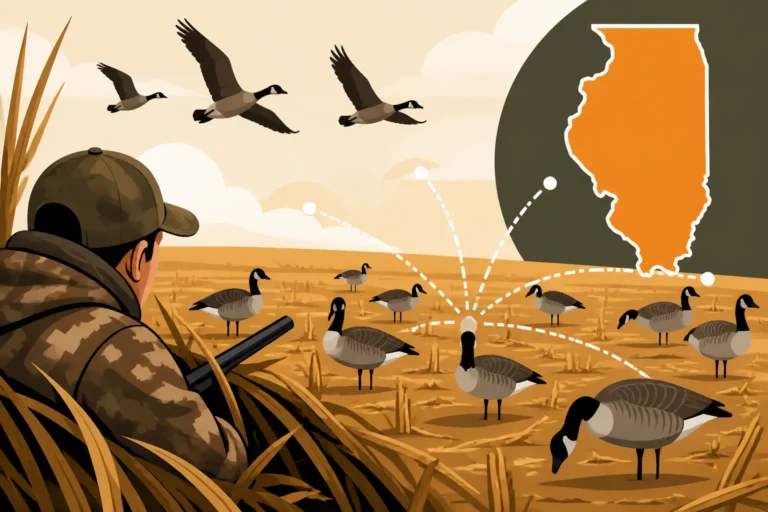
When it comes to placement, think about what a real flock of feeding birds looks like. They aren't in perfectly straight lines or neat circles. They're scattered, with some family groups, some singles, and a clear "landing zone" or "kill hole" where you want the birds to commit. This landing zone should be directly in front of your blinds, allowing for ethical shots. A common tactic is a "J" or "U" shaped spread, with the open end of the letter facing into the wind, leading directly to your blinds. This funneling effect guides birds right where you want them. Don't forget to put some "outlier" decoys further out, creating the impression of a larger, more confident flock. Understanding Illinois waterfowl migration timing can also inform your decoy choices, as different species arrive at different times.
| Decoy Type | Best Use Case | Advantage in Illinois Fields |
|---|---|---|
| Full-Body Geese | Main spread, high visibility, realistic profile | Highly visible from altitude, adds realism |
| Full-Body Ducks | Mix into goose spreads or separate duck spreads | Convincing for ducks, especially mallards |
| Shell/Silhouette | Bulk up numbers, create depth | Lighter to carry, can create large numbers |
| Motion/Spinner | Attract attention from afar, add realism | Movement catches eyes, mimics active birds |
| Sleeper Decoys | Convey relaxation, confidence in the spot | Can calm wary birds, natural appearance |
Effective Calling Techniques
Calling is an art, and it's especially critical when field hunting. You're trying to replicate the sounds of a contented, feeding flock, inviting new birds to join. For geese, a good mix of clucks, murmurs, and feeding calls is often more effective than aggressive hail calls once birds are within sight. You want to sound natural and reassuring. Save the loud hail calls for birds that are distant and need to be turned. As they get closer, switch to softer, more subtle calls that mimic contented feeding. For ducks, especially mallards, a soft greeting call, followed by a series of feeding chuckles, can be incredibly enticing. Don't overcall; let the birds work, and call sparingly to guide them. It's often better to call less and sound natural than to blast away and sound like a symphony. Practice is key, and listening to real birds in the field will teach you more than any instructional video. Understanding the nuances of calling is an important aspect of waterfowl hunting the Illinois River Valley, where birds face constant pressure.
The Role of Wind and Weather
Wind and weather profoundly impact how ducks and geese approach a field. On calm days, birds might circle more, giving them ample time to spot anything amiss. On windy days, they'll often commit faster, but their flight path might be more erratic. Always set your decoys and blinds to account for the wind direction, as birds will almost always land into it. Cold, clear days can bring ducks and geese down to feed more aggressively, while heavy fog or drizzle might keep them low, making your blind even more crucial. During late-season hunts, snow cover presents a unique challenge, as your dark blind can stand out against white. In these conditions, many hunters use white bedsheets or specialized snow covers for their blinds, and then add snow-covered stubble for natural blending. Always check the forecast before you go, and be prepared to adapt your strategy.
Logistics and Safety Considerations
Successful layout blind hunting in Illinois goes beyond just hiding and calling; it involves careful planning, safe practices, and adherence to regulations. From getting to your spot in the dark to ensuring everyone's safety, these logistical details are critical.
Transporting Gear to the Field
Hauling layout blinds, dozens of decoys, shotguns, ammunition, food, and water to a remote field spot can be a real workout. Consider investing in a good decoy sled or a large, rugged wagon if you have a bit of a trek. Some hunters even use electric utility carts or ATVs on private land where permitted. For smaller groups, each hunter carrying their own blind and a bag of decoys is manageable. Think about how to organize your gear efficiently at home so that loading and unloading are as quick and quiet as possible in the dark hours before legal shooting light. Headlamps are essential, but remember to use red or green light filters once you get close to your hunting spot to avoid spooking early-arriving birds. Being prepared for the haul means you'll have more energy for the actual hunt.
Legal Requirements and Regulations
Illinois has specific regulations for waterfowl hunting, and it's vital to be compliant. Ensure you have your current Illinois hunting licenses and what they cost, a state habitat stamp, and a federal duck stamp. You also need to have your Illinois HIP certification for bird hunters if you're hunting migratory birds. Pay close attention to legal shooting hours, which are typically one-half hour before sunrise to sunset. Gun safety is paramount, especially when hunting from a layout blind. All shotguns must be plugged to hold no more than three shells (one in the chamber, two in the magazine). Always unload your gun before getting into or out of your blind, and always keep the muzzle pointed in a safe direction. Knowing the current Illinois duck and goose bag limits is also crucial to avoid violations.
Safety in the Blind and in the Field
Hunting from a layout blind presents unique safety considerations. When birds are working, excitement runs high, and hunters can get tunnel vision. Always know where your hunting partners are in relation to your blind and your shooting lanes. Never swing your shotgun toward another hunter. Many hunters use an "up and shoot" command to ensure everyone is ready before revealing themselves. Communication is key. Before the hunt, discuss shooting zones and safety rules.
In terms of field safety, be aware of your surroundings. Farm fields can have hidden hazards like irrigation pipes, deep ruts, or old equipment. During colder months, hypothermia is a real risk. Dress in layers, wear waterproof outer shell clothing, and bring hand warmers. Make sure someone knows where you are hunting and when you expect to be back. Cellular service can be spotty in rural Illinois, so don't rely solely on your phone for emergencies. Hunting is a rewarding pursuit, but it's never worth taking unnecessary risks. Using tools like the Illinois DNR map tool can help you understand the terrain and plan for safety.
Disclaimer
Please remember that hunting regulations, seasons, and licensing requirements can change. Always consult the most current Illinois Department of Natural Resources (IDNR) hunting regulations before heading afield. This guide is for informational purposes only and does not supersede official state regulations.