Choosing Between Slugs and Straight-Wall Rifles
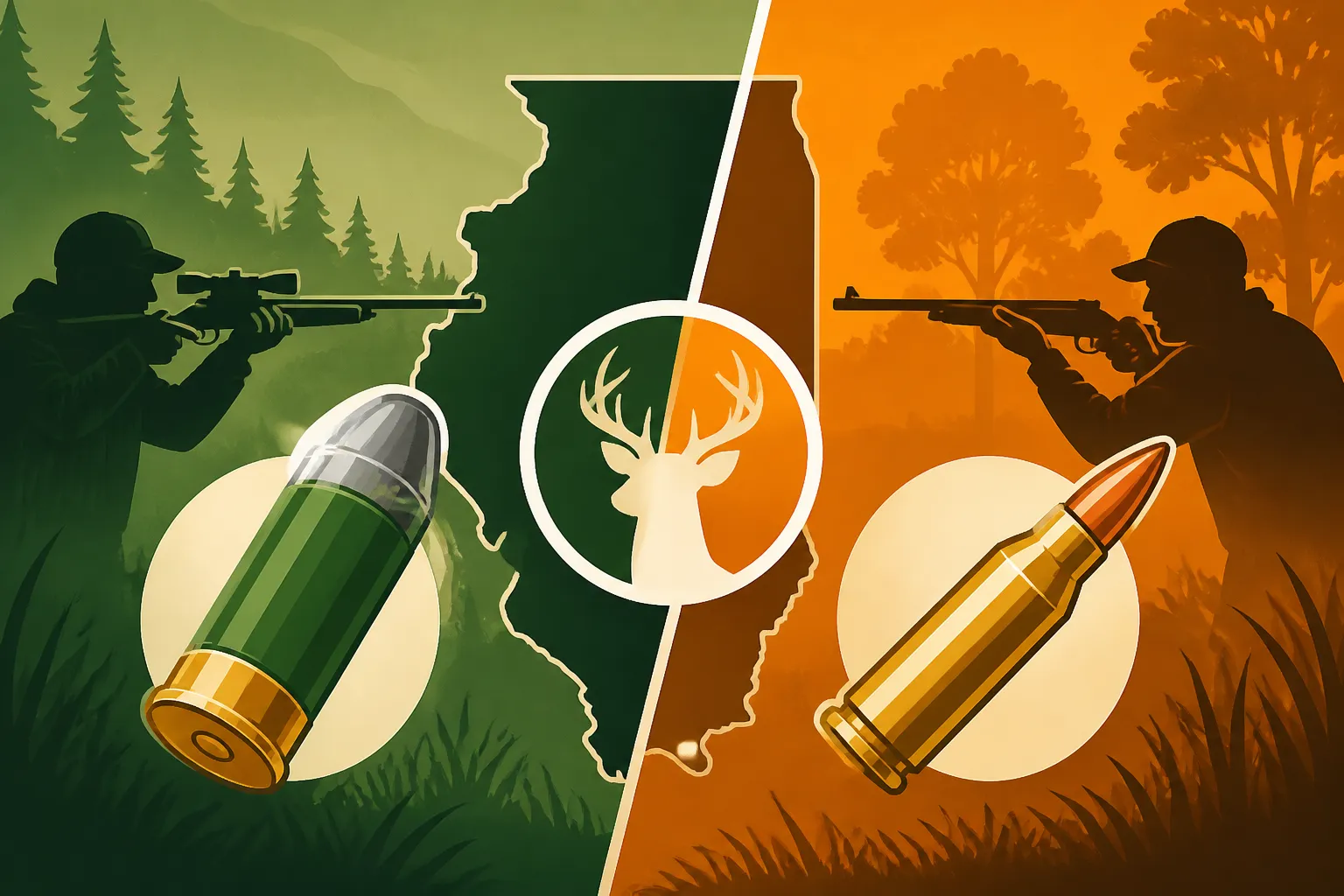
For generations, deer hunters in Illinois knew their firearm choices were limited almost exclusively to shotguns loaded with slugs. It was just the way things were, and while effective, it certainly came with its own set of challenges regarding range and accuracy. Now, with straight-wall rifles becoming a legal and popular alternative, many hunters are finding themselves at a crossroads, unsure which option truly offers the best advantage for their style of hunting. This guide aims to clear up that confusion, offering a deep dive into the pros and cons of both slugs and straight-wall rifles for deer hunting across the diverse landscapes of Illinois.
Understanding Illinois's Firearm Regulations for Deer
The rules around what firearms are legal for deer hunting in Illinois have evolved quite a bit over the years. For a long time, the landscape was dominated by shotguns, and for good reason. Understanding this history and the current regulations is the first step in making an informed choice for your next deer season.
The Traditional Role of Shotguns and Slugs
For decades, if you wanted to hunt deer with a firearm in Illinois, you were almost certainly going to be carrying a shotgun. The reasoning behind this was largely driven by safety concerns in a state with significant agricultural and residential areas interspersed with hunting grounds. Shotgun slugs, while powerful, were generally considered to have a more limited effective range and a faster drop-off in velocity compared to traditional centerfire rifle cartridges. This meant a lower risk of a projectile traveling for miles and potentially endangering populated areas.
Hunters adapted, and gear improved. Early slug guns were typically smoothbore shotguns, originally designed for birdshot, but fitted with iron sights or basic scopes to launch a single, heavy lead projectile. Accuracy could be challenging, often limiting shots to under 75 yards for most hunters. The introduction of rifled slug barrels, which put a spin on the slug, dramatically improved accuracy and extended effective ranges. Modern sabot slugs, often encased in a plastic sleeve that falls away after leaving the barrel, are highly aerodynamic and can achieve impressive accuracy, with some setups capable of 150-yard shots or even further. Despite these advancements, the inherent ballistics of a heavy, blunt slug still presented a trajectory that required precise range estimation and compensation.
The Advent of Straight-Wall Cartridges
The hunting community's desire for more rifle-like performance, combined with ongoing research into safe firearm alternatives, eventually led to a significant change in Illinois law. In recent years, the Illinois Department of Natural Resources (IDNR) approved the use of "straight-wall cartridges" for deer hunting. This was a game-changer for many, offering hunters a true rifle experience within the established safety parameters.
A straight-wall cartridge is exactly what it sounds like: a cartridge whose casing walls are parallel, without the typical taper or "bottle-neck" seen in many high-powered rifle cartridges. This design generally results in lower muzzle velocities and faster energy dissipation compared to bottlenecked cartridges like a .30-06, thus reducing the maximum range a projectile might travel. Common straight-wall cartridges now popular in Illinois include the .450 Bushmaster, .350 Legend, and even older handgun calibers like .44 Magnum or .45 Colt when fired from appropriate rifles. These cartridges offer a flatter trajectory, often superior accuracy, and generally less recoil than many magnum slugs, providing hunters with a more versatile and comfortable shooting experience. The shift meant hunters could now bring a rifle that felt and shot like a rifle, rather than a modified shotgun.
Legal Considerations and Permit Zones
Navigating the legal landscape of Illinois deer hunting permits and firearm restrictions is crucial, especially when considering new options. While straight-wall cartridges are now legal statewide for deer hunting during specific firearm seasons, there are always nuances to be aware of. For instance, specific public land sites or special hunt areas might have their own regulations, sometimes restricting weapon types or calibers even further. Always check the site-specific regulations for any public land you plan to hunt, whether it's a State Fish and Wildlife Area or a parcel within the vast Shawnee National Forest.
Understanding Illinois Legal Firearms for Deer Hunting is paramount. Generally, during the traditional Illinois's Two Firearm Deer Seasons, both shotguns firing slugs and rifles chambered in approved straight-wall cartridges are permitted. Muzzleloaders also have their own specific season and rules. It's important to remember that certain calibers might have minimum bullet diameter requirements, which all popular straight-wall options meet. You'll also want to ensure your chosen firearm adheres to magazine capacity limits for hunting. Staying informed by regularly checking the latest IDNR Digest is your best bet to avoid any unintended legal issues. A detailed hunting app like GoHunt can also be extremely helpful here, often including layers or information specific to local regulations for various hunting units.
Performance Comparison: Slugs vs. Straight-Wall Rifles
When it comes down to actually putting venison in the freezer, the real question is how these two firearm types perform in the field. This isn't just about what looks good on paper, but how they truly stack up in terms of accuracy, power, and shooting comfort when you're out there chasing whitetails.
Accuracy and Effective Range
This is arguably where straight-wall rifles shine brightest compared to their slug-shooting counterparts. While modern slug guns with rifled barrels and sabot slugs are impressively accurate, often capable of grouping 3-4 inches at 100 yards, a good straight-wall rifle setup can frequently cut those groups in half, achieving 1-2 MOA (Minute of Angle) or better. This increased precision translates directly to tighter groups and a larger margin for error in the field, especially as distances increase.
The flatter trajectory of most straight-wall cartridges is another significant advantage. A typical 12-gauge sabot slug might drop 8-10 inches at 150 yards if zeroed at 100, requiring considerable holdover. In contrast, popular straight-wall cartridges like the .350 Legend or .450 Bushmaster will often exhibit a much flatter flight path, making precise range estimation less critical out to 200 yards. This flatter trajectory is a game-changer for shots across wider openings or longer field edges, common when Hunting Central Illinois Farmland Deer. Of course, accuracy is always a combination of the firearm, the ammunition, and most importantly, the shooter. Regular practice at various distances with your chosen setup is non-negotiable, regardless of whether you pick a slug gun or a straight-wall rifle.
Terminal Ballistics and Knockdown Power
Both slugs and straight-wall rifle cartridges are absolutely lethal on deer within their effective ranges. The key difference lies in how they achieve that lethality and their performance across varying distances. Shotgun slugs are heavy, large-diameter projectiles that deliver immense energy on impact. When a 12-gauge slug hits a deer, it creates a massive wound channel due to its sheer size and weight, often resulting in devastating hydrostatic shock and rapid energy transfer. Even older foster slugs, while less accurate at range, are still incredibly effective at close quarters. Modern sabot slugs are designed to expand reliably, creating even larger temporary and permanent wound cavities.
Straight-wall rifle cartridges, while typically smaller in diameter, compensate with higher velocities and often more advanced bullet designs that ensure controlled expansion. Cartridges like the .450 Bushmaster deliver significant energy and often create impressive exit wounds, leading to good blood trails. The .350 Legend, while having less raw energy than the .450, is still more than sufficient for deer, especially with bullets designed for rapid and wide expansion. Because straight-wall rifle bullets maintain their velocity and energy more efficiently at longer distances, they tend to perform more consistently across their effective range. Ultimately, a well-placed shot with either option will result in a quick, ethical kill. The "knockdown power" myth often comes down to shot placement, not just raw energy.
Recoil and Shooting Comfort
Recoil is a factor that often gets overlooked until you're at the range or, worse, flinching in the field. Let's be honest, heavy 12-gauge slugs pack a punch. While some hunters are completely unfazed, for many, a string of shots from a slug gun can be genuinely uncomfortable, leading to developing a flinch. This flinch can severely impact accuracy, especially on follow-up shots or if you're not fully settled in your shooting position. The perceived recoil of a 12-gauge slug can range from stout to brutal, depending on the load, gun weight, and individual shooter.
Straight-wall rifles, generally speaking, offer a much more pleasant shooting experience. The .350 Legend, for example, is renowned for its very mild recoil, often comparable to a .223 Remington, making it an excellent choice for new hunters, youth hunters, or anyone sensitive to recoil. The .450 Bushmaster has more recoil, but it's typically a sharper push rather than the heavy shove of a 12-gauge slug, and often feels more manageable in a rifle platform with a good recoil pad. This reduced recoil allows for more comfortable practice sessions, better shot placement, and quicker recovery for potential follow-up shots. When you're Hunting the Illinois Rut in Early November, a comfortable and familiar rifle can make all the difference in making that critical shot.
Practical Considerations for Illinois Hunters
Beyond the pure ballistics, there are many real-world factors that should play into your decision when choosing between a slug gun and a straight-wall rifle for hunting Illinois whitetails. Your hunting environment, budget, and even your interest in pursuing other game species can all influence what's best for you.
Terrain and Habitat Suitability
Illinois offers a diverse range of hunting habitats, from the dense timber and rolling hills of the southern Shawnee National Forest to the vast agricultural fields interspersed with woodlots in central and northern regions. Your primary hunting grounds should heavily influence your firearm choice.
In thick cover, such as the bottomlands along the Illinois River or dense cedar thickets on southern Illinois ridges, shots are often close and fast. Here, the immediate power and broad wound channel of a slug gun can be highly effective. The limited visibility also means long-range accuracy is less critical. However, even in dense cover, the enhanced accuracy of a straight-wall rifle offers peace of mind for threading a shot through small openings. When Still-Hunting Southern Illinois Ridges, you might only get a small window to shoot.
Conversely, if you primarily hunt open agricultural fields, powerline cuts, or larger timber blocks where longer shots (100-200 yards) are more common, a straight-wall rifle's flatter trajectory and superior accuracy become a significant advantage. The ability to confidently take a shot at 150 yards without drastic holdover can be the difference between filling a tag or going home empty-handed. Consider using mapping tools like GoHunt to analyze the typical shot distances in your specific hunting areas, which can help solidify your decision.
Cost and Availability of Firearms and Ammunition
The financial aspect is always a factor for hunters. Generally, a basic pump-action shotgun can be a very affordable entry point into deer hunting. If you already own a smoothbore shotgun for Waterfowl Hunting the Illinois River Valley or Pheasant Hunting Illinois Farmland, you might only need to purchase a rifled slug barrel and suitable ammunition, which can be a cost-effective way to get into deer hunting. However, dedicated slug guns with rifled barrels and high-quality optics can quickly approach the price of a mid-range hunting rifle.
Straight-wall rifles typically start at a similar price point to a dedicated slug gun, but the options are vast, ranging from budget-friendly bolt-actions to more expensive semi-automatics. Ammunition costs are also a consideration. Premium sabot slugs can be quite expensive, sometimes rivaling or exceeding the cost per round of some straight-wall rifle cartridges. For example, a box of high-performance 12-gauge slugs can run upwards of $15-20 for five rounds, while many .350 Legend or .450 Bushmaster cartridges might be similar for a box of 20 rounds. It's wise to factor in the cost of practice ammunition, as you'll want to shoot your chosen firearm extensively before the season.
Versatility and Other Game Opportunities
Another point to consider is the versatility of your chosen firearm. A shotgun, especially a pump-action or semi-automatic with interchangeable barrels, offers incredible versatility. You can swap out a rifled slug barrel for a smoothbore barrel with a choke for bird hunting (pheasants, ducks, turkeys). This makes a shotgun a true multi-purpose hunting tool. If you're someone who hunts multiple species throughout the year and wants one firearm to do it all, a versatile shotgun might be a compelling option.
Straight-wall rifles, on the other hand, are generally more specialized for deer-sized game. While some calibers like the .350 Legend could technically be used for predator hunting or even small game with appropriate loads, their primary utility is for medium to large game. If deer hunting is your sole focus with a firearm, or if you already own other specialized firearms for birds or small game, then a straight-wall rifle offers dedicated, optimized performance for deer. Your choice here really comes down to whether you prefer a jack-of-all-trades or a master of one.
Choosing Your Weapon: Making an Informed Decision
Deciding between a slug gun and a straight-wall rifle isn't just about reading ballistics charts; it's a personal journey that involves understanding your own abilities, preferences, and the practicalities of your hunting style. This choice is about finding the right tool that empowers you to hunt ethically and effectively.
Assessing Your Personal Hunting Style and Skill
Before you commit to either a slug gun or a straight-wall rifle, take a good, honest look at your personal hunting style and skill set. Are you primarily a still-hunter who prefers to stalk through the timber, anticipating close-range encounters? Or do you favor sitting in a stand overlooking a large food plot or field, where longer shots are common? If you're participating in Deer Drives on Illinois Public Land, shot distances can vary wildly, requiring quick target acquisition and a degree of comfort with your firearm.
Your comfort with recoil is a huge factor, as discussed earlier. If you find heavy recoil distracting or painful, the milder recoil of most straight-wall rifles, especially the .350 Legend, could significantly improve your shooting accuracy and confidence. Conversely, if you're an experienced shooter accustomed to powerful firearms and have mastered the art of shooting a slug gun accurately, then sticking with what you know might be perfectly fine. Be honest about your effective shooting range – not just what you can do on a perfect day at the range, but what you can do consistently and ethically in the pressure of a hunting situation.
Factors Beyond the Gun: Optics and Accessories
The firearm itself is only one part of the equation; the accessories you pair with it are equally critical. For both slug guns and straight-wall rifles, quality optics are non-negotiable. A good scope with clear glass and a reliable reticle will dramatically improve your accuracy, especially in low-light conditions at dawn or dusk. Don't skimp on scope rings and mounts either; a loose scope is a useless scope.
For slug guns, especially those with significant recoil, durable, recoil-resistant scopes are essential. Many hunters opt for scopes specifically designed for shotguns or those with a wider field of view for quick target acquisition. For straight-wall rifles, you can often use standard rifle scopes, with options ranging from fixed power to variable magnifications (e.g., 3-9×40, 4-12×40). Additionally, consider slings for comfortable carrying, and perhaps a bipod or shooting sticks if you anticipate longer shots from a prone or seated position. A rangefinder is also an invaluable tool, particularly for slug gun hunters, to accurately gauge distances and make appropriate adjustments.
Trying Before You Buy: Range Time and Borrowing
The absolute best way to make your decision is to get hands-on experience with both types of firearms. Reading reviews and watching videos can only take you so far. Head to a local shooting range that offers rentals, or better yet, ask friends who own a slug gun and a straight-wall rifle if you can try theirs.
Pay attention to how each feels to shoulder, aim, and shoot. How quickly can you get on target? How does the recoil feel after several shots? Can you maintain a consistent group? Experiment with different ammunition brands and bullet weights, as guns can be particular about what they "like." Don't rush this process. Spend dedicated time with each platform. Many hunters find that once they shoot a straight-wall rifle, the flatter trajectory and reduced recoil make it a clear winner for their personal preferences. However, others, especially those who hunt in very dense cover and are comfortable with their slug gun, might find no compelling reason to switch.
Common Straight-Wall Cartridges for Illinois Deer Hunting
With the legality of straight-wall cartridges, a few calibers have really risen to prominence among Illinois deer hunters. Knowing the characteristics of these popular options can help you narrow down your choice and understand what you're getting into.
The .450 Bushmaster
Often referred to as "the thumper," the .450 Bushmaster quickly gained a reputation as a hard-hitting, effective deer cartridge when it became legal in Illinois. It's essentially a .45-caliber bullet in a straight-wall rifle casing, designed to be fired from AR-platform rifles (though bolt-action rifles are also common). It launches a heavy bullet, typically between 200 and 300 grains, at velocities ranging from 2,000 to 2,200 feet per second.
The .450 Bushmaster offers excellent terminal performance on deer, delivering significant energy and creating large wound channels. Its trajectory is relatively flat out to about 150-200 yards, making it suitable for a wide range of Illinois hunting scenarios. Recoil is substantial, more akin to a .243 or .30-30 in a lightweight rifle, but generally less jarring than a heavy 12-gauge slug. For hunters looking for maximum knockdown power within the straight-wall limitations, the .450 Bushmaster is a top contender. However, ammunition can sometimes be harder to find and more expensive than the newer .350 Legend, and the recoil can be a deterrent for some shooters.
The .350 Legend
The .350 Legend is a newer cartridge specifically designed to meet straight-wall hunting regulations while offering a more comfortable shooting experience than many other options. Winchester introduced it with the explicit goal of providing a low-recoil, affordable, and effective deer cartridge. It typically fires a .357-inch diameter bullet (ranging from 145 to 180 grains) at impressive velocities, often exceeding 2,300 feet per second.
Its main appeal lies in its extremely mild recoil, often compared to a .223 Remington, which makes it an outstanding choice for youth hunters, recoil-sensitive shooters, or anyone who simply wants a more enjoyable shooting experience. Despite the light recoil, the .350 Legend is more than capable of cleanly taking deer, with good expansion and energy transfer. It boasts a very flat trajectory out to 200 yards, often outperforming many slugs in terms of ballistic efficiency. Furthermore, .350 Legend rifles are available in a wide variety of platforms, including bolt-actions, single-shots, and AR-style rifles, and its ammunition is generally more widely available and affordable than .450 Bushmaster. It's quickly become a favorite for many Illinois hunters, especially when Hunting a Funnel Between Two Woodlots where shots might be quick but require precision.
Other Viable Options
While the .450 Bushmaster and .350 Legend dominate the straight-wall rifle market in Illinois, several other cartridges are perfectly legal and effective. Older handgun cartridges, when chambered in a rifle, qualify as straight-wall. The .44 Magnum and .357 Magnum are popular in lever-action rifles, offering classic aesthetics and mild recoil. These are excellent for close-range hunting in dense cover, where shots are typically under 100 yards. Their ballistics are generally flatter than slugs but not quite as flat-shooting as the purpose-built .350 Legend or .450 Bushmaster.
The .444 Marlin is another powerful straight-wall option, often found in lever-action rifles. It's a heavy-hitter, delivering serious energy, but with more significant recoil and typically less widespread availability in terms of firearms and ammunition. For hunters who appreciate traditional lever guns or already own one in a legal caliber, these options provide a solid, time-tested approach to deer hunting. Always confirm the specific regulations for minimum bullet diameter for deer hunting in Illinois, but generally, anything .357 and larger is well within legal limits for these calibers.
| Feature | Shotgun with Slugs (Rifled Barrel & Sabots) | Straight-Wall Rifle (.350 Legend, .450 Bushmaster) |
|---|---|---|
| Typical Accuracy | 3-4 MOA at 100 yards (good setup) | 1-2 MOA at 100 yards (good setup) |
| Effective Range | 100-150 yards (with practice and good setup) | 150-250 yards (depending on caliber and shooter) |
| Trajectory | Significant drop past 100 yards, requires holdover | Much flatter, less holdover needed within effective range |
| Recoil | Moderate to Heavy (can be substantial with magnum loads) | Mild (.350 Legend) to Moderate (.450 Bushmaster) |
| Terminal Energy | Very high at close range, large wound channel | High, consistent energy transfer with controlled expansion |
| Firearm Cost | $300-$800 for pump/semi-auto shotgun; $200-$500 for rifled barrel; plus scope | $400-$1000+ for rifle; plus scope |
| Ammunition Cost | $3-5 per round (premium sabot slugs) | $1.50-$3 per round (depending on caliber and brand) |
| Versatility | Excellent (can swap barrels for bird hunting, defense) | Specialized for deer/medium game (less versatile for other hunting types) |
| Best For | Dense cover, close-range shots, multi-purpose firearm owners | Open fields, longer shots, recoil-sensitive shooters, dedicated deer hunters |
| Brand Examples | Browning, Mossberg, Remington, Savage (using specialized slug guns or rifled barrels with Federal, Hornady slugs) | Ruger, Winchester, Savage, CMMG, Smith & Wesson (for .350 Legend, .450 Bushmaster ammunition from Winchester, Hornady) |
Disclaimer
The information provided in this guide is for general informational purposes only and does not constitute legal advice. Hunting regulations, laws, and seasons can change frequently. Always consult the most current Illinois Department of Natural Resources (IDNR) hunting regulations and local ordinances before engaging in any hunting activities. Hunters are responsible for knowing and adhering to all applicable laws.