Hunting Limestone Bluff Country
Hunting the rugged, unforgiving terrain of Illinois's limestone bluff country presents a unique set of challenges that can leave even seasoned hunters scratching their heads. The steep slopes, dense cedar thickets, and ever-shifting thermals can feel like an entirely different world compared to the flat farmlands most people associate with our state. But with the right approach, knowledge of the landscape, and a bit of grit, these challenging areas can unlock incredible opportunities for mature deer and elusive turkeys. This guide will walk you through the distinct characteristics of these bluffs, smart scouting tactics, and effective hunting strategies to help you find success where others might give up.
Understanding the Unique Challenges of Limestone Bluff Country
Illinois is often pictured as flat, rolling farmland, but head to the river valleys, especially along the Mississippi, Illinois, or Kaskaskia Rivers, and you'll encounter a dramatically different landscape: towering limestone bluffs. These aren't just hills; they are ancient formations carved by water and time, presenting a formidable environment for both wildlife and hunters. The geology here shapes everything, from the vegetation to the way deer and turkeys move through the landscape.
The Geology and Topography of Illinois Bluffs
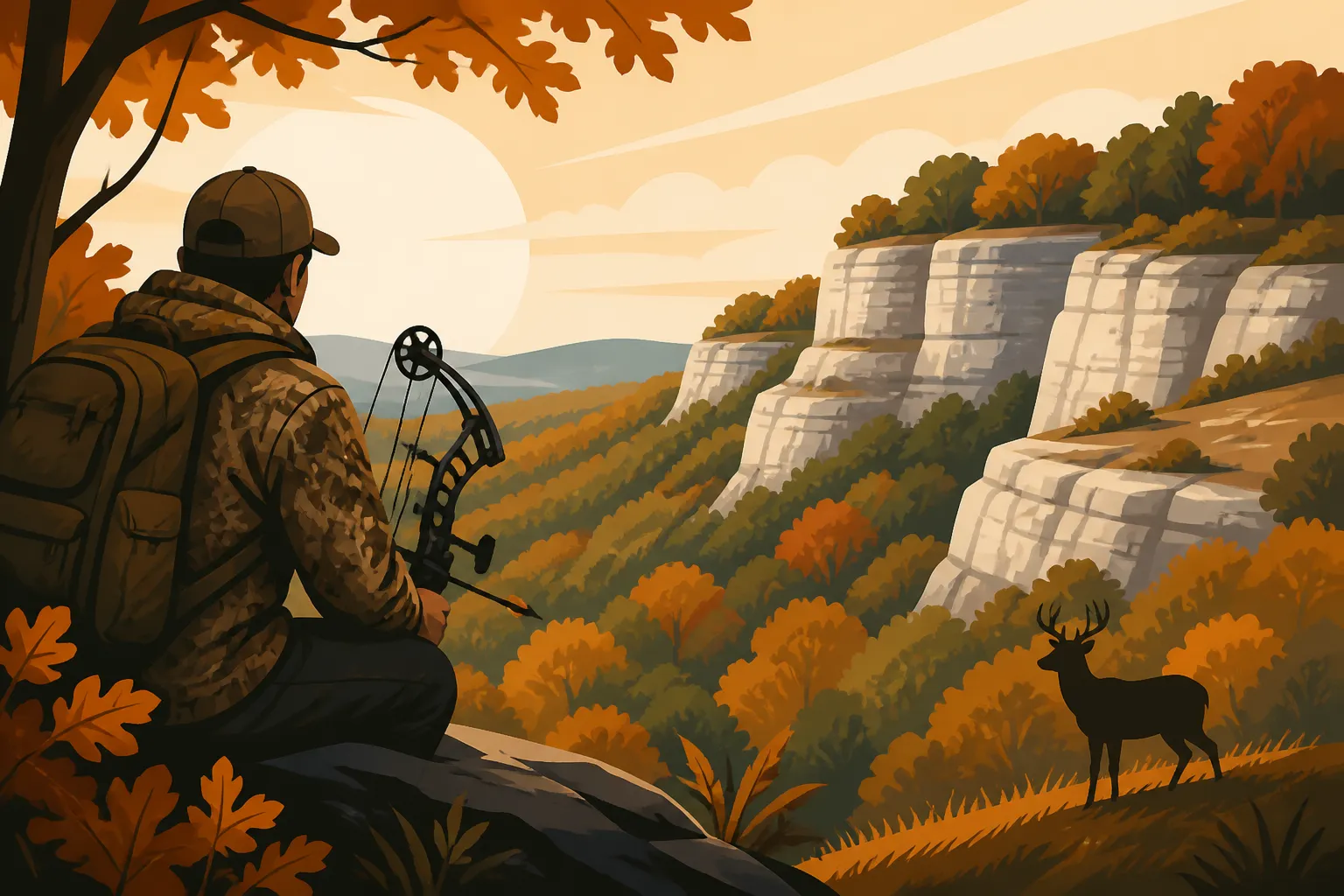
Limestone bluffs are characterized by their steep, often rocky slopes, sheer cliff faces in some areas, and a unique soil composition that differs significantly from the fertile prairie soils elsewhere. This rocky, alkaline soil influences the vegetation, often leading to stands of red cedar, oak-hickory forests, and pockets of unique plant life adapted to the drier, thinner soil. The sheer elevation changes, sometimes hundreds of feet from the river bottom to the bluff top, create a vertical world where gravity and thermals dictate much of the game movement. You'll find deep ravines, hidden benches, and cliff lines that can either funnel or completely block animal travel. It's a land of extremes, from sun-baked rocky outcrops to damp, shaded hollows.
Hunting these areas means constantly contending with elevation. Dragging a deer out of a deep ravine can be an all-day affair, and just walking to your stand can feel like a mountain climb. This physical demand is often a natural deterrent for many hunters, which, ironically, can mean less pressure on the game and potentially older, wiser animals. Before you even think about setting up a stand, you need to mentally prepare for the physical toll this terrain will take. Knowing how to efficiently navigate these steep climbs and descents is crucial, as is understanding how deer and turkeys use these micro-habitats.
Thermal Currents and Wind Patterns
One of the biggest frustrations and critical factors in bluff country hunting is the unpredictable nature of wind and thermal currents. Unlike flat ground where wind might be relatively consistent, the drastic elevation changes create dynamic thermal drafts. As the sun rises, warm air from the river bottom begins to lift, creating an updraft along the bluff face. In the evening, as the air cools, it sinks back down, creating a downdraft. These thermal shifts are almost as important as the prevailing wind, and often more so, especially during the early morning and late evening hours.
You might have a perfect prevailing wind, but a thermal current can swirl your scent directly into a deer's bedding area. This is why careful observation and understanding of thermals are paramount. A smart hunter in bluff country doesn't just check the wind direction; they consider the time of day, the sun's position, and the terrain features to anticipate how their scent will travel. This often means adjusting your approach, your stand location, or even your hunting times to avoid spooking game. It's a constant chess match against nature's unseen forces, and it's where many hunters get frustrated and give up.
Effective Scouting Strategies for Bluff Country
Scouting is always important, but in Illinois's limestone bluff country, it's absolutely non-negotiable. You can't just walk in blindly and expect to stumble onto success. The sheer scale and complexity of the terrain demand a methodical, often physically demanding, approach to locating game. This isn't just about finding tracks; it's about understanding how the animals live, feed, and travel within this vertical maze.
Digital Reconnaissance and Map Tools
Before you ever set foot in the woods, the best scouting starts from the comfort of your home. Utilizing digital mapping tools like GoHunt, OnX Hunt, or other similar platforms is incredibly powerful for bluff country. These tools allow you to study topography in detail, identifying key features that might be invisible at ground level. Look for contour lines that indicate benches, saddles, and steep drop-offs. Identify potential bedding areas on south-facing slopes (for warmth) or thick cedar pockets, and pinpoint feeding areas in creek bottoms or on accessible ridge tops.
I always start by looking for pinch points or funnels. These could be narrow benches along a steep bluff face where deer are forced to travel, saddles connecting two ridges, or crossings in a creek bottom. These are high-percentage areas for ambushing a traveling buck. Also, pay close attention to access points. Where are the roads? Where are the trails? The areas furthest from easy access, especially those requiring a challenging hike, often hold the least pressured animals. A tool like GoHunt can layer property boundaries, showing public land access points and private land lines, which is essential when Reading Aerial Photos for Southern Illinois Deer.
Boots-on-the-Ground Exploration
Once you've narrowed down potential areas on your map, it's time to put boots on the ground. This is where the physical aspect of bluff country scouting truly begins. Focus on walking the elevation, not just along the contours. Start by walking creek bottoms, looking for tracks, rub lines, and scrape lines. These bottoms often serve as natural travel corridors, connecting different parts of the bluff system. Then, slowly work your way up the slopes, investigating benches and hidden draws.
When you find deer sign, don't just note it; try to interpret it. Are these fresh tracks leading to a bedding area? Is the rub line active, indicating a buck frequently uses this path? How do the trails connect? Look for "ridge-top saddles" or "funnels between two woodlots" that could be natural crossings. Pay close attention to vegetation changes – dense cedar thickets on a bluff face might be prime bedding cover, offering protection from wind and predators. Don't be afraid to get off the main trails and push into the nastiest cover; that's often where the mature bucks hide. Remember, Scouting Illinois Public Land Before Season is about piecing together the puzzle of deer movement, and in bluff country, that puzzle has many more dimensions.
Hunting Tactics Tailored to Limestone Bluffs
Hunting limestone bluff country effectively requires a departure from typical flatland tactics. Your stand setups, approach, and even your timing will need to be adapted to the unique challenges of the terrain and the behavior of the game animals that call it home.
Strategic Stand Placement and Entry/Exit Routes
Stand placement in bluff country is paramount, and it goes hand-in-hand with understanding thermals. Instead of hunting directly on a ridge top, which can expose you to swirling winds, consider placing your stand on a bench or just below a crest. This allows rising thermals in the morning to carry your scent up and over the ridge, and falling thermals in the evening to carry it down into the valley. You need to identify key travel corridors: worn deer trails along benches, saddles that connect ridgelines, and crossings over ravines.
Entry and exit routes are equally critical. You want to approach your stand silently, with the wind and thermals in your favor, and without walking through potential bedding or feeding areas. This often means taking a longer, more circuitous route. For example, if you're hunting a morning stand on a bluff side, approach from the bottom before the thermals start to rise. For an evening hunt, approach from the top, allowing falling thermals to carry your scent away from the areas deer will be entering. Always consider where deer might stage before moving to feeding areas, often just below the crest of a ridge or in a secluded pocket. Treestand Setups in Shawnee National Forest can offer valuable insights, as the Shawnee shares similar rugged characteristics.
Deciphering Deer Movement in Vertical Terrain
Deer in bluff country move differently than their flatland counterparts. They are masters of using the terrain to their advantage, often traveling just below ridgelines to stay out of sight, or hugging the contour lines of benches to conserve energy. They will use the steepest, thickest areas for bedding, knowing most hunters won't penetrate those spots. Look for trails that cut across steep faces, connecting different benches or moving from a creek bottom up to a ridge. These are often primary travel routes.
During the rut, bucks will cruise these benches and saddles, scent-checking for does. Understanding Hunting the Rut in Early November is crucial, and in bluff country, this means focusing on those high-traffic corridors during daylight hours. Also, don't overlook natural barriers like rock outcroppings or sheer cliffs. Deer will find the path of least resistance around these, creating predictable pinch points. If you can locate a spring or a secluded water source high on a bluff, especially during dry periods, it can be a magnet for deer. Patience is key; sometimes the best strategy is to sit and observe, letting the deer tell you how they use the landscape.
Turkey Hunting the Bluffs
Turkeys thrive in bluff country, using the diverse habitat for roosting, feeding, and strutting. The high bluffs offer perfect roosting trees, often large oaks or sycamores along river edges, allowing them to survey the landscape. Spring turkey hunting here can be exhilarating but also maddeningly difficult. Gobblers will often pitch down from their roosts into creek bottoms or onto benches to meet hens, and then work their way up the bluff as the day progresses.
Roosting and Setup Tactics
Locating a roost tree is your first priority. Before dawn, listen intently for gobblers sounding off from their roosts. Once you've pinpointed one, strategize your approach. You'll want to get as close as possible without spooking them, often setting up on a bench or in a saddle that the gobbler will likely use after pitching down. Place your decoys (if using them) where they are visible from the expected fly-down path. Be aware of thermals in the morning; they will carry sound and scent upwards, so approach from below if possible to keep the gobblers from hearing or smelling you. Often, if a gobbler flies down the opposite direction, a quick "run-and-gun" approach might be necessary to circle around him, but it's physically demanding. For more details on strategy, check out Roost Hunting Illinois Gobblers.
Calling Strategies and Movement
Calling in bluff country requires adjusting your volume and cadence to the terrain. A loud, aggressive call might echo too much in open timber or across ravines, making it sound unnatural. Soft, seductive hen calls often work best to entice a wary gobbler to come closer. If a gobbler is across a deep ravine, it can be nearly impossible to get him to cross, so consider moving to a position that allows him an easier path. Turkeys in bluff country can be very vocal, but they also have numerous escape routes and places to hide. Patience and persistent, soft calling can often convince a curious gobbler to investigate, especially if you're set up in a natural travel corridor he's already planning to use.
Essential Gear and Safety Considerations
Hunting limestone bluff country is physically demanding and often takes you far from easy access. This means your gear choices and safety preparations are even more critical than in flatter terrain. Being prepared can be the difference between a successful, safe hunt and a dangerous situation.
Gear for Navigating Rugged Terrain
Your footwear is arguably the most important piece of gear. Invest in high-quality, waterproof hunting boots with excellent ankle support and aggressive traction. The steep, often rocky and muddy slopes demand it. Trekking poles can be a game-changer for stability on ascents and descents, saving your knees and preventing falls, especially when packing out game. A sturdy backpack capable of carrying heavy loads is also essential, not just for your gear, but for packing out venison.
Consider carrying a good quality pair of binoculars, like those from Vortex Optics or Maven, to glass across ravines and identify game without having to traverse the treacherous terrain. A rangefinder is also invaluable for confirming distances in areas with optical illusions caused by elevation. Beyond that, layers of clothing are key. You'll work up a sweat climbing, but then cool down quickly when sitting still. Moisture-wicking base layers, insulating mid-layers, and a durable, waterproof outer shell are crucial. Finally, a reliable headlamp with extra batteries is non-negotiable for early morning entries and late evening exits.
| Gear Item | Why It's Essential for Bluff Country |
|---|---|
| High-Traction Boots | Stability on steep, rocky, muddy slopes; ankle support |
| Trekking Poles | Balance, knee support, reduces fatigue on ascents/descents |
| Durable Backpack | Carries gear, essential for packing out game meat |
| Digital Mapping App | Topo maps, property lines, waypoints (e.g., GoHunt, OnX) |
| Binoculars | Scouting distant slopes, identifying game without moving |
| Rangefinder | Accurate distance measurement in varied terrain |
| Layered Clothing | Adapts to exertion and sitting still, temperature changes |
| Headlamp (w/ spare) | Safe navigation in low light, hands-free operation |
| First-Aid Kit | Minor injuries, blisters, emergencies |
| Signaling Device | Whistle, small mirror for emergencies |
Safety and Emergency Preparedness
Hunting alone in bluff country can be risky. Always let someone know exactly where you are going and when you expect to return. Carry a fully charged cell phone, but don't rely on it for navigation or emergency communication, as cell service can be spotty or non-existent in deep valleys or remote areas. A satellite messenger device, such as a Garmin inReach or Zoleo, is a smart investment for areas without cell service, allowing you to send messages and even an SOS in an emergency.
A well-stocked first-aid kit is critical for treating blisters, cuts, scrapes, and other minor injuries that are common in rugged terrain. Carry plenty of water, even on cool days, as the physical exertion can lead to dehydration. Pack high-energy snacks. Be aware of venomous snakes, especially in warmer months, as copperheads and timber rattlesnakes can inhabit rocky areas. Know how to identify them and what to do if you encounter one. Finally, if you're hunting during firearm season, remember Illinois's blaze orange requirements; visibility is even more important in steep, broken terrain where it's easy to lose sight of other hunters.
Conclusion
Hunting Illinois's limestone bluff country is undeniably tough, both mentally and physically. It demands a different approach, a willingness to work harder, and a keen understanding of how game animals interact with a vertical landscape. The frustrations of swirling thermals, grueling climbs, and seemingly impenetrable cover are real, but so are the rewards. The satisfaction of harvesting a mature deer or a stubborn gobbler from these wild, rugged hills is immense, knowing you've outsmarted an animal on its home turf. By leveraging digital scouting tools like GoHunt, putting in the arduous groundwork, and adapting your tactics to the unique challenges of the bluffs, you can unlock incredible hunting experiences and create memories that will last a lifetime. So lace up your best boots, pack your patience, and get ready to climb—the bluffs are waiting.
Disclaimer
Hunting is an inherently dangerous activity. This guide provides general information and recommendations, but it is your responsibility to understand and comply with all local, state, and federal hunting regulations. Always prioritize safety, respect wildlife, and obtain proper landowner permission before hunting. The author and publisher are not responsible for any injuries, accidents, or legal issues that may arise from the use of this information.