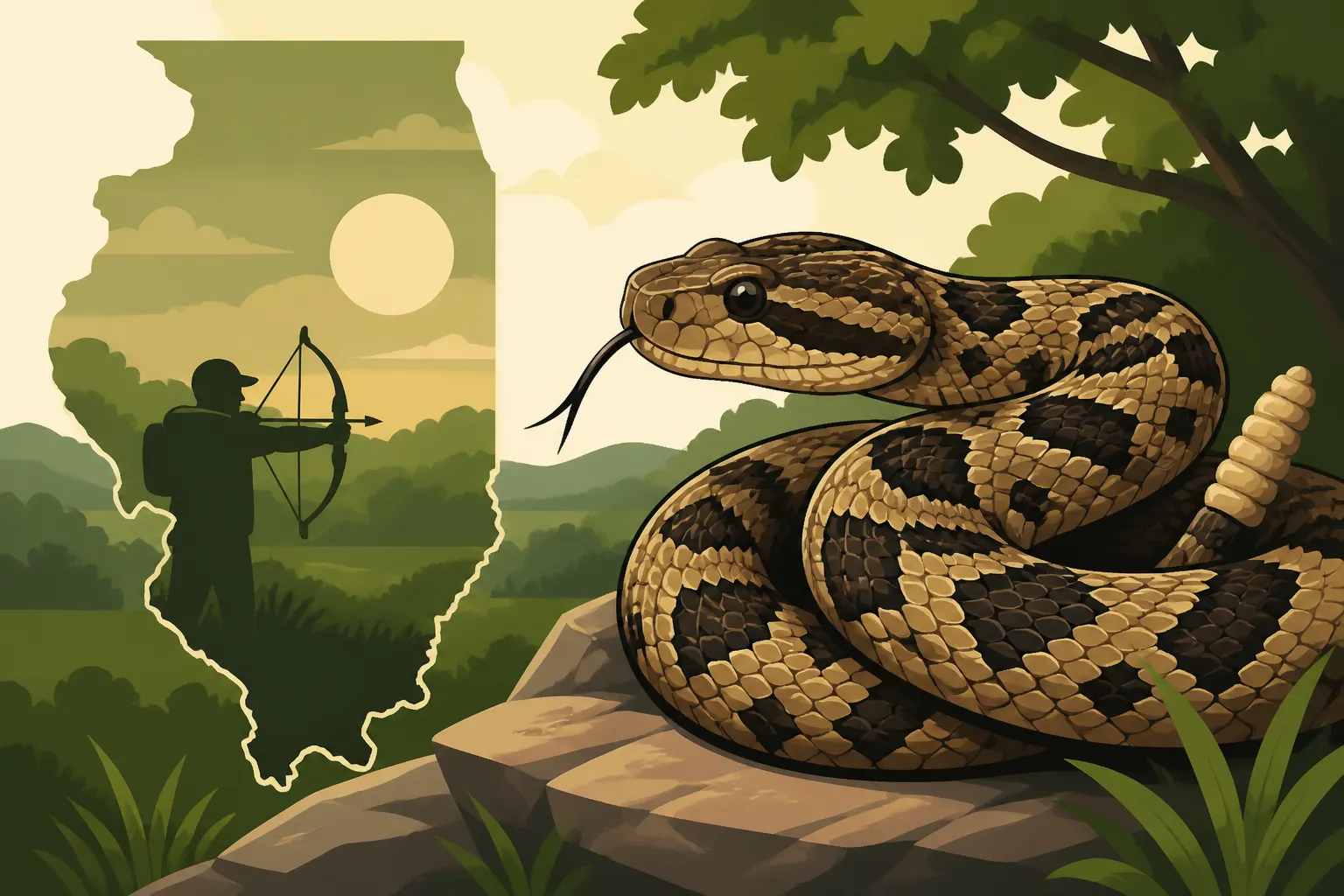
Illinois Timber Rattlesnake Range
For many of us who spend time exploring Illinois's wilder places, especially deep in the timber or along rocky river bluffs, there's always that tiny whisper in the back of our minds: snakes. And let's be honest, the timber rattlesnake often tops the list of concerns. It's easy to let fear or misinformation take over, but understanding where these elusive reptiles live, how they behave, and what to do if you encounter one can turn that fear into a healthy respect, making your time afield much safer and more enjoyable. This guide will delve into the true range of the timber rattlesnake in Illinois, helping you understand their habitat and how to coexist with these fascinating, yet often misunderstood, native creatures.
Understanding Illinois's Timber Rattlesnakes
Before we talk about where timber rattlesnakes live, it's crucial to understand who they are. These are not aggressive serpents lying in wait to strike, but rather a vital, shy component of our state's ecosystem. Their very presence speaks to the health of certain wild habitats. Knowing a little about them helps dispel myths and promotes a respectful coexistence.
Identifying a Timber Rattlesnake
Spotting a timber rattlesnake can be a bit startling, but knowing their distinct features can help you differentiate them from other non-venomous snakes you might encounter in the Illinois woods. First and foremost, the most obvious characteristic is their rattle, a series of keratin segments at the end of their tail that produces that unmistakable buzz when vibrated. Keep in mind, however, that young snakes may only have a button, and sometimes rattles can be broken off, so it’s not the only identifier.
Their body is thick and heavy-bodied, not slender. Adults typically range from three to five feet long, with some rare individuals exceeding that. Their heads are broad and distinctly triangular, much wider than their neck, a classic sign of a pit viper due to the venom glands located there. Look for prominent dark chevrons or V-shaped bands along their dorsal side, often alternating with lighter brown or tan bands. Some individuals, particularly in southern Illinois, might exhibit a more yellowish or greenish-yellow base color, while others can be quite dark, almost black, especially towards the tail. The tail itself is often dark, almost velvety black. Two internal links that might help visualize the terrain are Reading a Ridge for Shawnee Forest Deer and Hunting Illinois River Bluff Country. Remember, if you're not sure, give it space and don't take risks trying to identify it up close.
Habitat Preferences and Behavior
Timber rattlesnakes are creatures of specific habitats, which directly influences their limited distribution in Illinois. They are primarily found in mature, deciduous forests, especially those with rugged, rocky terrain, steep bluffs, and south-facing slopes. These rocky areas provide crucial den sites for overwintering, known as hibernacula. In the spring and fall, you might find them basking on rock outcroppings or along trails that offer sun exposure.
During the warmer summer months, they disperse from their dens to hunt, often seeking out cooler, denser forest cover, sometimes near creek bottoms or even agricultural field edges if those areas adjoin suitable timber. They are ambush predators, often lying coiled and camouflaged, waiting for small mammals like mice, voles, and chipmunks, or even birds, to pass by. They are generally quite reclusive and prefer to avoid conflict. A rattlesnake's first line of defense is usually to remain perfectly still and camouflaged, relying on its markings to blend into leaf litter or rocks. They will only rattle as a warning if they feel threatened, and striking is always a last resort, as expending venom is costly for them. Knowing this helps you understand that a rattlesnake isn't actively seeking you out; it simply wants to be left alone.
Pinpointing the Timber Rattlesnake Range in Illinois
The phrase "timber rattlesnake range" can sometimes conjure images of snakes everywhere in Illinois. However, their actual distribution is quite specific and much smaller than many imagine. Understanding where these snakes are most likely to be found is key for hunters, hikers, and anyone enjoying the outdoors.
Historical Distribution vs. Current Strongholds
Historically, timber rattlesnakes were found in many timbered areas across Illinois, extending as far north as some of the river bluffs along the Illinois River and even into parts of northwestern Illinois along the Mississippi. However, due to extensive habitat destruction, land conversion for agriculture, and historical persecution, their range has dramatically shrunk and fragmented. Today, they are a state-threatened species, meaning their populations are significantly reduced and vulnerable.
The undisputed stronghold for timber rattlesnakes in Illinois is the deep southern portion of the state, particularly within the Shawnee Hills Region. This includes the vast expanse of the Shawnee National Forest Hunting and surrounding private lands that feature rugged, unglaciated terrain. Counties like Union, Jackson, Alexander, Johnson, Pulaski, Pope, Hardin, Massac, Gallatin, and Williamson are the primary areas where viable populations persist. The steep, rocky bluffs and deep ravines along the Mississippi and Ohio Rivers within these counties provide the critical denning sites and foraging habitat they need. While sightings can occur further north, particularly along major river systems like the Illinois River, these are generally isolated incidents or remnants of fragmented populations, not robust, self-sustaining communities. You might even use tools like GoHunt to scout specific topographical features, such as rock outcrops or south-facing slopes, in these areas that are ideal for denning.
Factors Influencing Their Range
Several critical factors dictate where timber rattlesnakes can and cannot thrive in Illinois. The most significant is habitat suitability. These snakes require specific environmental conditions for survival, which aren't widespread across the entire state.
- Geology and Topography: They need rocky outcroppings and bluff systems for their communal den sites (hibernacula), which offer protection from harsh winter temperatures. These features are abundant in the unglaciated regions of Southern Illinois. Flat, agricultural prairie, which covers much of central and northern Illinois, simply doesn't provide this essential habitat.
- Forest Cover: Timber rattlesnakes rely on mature, deciduous forests for foraging, cover, and shade. Extensive logging and fragmentation of large forest blocks negatively impact their ability to disperse and find food.
- Human Perception and Persecution: Historically, and even sometimes today, these snakes were actively killed out of fear or misunderstanding. As a protected species, it is illegal to harass, kill, or collect them, but past actions certainly contributed to their decline.
- Prey Availability: A healthy population of small mammals (rodents, rabbits) is necessary to sustain them.
- Connectivity: Fragmented habitats make it difficult for snakes to move between suitable areas, leading to isolated populations that are more vulnerable to local extinctions. This is why preserving large, contiguous blocks of forest, especially in areas like Hunting the Shawnee Hills Region, is so vital. When using mapping tools like GoHunt, understanding property lines and connecting corridors between forested tracts can highlight potential travel routes or isolated habitat pockets for all wildlife, including snakes.
Coexisting with Timber Rattlesnakes in the Field
Encountering a timber rattlesnake in the wild is a rare but memorable experience. For most hunters and outdoor enthusiasts, the goal isn't to find one, but to avoid an unwanted encounter. If you spend time in the prime timber rattlesnake country of southern Illinois, a healthy respect and understanding of safe practices are your best allies.
Safety Precautions for Hunters and Hikers
Your best defense against an unwanted snake encounter is awareness. When you're in timber rattlesnake territory, especially in rugged areas like those along the Mississippi River Backwater Access Points or deep in the Union County Public Land Access, it pays to be mindful.
- Footwear: Always wear sturdy, high-top boots, preferably leather or snake-proof gaiters, when walking through tall grass, dense brush, or rocky areas. Many snake bites occur on the lower leg or ankle.
- Situational Awareness: Watch where you step and where you place your hands. Never reach into a crevice, under a log, or into dense brush without first checking. When climbing over a downed log, step on it first, then over it, allowing you to see what's on the other side.
- Use a Stick: Carrying a walking stick or shooting stick isn't just for balance; it can be used to probe areas ahead of you, tap dense vegetation, or gently move small obstacles, alerting any hidden snakes to your presence.
- Give Them Space: If you encounter a timber rattlesnake, the most important thing is to remain calm and give it a wide berth. They don't want to strike you, and they certainly don't want to chase you. Slowly back away, maintaining a safe distance. Do not provoke it, try to handle it, or attempt to kill it. This is when most bites occur. Even if it's rattling, it's a warning, not an immediate attack.
- First Aid (and Medical Help): In the unfortunate event of a bite, the most critical step is to seek immediate medical attention. Keep the bitten area still and below the heart, if possible. Remove any tight clothing or jewelry from the affected limb. Do not try to cut the wound, suck out venom, apply a tourniquet, or use ice. Focus on getting to a hospital quickly. It's wise to know the nearest medical facilities, especially if you're hunting deep in areas like the Jackson County Public Hunting Access.
The Role of Conservation
It's easy to view venomous snakes as solely a threat, but the timber rattlesnake is a critically important part of Illinois's natural heritage. As a state-threatened species, they are protected by law. This means it's illegal to harass, harm, or kill them. Beyond legal protection, there's an ecological argument for their preservation.
- Ecological Importance: Timber rattlesnakes are apex predators in their micro-ecosystem, helping to control rodent populations, which in turn can help prevent the spread of diseases carried by these animals. Their presence is also an indicator of healthy, intact forest ecosystems.
- Reporting Sightings: If you encounter a timber rattlesnake, especially outside of its known strongholds or in unusual circumstances, consider discreetly reporting the sighting to the Illinois Department of Natural Resources (IDNR). This data helps biologists monitor populations and better understand their distribution, contributing to conservation efforts. Just remember to do so without disturbing the animal.
- Respect, Not Fear: By understanding their habits and habitats, we can foster a sense of respect rather than fear. When you're scouting for deer in the timbered ridges of southern Illinois, perhaps using a detailed mapping app like GoHunt to analyze terrain and potential bedding areas, remember that these areas are also home to other incredible wildlife, including the often-misunderstood timber rattlesnake. Learning to appreciate their role in the wild makes every outing a richer experience.
Here's a quick comparison of common snakes you might encounter:
| Feature | Timber Rattlesnake | Bullsnake | Garter Snake | Black Rat Snake (Eastern Rat Snake) |
|---|---|---|---|---|
| Venomous? | Yes | No | No | No |
| Head Shape | Broad, triangular, distinct neck | Narrow, oval, not distinct from neck | Narrow, oval, not distinct from neck | Oval, somewhat distinct from neck |
| Body Build | Heavy-bodied, stout | Heavy-bodied, very muscular | Slender to medium | Slender to medium, athletic |
| Rattle? | Yes, distinct segmented rattle on tail (or button) | No, may vibrate tail in leaf litter to mimic rattle | No | No, may vibrate tail |
| Color/Pattern | Dark chevrons on lighter background, dark tail | Varied light brown/yellow with dark blotches | Stripes (often yellow) down back/sides | Generally black, often with subtle white between scales |
| Typical Size | 3-5 feet | 4-6 feet | 1-3 feet | 3-6 feet |
| Behavior | Reclusive, often freezes, rattles when threatened | Aggressive bluffing, hissing, coiling, tail vibration | Active foragers, usually flee | Climbs trees, often freezes, may coil and strike bluffing |
| Pupils | Vertical (like a cat's) | Round | Round | Round |
The timber rattlesnake is a magnificent and integral part of Illinois's natural landscape, particularly in its southern reaches. Far from being a widespread threat, it is a shy, protected species that requires specific habitats to survive. By understanding their preferred range, recognizing their key characteristics, and practicing respectful outdoor etiquette, we can ensure that future generations of hunters and nature lovers can continue to marvel at Illinois's diverse wildlife, including its secretive venomous residents. So the next time you're deep in the timber planning a Treestand Setups in Shawnee National Forest or traversing some rugged river bluffs, keep your eyes open, your feet protected, and carry a healthy respect for all the creatures that call this wild state home.
Disclaimer
This article is for general informational purposes only and does not constitute professional advice. Laws, prices and regulations vary by location and change over time. Consult a qualified professional for guidance on your specific situation.