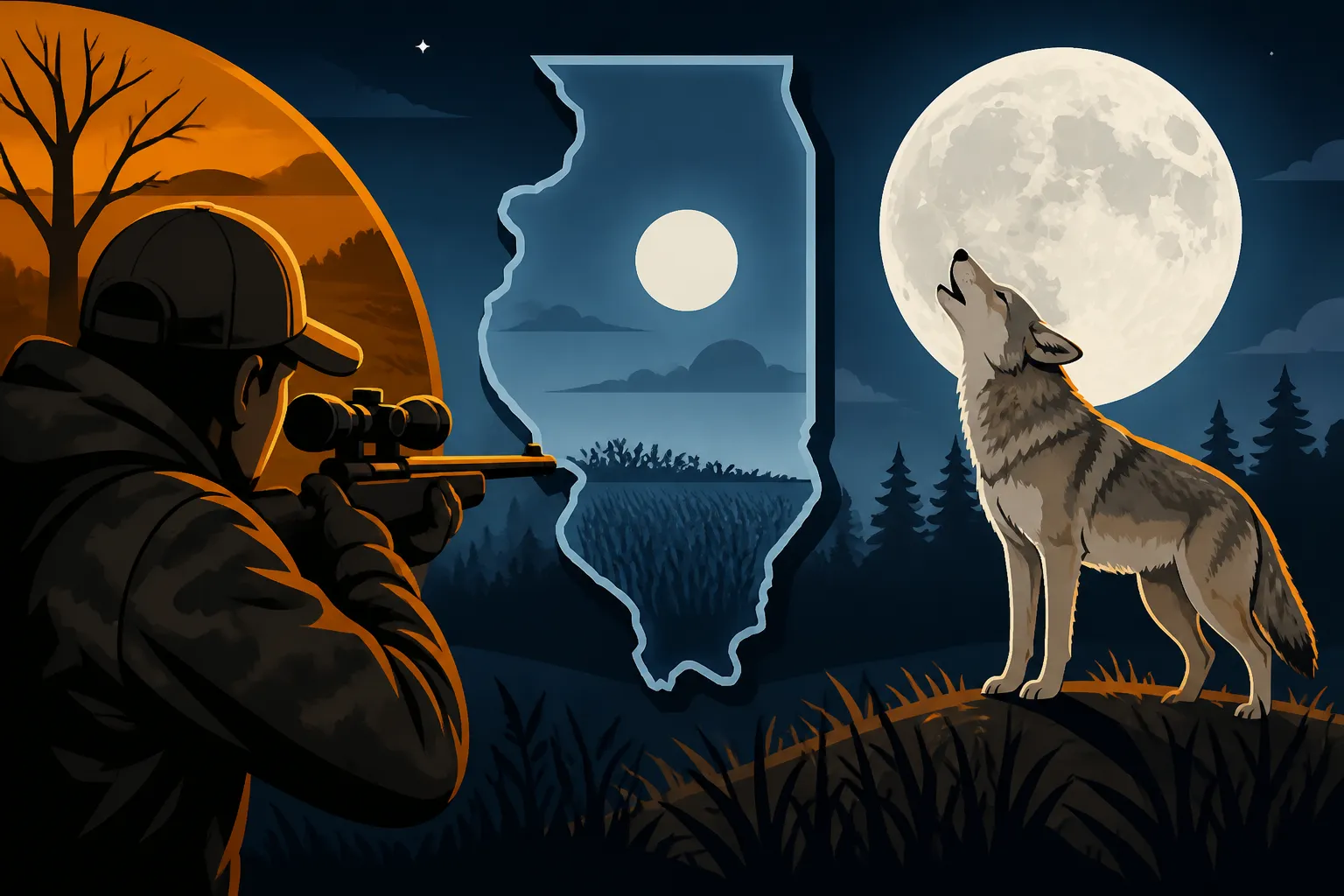
Night Hunting Rules for Illinois Coyotes
Trying to figure out the ins and outs of night hunting coyotes in Illinois can feel like navigating a maze in the dark. Many hunters wonder if it's even allowed, what equipment they can use, and how to stay on the right side of the law while pursuing these elusive predators after sundown. This comprehensive guide will illuminate Illinois's specific regulations for night hunting coyotes, detailing legal equipment, necessary permits, and crucial safety considerations to ensure a successful and compliant hunt.
Illinois's Approach to Coyote Hunting
Illinois treats coyotes somewhat differently than most traditional game species, reflecting their prevalence and status as a predator that can impact livestock and other wildlife. Understanding this foundational difference is key to grasping the specific rules around hunting them, especially at night.
Legal Status of Coyotes in Illinois
Unlike deer or turkey, coyotes in Illinois are not classified as protected game animals. Instead, the Illinois Department of Natural Resources (IDNR) considers them furbearers, but with very liberal hunting allowances due to their abundance and impact on agricultural interests and sometimes even suburban areas. This means many of the restrictive seasons, bag limits, and daily hunting hours that apply to other species simply don't apply to coyotes. They are often viewed more as a nuisance or pest species in many contexts, leading to less stringent regulations compared to, say, a white-tailed deer. This distinction is crucial because it opens up opportunities like night hunting that are strictly forbidden for most other wildlife.
This classification allows for management strategies that prioritize population control and nuisance abatement. It's why you'll find different rules when you look at something like Illinois Deer Season Structure Explained compared to the year-round, open-ended approach for coyotes. The state aims to provide landowners and hunters with ample opportunity to manage coyote populations, recognizing the challenges they can pose to livestock producers and rural residents.
Year-Round Season, Day or Night
One of the most appealing aspects of coyote hunting in Illinois is its year-round, virtually 24/7 availability. There is no closed season for hunting coyotes in Illinois, and they can be hunted day or night, provided you adhere to specific equipment and land permission rules. This continuous season offers incredible flexibility for hunters, especially those with busy schedules or those who prefer the cooler temperatures and increased activity that often come with nighttime hours. This also means that many general hunting restrictions, such as specific shooting hours for deer or turkey, don't apply.
However, just because there's no "season" doesn't mean there are no rules. This freedom comes with the responsibility of knowing and following the regulations concerning methods, specific tools, and property lines. For instance, while you can hunt coyotes at night, you can't just use any weapon or any light source; there are specific stipulations that must be met. The year-round nature of coyote hunting also makes them a popular target for hunters looking to stay sharp in the off-season for other game, or to simply get out in the woods when other hunting opportunities are closed.
Specific Regulations for Night Hunting Coyotes in Illinois
Navigating the nuances of night hunting regulations in Illinois requires attention to detail. While the year-round aspect is straightforward, the rules governing what you can actually use after dark are where many hunters get confused.
Lighting and Artificial Light Sources
When it comes to night hunting coyotes in Illinois, the use of artificial lights is generally permitted, but there are important caveats to keep in mind. You can use spotlights, handheld lights, and weapon-mounted lights to locate, identify, and shoot coyotes. This is a significant departure from regulations for most other game animals. The key is that these lights are specifically allowed for coyotes, foxes, skunks, opossums, and raccoons during their respective open seasons. This opens up a world of possibilities for hunters using various illumination tools.
Many hunters prefer red or green lights, as these colors are often less disruptive to the coyotes and are believed to be less noticeable by them. However, white lights are also legal. Beyond traditional spotlights, modern technology has brought thermal imaging and night vision optics into the hands of hunters. In Illinois, both thermal imaging and night vision scopes are legal for hunting coyotes at night. This technological advantage allows hunters to detect heat signatures or amplify ambient light, making it far easier to spot coyotes that would otherwise remain hidden in the dark. Always double-check county-specific ordinances, as a few local jurisdictions might have stricter rules, though this is rare for coyote hunting.
Weapon Restrictions for Night Hunting
While coyotes can be hunted almost anytime, the weapons you can use still fall under certain state guidelines, especially when it comes to night hunting. Generally, all legal firearms and archery equipment that are allowed for daytime hunting of coyotes are also permissible at night. This includes centerfire rifles, rimfire rifles, shotguns with appropriate loads, muzzleloaders, and bows (including crossbows during the archery season for deer or with a special permit if outside that season, but for coyotes specifically, crossbows are generally allowed year-round).
However, it's crucial to understand that certain public lands might have specific restrictions on weapon types, discharge hours, or even prohibit night hunting altogether. For example, some State Fish and Wildlife Areas or National Wildlife Refuges may have blanket rules against rifle use or night activity that supersede the general state coyote hunting rules. Always consult the specific site regulations for any public land before heading out. On private land, the owner's permission dictates much of what you can do, but state weapon laws still apply. For instance, while high-powered rifles are legal for coyotes, you must still adhere to safe shooting practices and understand your backstop, especially when Night Hunting Hogs With Lights on Private Land, which shares similar weapon considerations.
Private Versus Public Land Considerations
The distinction between hunting on private versus public land becomes even more critical when discussing night hunting for coyotes in Illinois. On private land, with explicit permission from the landowner, you have the most flexibility. In fact, many night coyote hunts are conducted on private farmland where coyotes are causing problems for livestock or crops. Getting Private Land Permission in Illinois is paramount, and it's always a good idea to have it in writing, especially when hunting at unusual hours. Landowners might also have specific requests regarding the type of light you use or areas you can hunt to avoid disturbing neighbors or livestock.
Public land, on the other hand, often comes with more restrictions. While the general state regulations for coyote hunting allow night hunting, many individual public sites — such as State Fish and Wildlife Areas, State Parks, or National Forests like Shawnee National Forest — have their own specific rules. These site-specific regulations might prohibit hunting after sunset, restrict vehicle access at night, or ban the use of certain weapons like centerfire rifles. It is absolutely essential to check the IDNR site-specific regulations for any public land you plan to hunt. A general rule of thumb is that if a site closes its gates at dusk, night hunting is likely prohibited. Understanding these local rules is crucial to avoid violations, especially given how busy some public areas can be. For detailed public land maps and rules, services like GoHunt can be invaluable resources for pre-scouting and ensuring compliance.
Safety and Ethical Considerations for Night Hunters
Beyond the letter of the law, successful and responsible night hunting for coyotes requires a strong commitment to safety and ethical conduct. The darkness adds layers of complexity that demand extra vigilance and consideration for both personal safety and the perception of the sport.
Identifying Your Target and Backstop in the Dark
This is arguably the most critical safety consideration for night hunting. In the dark, positive target identification is infinitely more challenging than in daylight. Every shadow can play tricks on your eyes, and the glint of a coyote's eyes in a spotlight could easily be another animal, a domestic dog, or even a person. You must be 100% certain of your target before pulling the trigger. This means using high-quality optics, taking your time, and being absolutely sure it's a coyote and not something else.
Equally important is knowing your backstop. What is behind your target? In the dark, terrain features, buildings, or roads can be obscured. A bullet can travel a long distance, and stray rounds are incredibly dangerous. Always position yourself to have a safe, unobstructed background, like a hillside or thick timber, that can absorb a bullet. Never shoot towards a horizon or where you can't clearly discern what's beyond your target. This requires diligent scouting during daylight hours, perhaps using a mapping tool like GoHunt to mark potential stand locations and safe shooting lanes, before you ever venture out under the cover of darkness.
Respecting Landowners and Neighbors
Night hunting naturally generates concerns from non-hunters and nearby residents, often due to noise and lights. If you're hunting on private land, ensure you have a clear understanding with the landowner about your hunting times, especially if you'll be active late into the night. It's courteous to inform neighbors if you plan to be calling or shooting coyotes at night, so they aren't alarmed by unusual sounds or lights. A quick conversation can prevent a call to the sheriff.
Minimizing disturbance is key. Park vehicles discretely, avoid shining lights into residential windows, and keep your movements as quiet as possible. Remember, many people who aren't hunters might not understand why someone is "out there" at 2 AM. Your actions directly impact the public perception of hunting. Being considerate can go a long way in maintaining good relationships and preserving hunting opportunities for everyone. This is a common theme whether you're coyote hunting or even Predator Calling Southern Illinois Ridgelines where sounds carry far.
Hunting Etiquette and Public Perception
The ethics of hunting extend beyond simply following the law. Night hunting, in particular, can be a sensitive topic for the non-hunting public. Hunters have a responsibility to conduct themselves in a manner that upholds the integrity of the sport. This means practicing clean kills, making every effort to recover any animal shot, and not leaving any trace of your presence behind (like spent shell casings or trash).
It also means being prepared for questions or concerns from law enforcement or curious citizens. Always carry your hunting license (check Illinois Hunting Licenses and What They Cost if you need to renew) and permits, and be ready to explain what you're doing respectfully and calmly. Public perception can greatly influence future hunting regulations. A few irresponsible night hunters can create negative stereotypes that impact everyone, potentially leading to new restrictions on what is currently a very open season. Strive to be an ambassador for hunting, demonstrating respect for wildlife, landowners, and the law at all times.
Tools and Tactics for Successful Night Coyote Hunting
Once you understand the rules and ethical considerations, gearing up and strategizing for a night coyote hunt becomes the next step. The right tools and thoughtful tactics can dramatically increase your success rate.
Essential Gear for Night Hunts
Successful night hunting relies heavily on specialized equipment that helps you overcome the challenges of darkness. At the top of the list are quality lights. As discussed, white, red, or green lights are all legal. Many hunters prefer weapon-mounted lights for hands-free operation and precise illumination of the target area. A powerful headlamp is also invaluable for walking in and out, setting up, and tracking. When choosing a light, consider its throw distance, beam adjustability, and battery life.
Thermal or night vision optics are game-changers. While an investment, they provide a significant advantage in detecting coyotes at range and identifying them clearly before a shot. For calling, electronic callers are almost essential for night hunting. They allow you to project realistic sounds like distress calls, pup howls, or challenge howls over long distances without moving, which is critical when trying to remain undetected. Brands like Foxpro and ICOtec offer a wide range of calls and features. Don't forget proper camouflage (even at night, your silhouette can be seen against a lighter background or by ambient light) and comfortable, quiet clothing. A good rangefinder and shooting sticks or a bipod are also highly recommended for precise shots in low light. For safety, always have a first-aid kit, a fully charged phone, and be aware of your surroundings, especially if you're on unfamiliar ground. You'll also want to consider bringing along the necessary gear for field dressing if you're successful.
Effective Night Hunting Strategies
Night hunting coyotes often requires a slightly different approach than daytime calling. Coyotes tend to be more active after dark, but also more cautious.
- Wind is Your Friend and Foe: Just like during the day, wind direction is paramount. Always try to set up so your scent blows away from where you expect coyotes to approach. Coyotes have an incredible sense of smell, and a single whiff of human scent will send them packing. Using a mapping app like GoHunt to plot wind direction and terrain can help you choose the best entry and setup points.
- Stealthy Entry and Exit: Minimize noise and light pollution when moving to and from your stand. Coyotes are incredibly wary, and any unnatural disturbance can alert them to your presence.
- Strategic Stand Placement: Look for elevated positions that give you a good view of open areas where coyotes might cross, or pinch points where they are funneled. Field edges, clearings, and saddles on ridges (especially if you're calling Hunting Shawnee Hills Ridgelines) are prime locations. Consider using a ground blind that's brushed in if available, as it provides concealment and helps contain your scent.
- Calling Sequences: Start with quieter, more inquisitive calls (like a lone howl or a short series of pup distress calls), gradually increasing volume and intensity if you don't get a response. Coyote vocalizations mixed with rabbit or rodent distress calls can be highly effective. Vary your calls and allow for periods of silence. Often, a coyote will circle downwind to get a sniff, so be prepared for approaches from unexpected directions.
- Patience is Key: Night hunts can be cold and quiet. Remain vigilant and patient. Coyotes can appear silently and quickly.
- Shot Placement: With limited visibility, shot placement becomes even more critical for a quick, ethical kill and easy recovery. Aim for the vital zone and be aware that a coyote's exact location might be harder to pinpoint in low light, even with illumination.
Legal Night Hunting Gear in Illinois
To help summarize, here's a quick reference for common legal equipment when night hunting coyotes in Illinois. Always cross-reference with the latest IDNR regulations and any site-specific rules for public lands.
| Category | Legal Status for Night Coyote Hunting in Illinois | Notes |
|---|---|---|
| Artificial Lights | Permitted | Spotlights, weapon-mounted lights, headlamps (white, red, green). Must be used for legal species (coyotes, fox, skunk, opossum, raccoon). |
| Thermal Optics | Permitted | Thermal imaging scopes and handheld thermal monoculars are legal for hunting coyotes at night. |
| Night Vision Optics | Permitted | Night vision scopes and handheld night vision devices are legal for hunting coyotes at night. |
| Centerfire Rifles | Permitted | Legal calibers (e.g., .223, .22-250, .243). Always be aware of your backstop and safe shooting distances. Some public lands may restrict rifle use. |
| Rimfire Rifles | Permitted | Legal calibers (e.g., .22 LR, .17 HMR, .22 WMR). Suitable for closer ranges. |
| Shotguns | Permitted | Any gauge, with legal shotshells (e.g., buckshot, predator loads). Effective at closer ranges. |
| Muzzleloaders | Permitted | Legal calibers and loads. |
| Bows/Crossbows | Permitted | Legal for hunting coyotes year-round. Check specific regulations for crossbow use during deer archery season if hunting other species simultaneously. |
| Electronic Calls | Permitted | Electronic callers are legal and highly effective for attracting coyotes. |
| Silencers/Suppressors | Permitted | Legal for hunting in Illinois with proper federal registration and tax stamp. Always verify local ordinances. |
Disclaimer
Please remember that hunting regulations can change. Always consult the most current Illinois Department of Natural Resources (IDNR) hunting regulations and any specific site rules before heading afield. This guide is for informational purposes only and should not be considered legal advice.