Working a Timbered Fence Line for Deer
Many deer hunters, myself included, have spent countless hours in vast timber blocks or overlooking expansive fields, sometimes overlooking the subtle, yet incredibly productive, opportunities presented by a simple timbered fence line. It's frustrating to pour effort into seemingly prime spots only to find them empty, while deer seem to materialize out of nowhere along a narrow strip of woods you barely noticed. This guide is dedicated to unlocking the potential of these often-underestimated corridors, teaching you how to effectively identify, scout, and hunt timbered fence lines for deer across Illinois, turning those overlooked areas into your next honey hole.
Understanding Why Deer Use Timbered Fence Lines
When you're out in the Illinois countryside, whether it's the rolling hills of the south or the flat farmland of central Illinois, timbered fence lines might just look like a boundary. But to a whitetail, they are so much more. These linear strips of woods, often a mix of mature trees, brush, and thickets, serve multiple vital functions that make them magnets for deer activity.
Natural Travel Corridors and Edge Habitat
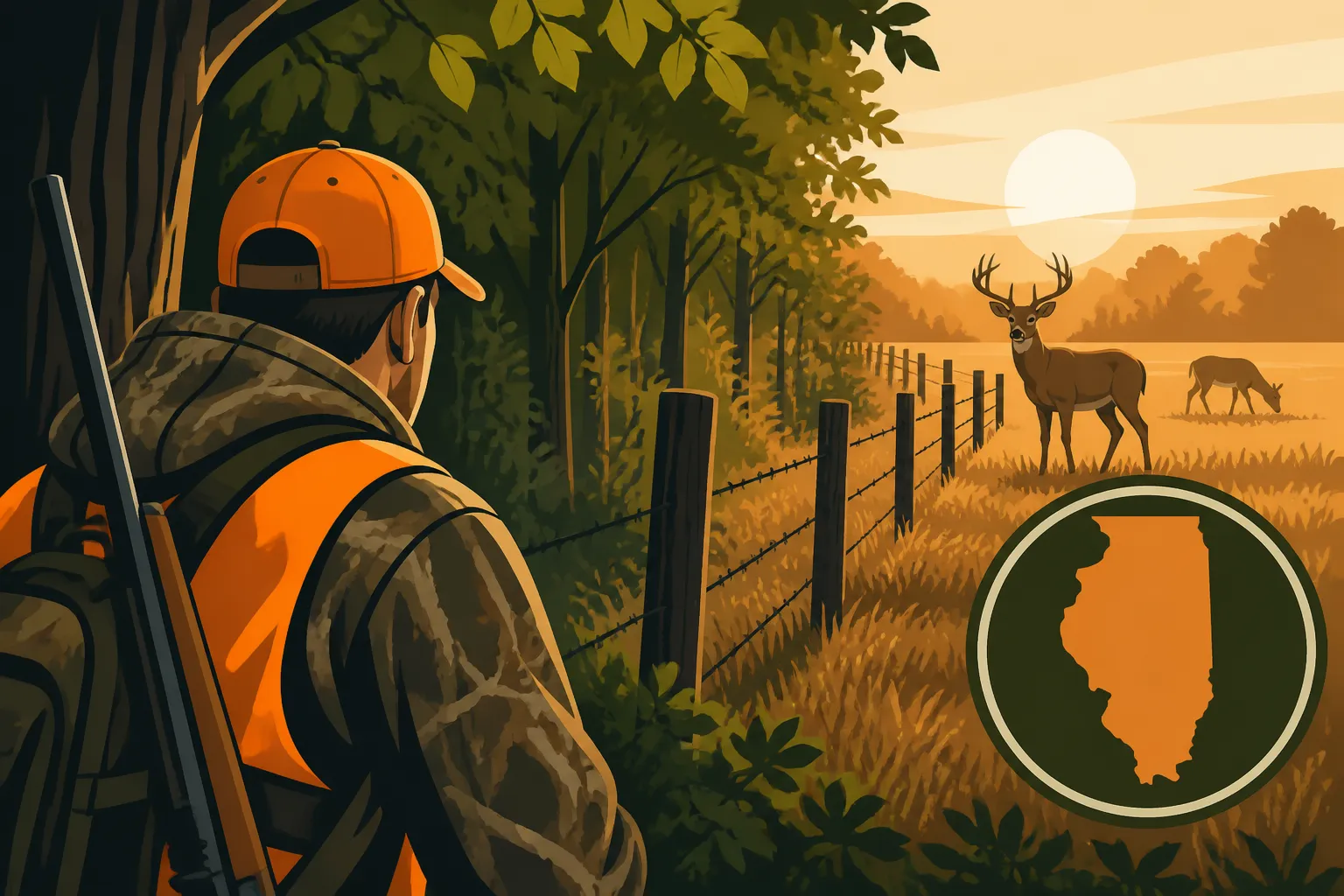
Imagine a deer needing to get from a secluded bedding area in a dense woodlot to a rich soybean field across an open pasture. Walking directly across that open pasture is a huge risk. This is where the timbered fence line shines. It acts as a natural, concealed highway, offering cover and security as deer move between different habitat types. These aren't just random lines of trees; they are intentional pathways. Deer instinctively seek out cover, and these lines provide that much-needed visual buffer from predators, including us hunters.
This phenomenon is often referred to as the "edge effect." Where two distinct habitats meet – like a timbered fence line bordering an open field – you often find an increased diversity and abundance of wildlife. Deer thrive in these "edge" environments because they can access the resources of both habitats simultaneously. They can browse on vegetation within the fence line itself, while staying close to the bounty of a crop field or the safety of a larger woodlot. For example, a fence line bordering a cut cornfield in December can be a hotspot, as deer utilize the remaining cover of the timbered strip while foraging for waste grain.
Food, Water, and Bedding Connections
Beyond just offering safe passage, timbered fence lines often connect critical resources for deer. Think about a mature oak tree dropping acorns within the fencerow, or a thick patch of honeysuckle providing year-round browse. These lines can hold a surprising amount of food. They might run along the edge of a creek or a drainage ditch, connecting deer to essential water sources. In areas where larger timber blocks are scarce or fragmented, a dense timbered fence line can even offer temporary bedding cover, especially during the middle of the day for a buck looking to sneak a quick nap before heading out to feed again.
Consider a scenario where a fence line connects a distant timber stand to a small, isolated pond. Deer will use that fence line not just for food and cover, but as their primary route to water. During the rut, a buck might cruise these lines, scent-checking for does, knowing that it's a high-traffic zone for them moving between various resources. You'll often find signs like rubs on saplings and fresh scrapes right within these corridors, indicating that bucks are actively utilizing them for more than just travel.
Sanctuary from Pressure
One of the most appealing aspects of timbered fence lines, especially on public land or in areas with moderate hunting pressure, is their potential to offer sanctuary. Many hunters focus on the "big woods" or the most obvious field edges, inadvertently overlooking these narrow strips. Deer are incredibly adept at finding the path of least resistance and greatest security. If a major woodlot is getting pounded by hunters, deer might choose to spend their days bedded down in a surprisingly small, thick timbered fence line, only venturing out under the cover of darkness.
These areas can be tough to hunt and aren't always conducive to large groups, which further reduces human disturbance. A savvy hunter who is willing to slip into a tight, dense fencerow might find deer that have been bumped from larger, more accessible areas. It’s about thinking like a deer: where would you go if you felt pressured? Often, it’s the place that other hunters pass by, dismissing it as "too small" or "not worth the effort." This is particularly true in heavily farmed regions of Illinois, where these lines might be the only consistent cover for miles.
Scouting Timbered Fence Lines for Success
Finding a timbered fence line is one thing; understanding how deer are using it and developing a hunting strategy is another. Effective scouting is paramount, and it goes beyond just a quick walk-through. It involves detailed observation, map analysis, and careful planning.
Reading Sign: Rubs, Scrapes, and Trails
When you're walking a timbered fence line, don't just look for deer; look for their story written on the landscape. Fresh rubs on saplings, especially those with sap still oozing, tell you a buck has recently passed through. Pay attention to the size and height of the rubs – larger, higher rubs often indicate a more mature buck. Scrapes, particularly those under low-hanging branches with an overhanging "licking branch," are communication hubs for deer. If you find multiple fresh scrapes strung along a fence line, you've hit on a prime travel corridor, especially during the pre-rut and rut phases. For a deeper dive into these indicators, check out our article on Scrape Lines Along a Logging Road.
Beyond rubs and scrapes, look for distinct deer trails. In a narrow fence line, these trails can be very well-defined, almost like little highways. Are they fresh? Are there multiple trails converging? Are there tracks indicating size and direction of travel? Note where trails enter and exit the fence line, as these are natural funnels where deer will be concentrated. During early season, look for trails leading to obvious food sources. As the rut approaches, watch for cruising trails where bucks are patrolling. Later in the season, trails leading to thermal cover or remaining food sources will be key. Pay attention to the subtle details like broken spiderwebs across a trail or displaced leaves, which can tell you just how recent the activity was. You can often learn a lot about recent deer movement just by Reading Illinois Mud for Fresh Deer Movement.
Utilizing Topography and Aerial Imagery
Before you even step foot in the woods, leverage technology. Aerial imagery, found on tools like GoHunt, is your best friend for identifying promising timbered fence lines. Zoom in and look for connections: does the fence line link two large woodlots? Does it run along a creek or connect to a field edge? Look for natural pinch points or funnels created by the fence line itself, or where it intersects with other habitat features like a ditch or a slight ridge. These are areas where deer movement is naturally concentrated.
Pay close attention to changes in elevation. Even subtle rises or dips along a fence line can influence how deer travel and how wind and thermals will behave. A fence line running along a contour or a slight ridge might be a preferred route, offering a better vantage point for deer. If the fence line runs through a low-lying area, it might be a cold air sink, or a more sheltered route on a windy day. Tools like GoHunt can show you property lines too, which is critical for identifying huntable public land fence lines or understanding boundaries on private ground. Understanding the lay of the land from above can save you hours of on-the-ground scouting and help you predict deer movement. This is especially useful when Reading Aerial Photos for Southern Illinois Deer.
Entry and Exit Strategy Considerations
Once you've identified a promising fence line and potential stand locations, your entry and exit routes become paramount. A perfect stand location is worthless if you spook every deer in the area on your way in or out. Plan your approach to minimize scent and noise. This often means using natural terrain features, ditches, or even the edge of an adjacent crop field (if allowed and unharvested) for cover. Always consider the prevailing wind direction for your entry and exit, just as you would for your hunt itself. You want to approach and depart undetected, with the wind in your favor.
If you're hunting a fence line that borders an open field, consider approaching from the timbered side or using a natural draw. If you're on public land, this might mean a longer walk, but it's often worth it. In agricultural areas, Entry Routes Through Standing Corn can provide excellent concealment early in the season. The key is to be as stealthy as possible, moving slowly and deliberately. Think about how you'll get your gear in and out, and where you'll park your vehicle to minimize disturbance. The less impact you make, the more likely deer are to continue using that fence line.
Effective Hunting Tactics for Timbered Fence Lines
So, you've scouted your fence line, identified the hot spots, and planned your approach. Now comes the exciting part: putting those boots on the ground and hunting. Timbered fence lines offer unique opportunities and challenges that require specific tactics.
Stand Placement and Concealment
When setting up on a timbered fence line, concealment is your number one priority. These narrow corridors mean deer are often closer than in a big woods setting. For treestands, look for a tree that offers good cover from multiple angles, ideally with some thick branches or other trees to break up your silhouette. Position yourself so you can effectively cover the main trails and any pinch points you've identified. Consider the sun's position – you don't want to be silhouetted against a bright sky. While you can find suitable trees in many fencerows, it's not always easy. Sometimes, the trees are too small, too limby, or simply not positioned correctly. For more general advice on vertical setups, consider our guide on Treestand Setups in Shawnee National Forest.
Ground blinds can be incredibly effective in a fence line, especially where suitable trees are lacking or when hunting with youth. Natural ground blinds, built into existing brush piles or thickets, can blend in seamlessly. Pop-up blinds also work, but require careful brushing in to make them look natural. Place your blind so you have clear shooting lanes down the fence line and towards any crossing points. Ensure your blind is set up far enough in advance for deer to get used to it. Remember, these linear features mean deer are often traveling straight past you, not just meandering through a woods. Using a Ground Blind on Illinois Public Land can provide excellent concealment and warmth during colder hunts.
Hunting Different Seasons and Conditions
Timbered fence lines are productive throughout the entire Illinois deer season, but your tactics need to adapt.
- Early Season (October): Focus on fence lines connecting bedding areas to early-season food sources like alfalfa, clover, or standing beans. Deer are in predictable patterns, and these lines are their safe routes. A midday sit on a fence line connecting a bedding area to water can be effective.
- The Rut (Late October/Early November): This is prime time for timbered fence lines. Bucks will actively cruise these corridors, scent-checking for does and covering ground quickly. Look for fresh rubs and scrapes. Setting up near a junction or a tight pinch point where multiple trails converge can be deadly. Our article on Hunting the Rut in Early November delves deeper into these peak activity periods.
- Late Season (December/January): As the landscape becomes barren and cold, fence lines offering dense thermal cover and connecting to late-season food sources like waste grain in cut fields become crucial. Deer will seek shelter from biting winds and find any remaining calories. A warm, sunny day might see deer bedding on the sunny side of a dense fencerow. For further ideas, read about Late-Season Food Sources for Illinois Whitetails.
- Weather Conditions: Don't underestimate how weather influences fence line usage. During heavy rain or high winds, deer will often seek the sheltered cover of a dense fencerow. After a fresh snowfall, tracks will be easy to read, making scouting more efficient and showing exactly where deer are moving.
Using Calls and Decoys in a Fence Line Setting
Calls and decoys can be effective in a fence line, but discretion is key due to the often-close quarters.
- Calls: Grunt tubes, doe bleats, and rattling antlers can all be used. During the rut, a soft grunt or a short rattling sequence can be enough to draw a curious buck in. However, in a narrow timbered corridor, loud, aggressive calling might be too much and could spook deer. Keep it subtle and observe how deer respond. Remember that Rattling Volume in Thick Cover should be adjusted based on the density of the cover you are hunting.
- Decoys: Decoys can be tricky in a narrow fence line. A single doe or young buck decoy, placed upwind and within easy view of the fence line, can be effective during the rut to draw a cruising buck. Ensure your decoy isn't going to get tangled in brush or become obstructed by trees. The goal is to make it look as natural as possible without creating an unnatural obstacle. Always ensure your decoy setup is safe and visible to other hunters, especially on public land.
Common Mistakes and How to Avoid Them
Even with the best intentions and thorough scouting, it's easy to make mistakes when hunting timbered fence lines. Avoiding these common pitfalls can significantly increase your chances of success.
Ignoring Wind Direction
This is perhaps the most critical mistake, especially in a linear habitat. A timbered fence line acts like a funnel, not just for deer, but for scent. If the wind is blowing your scent directly down the fence line, any deer approaching from that direction will pick you up long before they come into view. It's the quickest way to educate a deer and blow your hunt.
Always, and I mean always, know the wind direction relative to your stand and the expected deer travel routes. Have multiple stand options along the same fence line, allowing you to pick the best setup for the prevailing wind. Sometimes, you might even need to consider a completely different fence line or area if the wind simply isn't cooperating for your primary spot. Portable treestands or ground blinds can offer the flexibility needed to adapt to changing winds, which are a constant in Illinois hunting.
Overlooking Pressure Signs
It's easy to get excited when you find a promising timbered fence line with good sign. However, don't forget to scout for human pressure as well. Old boot tracks, discarded energy drink cans, orange flagging tape, or old treestand straps can all indicate that other hunters are frequenting the area. Deer are masters at detecting and avoiding human disturbance. A heavily pressured fence line, even if it looks good on paper, will likely hold only nocturnal deer.
When scouting, look for fresh, obvious human signs. If you see them, chances are the deer do too. Your best bet is to find those less-traveled fence lines, often those requiring a bit more effort to reach or those that simply don't look as "sexy" as a wide-open timber stand. Sometimes, the most productive spots are the ones that others walk right past. For a general understanding of how deer react to hunting pressure, check out our piece on Hunting Pressure on Illinois Public Land. Don't be afraid to walk a little further or investigate a seemingly unappealing strip of timber; you might just find unpressured deer.
Not Adapting to Changing Conditions
The landscape of Illinois, particularly its agricultural regions, is constantly changing. Crop fields are planted, harvested, and sometimes left fallow. Timber stand improvement might clear out a section of woods, or a new thicket could grow up. A fence line that was a deer highway last year might be a barren wasteland this year if its adjacent food source or cover changed. Failing to adapt to these shifts is a common mistake.
Don't assume that because a fence line was productive one year, it will be the next. Continuous scouting, even during the season, is crucial. If a cornfield next to your favorite fence line is harvested early, deer patterns will shift. If a logging operation comes through, it will change bedding and travel habits. Be flexible, be observant, and be willing to move your setup. The deer will tell you where they're going; your job is to listen and adjust. Always be ready to reconsider your strategy based on current field conditions and deer behavior.
Here's a quick look at how various elements might influence your fence line hunting strategy:
| Season | Key Deer Behavior | Preferred Fence Line Use | Ideal Stand Placement | Calling/Decoy Strategy |
|---|---|---|---|---|
| Early Season | Predictable travel from bed to food, less aggressive | Connecting bedding to green food plots/ag fields, water sources | Overlooking primary trails entering/exiting field edges | Soft grunts, doe bleats; minimal decoy use |
| The Rut | Bucks actively cruising for does, increased daytime movement | High-traffic corridors, scent-checking points, pinch points | Near junctions, heavy rub lines, active scrapes | Aggressive grunts, rattling; doe or young buck decoy |
| Late Season | Seeking thermal cover and remaining food sources | Dense cover, connecting to waste grain/browse; sunny slopes | On leeward side for warmth, overlooking waste grain fields | Minimal calling; focus on ambush |
Disclaimer
Hunting is an inherently dangerous activity. Always prioritize safety, adhere to all Illinois hunting regulations, and be aware of your surroundings. This guide provides general information and recommendations, but it is your responsibility to ensure you are hunting legally and safely. Always inform someone of your hunting location and expected return time.