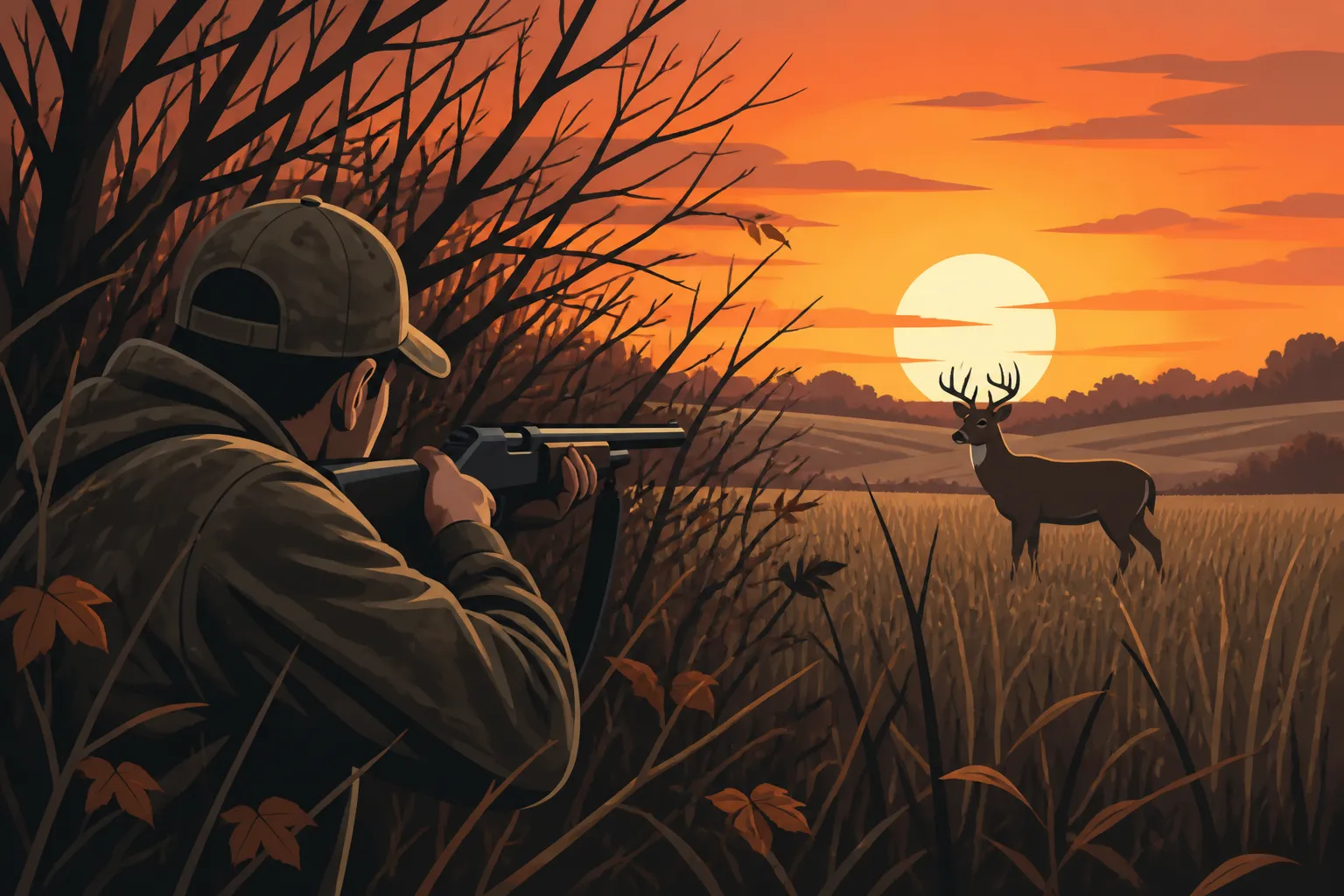
Hunting a Brushy Fence Row at Dusk
There's something uniquely challenging, yet incredibly rewarding, about being in the deer woods as the day winds down and twilight creeps in. Many hunters struggle to pinpoint exactly where deer will emerge from their bedding areas or stage before hitting evening food sources. But if you're overlooking the humble brushy fence row, you might be missing one of Illinois's most consistent hotspots for catching whitetails on the move, especially as legal shooting light fades into darkness. This guide will walk you through how to effectively hunt these often-underestimated corridors, turning frustrating last-light moments into success stories.
Why Brushy Fence Rows Are Whitetail Hotspots at Dusk
Brushy fence rows aren't just property markers; they're vital arteries in the whitetail deer's daily routine, especially as the sun begins to dip below the horizon. Understanding why deer favor these linear strips of cover at dusk is the first step to hunting them successfully.
Natural Travel Corridors for Deer Movement
Think of a brushy fence row as a natural highway, a hidden path that deer prefer to use when traveling from their daytime bedding areas to their evening feeding grounds. They offer a sense of security that open fields simply can't. Deer, being creatures of habit and comfort, will almost always choose the path of least resistance and greatest cover. These linear strips provide visual obstruction from predators (including hunters), allowing them to move with confidence. This is particularly true in areas where large tracts of timber are fragmented by agricultural fields. A brushy fence row can act as a critical connection, much like how deer utilize a natural funnel between two woodlots. They link bedding areas to food sources, or even connect one block of timber to another, creating a discreet path for deer to follow.
Providing Security, Thermal Protection, and Forage
Beyond just cover for travel, brushy fence rows offer multiple benefits to deer. The dense vegetation provides excellent thermal protection from chilling evening winds in cooler months, allowing deer to conserve energy as they move. More importantly, they offer a psychological sense of security. A deer feels safer when it can move without being exposed in the open. As dusk approaches, deer become more active and are willing to take calculated risks, but they still prioritize safety. A thick fence row gives them that safety blanket, allowing them to linger longer before stepping out into a field. Many fence rows also contain a surprising array of forage, from briars and wild grapes to young saplings and forbs, offering a convenient snack before they hit the main food plot or crop field. This means deer might not just travel through a fence row; they might stage and browse within it, offering you a longer window of opportunity.
Maximizing the Edge Effect for Evening Activity
The "edge effect" is a well-known principle in wildlife management, describing how the boundary between two distinct habitats often supports a greater diversity and abundance of wildlife than either habitat type alone. Brushy fence rows are a prime example of this phenomenon in action. They are, by definition, an edge: one side might be a wide-open soybean or cornfield, while the other could be timber, pasture, or even another field. This junction provides the best of both worlds for deer—access to rich food sources in the open fields combined with the crucial cover and security of the brush. As evening descends, deer instinctively gravitate towards these edges, using the cover to slowly work their way to the field, browsing along the fringe before committing to the open. It's this natural transition point that makes hunting a brushy fence row at dusk so effective, as you're positioning yourself where these movements are most concentrated and predictable.
Scouting Your Target Fence Rows for Optimal Ambush Points
Successful hunting isn't just about showing up; it's about doing your homework. Scouting brushy fence rows requires a keen eye and a strategic approach, turning a random linear feature into a predictable ambush point.
Identifying Productive Fence Rows from Afar
Not every brushy fence row holds the same potential. The key is to identify the ones that connect key habitat features. Start your scouting from above, using aerial maps on tools like GoHunt or similar mapping applications. Look for fence rows that link a known bedding area (thick timber, CRP fields, dense creek bottoms) to a primary food source (corn, soybean, alfalfa fields, or established food plots). Pay attention to any topographical features, even subtle ones, that might influence deer movement along the fence line. Is there a low spot in the fence line that deer might prefer to cross? Does it run along a natural ridge or dip? A fence row that terminates at a major timber block or leads directly into a secluded field corner is far more productive than one that just ends in the middle of nowhere. Sometimes, the most productive fence rows are those that run perpendicular to main timber lines, creating a natural funnel for deer moving across open country.
| Characteristic | High Potential Fence Row | Low Potential Fence Row |
|---|---|---|
| Connectivity | Links bedding to food, or large timber blocks | Dead ends in open field, or runs parallel to only one habitat type |
| Density | Thick, multi-layered brush, briars, small trees | Sparse, gappy, only low grass or weeds |
| Sign Density | Numerous rubs, scrapes, fresh tracks, droppings | Minimal or old sign |
| Cover Type | Varied, includes evergreens, thick understory | Uniform, mostly deciduous, sparse in winter |
| Location | Borders active crop fields, secluded corners, draws | Along busy roads, highly disturbed areas |
| Human Pressure | Low access, difficult to approach silently | High foot traffic, easy access for others |
Reading Deer Sign Within the Cover
Once you've identified promising fence rows from your maps, it's time to get boots on the ground. Walk the length of these brushy corridors, focusing on the inside edges of the cover. This is where deer often feel safest and leave the most sign. Look for fresh tracks, especially larger ones indicating mature bucks. Pay attention to the direction of travel – are most tracks heading towards the feeding fields in the evening? Search for rubs on saplings and small trees, particularly those on the thicker side of the fence row, which often indicate a buck's preferred travel route or staging area. Scrapes, though less common inside a dense fence row, can sometimes be found on the edges, indicating an active scent checking point. Fresh droppings are another clear indicator of recent activity. Use a tool like GoHunt to mark these signposts, helping you build a comprehensive picture of deer movement patterns. Remember, consistent fresh sign is far more important than a single impressive rub. When you're scouting Illinois public land before season, these little details add up to a successful hunt plan.
Understanding Wind and Thermals in Linear Cover
This is arguably the most critical element of scouting any stand location, and brushy fence rows are no exception. Deer are incredibly wary of scent, especially at dusk when they are preparing to move into open areas. As a general rule, the wind should always be in your favor. However, linear features like fence rows can create unpredictable thermals and wind swirls, especially in rolling terrain or areas bordering large temperature differentials (like a warm field next to a cool woodline). As evening cools, thermals generally begin to fall, meaning your scent will drift downhill. But along a fence row, micro-thermals can still push scent horizontally or even slightly uphill depending on the slope and surrounding vegetation.
Before you set a stand, visit the fence row multiple times at different times of day, including dusk, to observe wind patterns. Toss some milkweed seeds or use a commercial wind checker to see exactly how the air currents are moving at different heights. If the fence row is on a subtle rise, similar to a low ridge, applying principles from "Wind and Thermals on a Southern Illinois Ridge" can be helpful; expect thermals to fall down both sides into the lower fields or timber. Your goal is to identify a spot where the prevailing evening breeze, combined with any falling thermals, will carry your scent away from the anticipated deer travel paths. Never assume the wind will be consistent.
Setting Up Your Stand or Blind for a Dusk Hunt
Once you've done your scouting homework and identified a promising brushy fence row, the next critical step is to execute a flawless setup. Your ability to remain undetected is paramount during those crucial last minutes of daylight.
Strategic Stand Placement for Maximum Advantage
Where you place your stand or blind within or alongside the fence row is everything. The goal is to intercept deer as they move from cover to open, or even as they browse within the fence row itself. Avoid placing your stand directly in the most obvious travel lane, as deer might spot you. Instead, look for a spot slightly off to the side, perhaps just inside the timber line that the fence row feeds into, or tucked deeply within the thickest part of the brush if it's dense enough. For a bowhunter, aiming for a setup 15-20 yards from the primary travel path is ideal, allowing for a good shot angle without being directly over their heads. If using a firearm, you might be able to stretch that distance a bit.
Consider the prevailing wind carefully. Your stand should offer a clear shooting lane downwind of the anticipated deer path. If the fence row borders an open field, consider setting up on the inside edge of the fence row, allowing deer to pass between you and the open field. This gives you a better chance to see them before they fully commit to the open, and they're less likely to be looking into the fence row for danger. When setting up on a central Illinois field edge, remember that the closer you are to the primary entry point, the higher your chances of success, but also the higher the risk of being busted. A good compromise is often 20-30 yards from where you expect deer to emerge.
Planning Silent Entry and Exit Routes
This is where many dusk hunts go wrong. A perfect setup can be ruined by a noisy entry or exit that spooks deer before or after you hunt. Your entry route must keep you out of the deer's line of sight and downwind of their bedding and travel corridors. This often means walking a circuitous path, potentially using a ditch, a creek bed, or a deeper section of timber to approach your stand. Avoid walking along the fence row itself to get to your stand, especially if deer are already staging there.
For dusk hunts, the exit is just as important, if not more so. Deer will likely be out in the fields or still moving along the fence row as you climb down in the dark. Plan an exit that takes you away from these active areas. Sometimes, this means waiting a good 30 minutes after legal shooting light ends, giving deer time to move off. If the fence row is adjacent to a standing cornfield, planning an entry route through standing corn can be incredibly effective for concealment. Always use a headlamp on its lowest red-light setting for navigation, and move as quietly as possible. The goal is to leave the area without alerting any deer to your presence, so they continue to use that fence row tomorrow.
Mastering Camouflage and Scent Control
In the low light of dusk, deer are still incredibly sensitive to human presence. Camouflage isn't just about matching the colors of your surroundings; it's about breaking up your silhouette. Wear layers that allow you to blend into the brushy background. If you're using a ground blind, ensure it's well-brushed in with natural vegetation from the area. This is especially true if you're using a ground blind on Illinois public land, where blinds must often be removed daily or adhere to specific setup rules.
Scent control is non-negotiable. Deer rely heavily on their sense of smell, and a single whiff of human odor can send them scattering. Shower with scent-free soap, use scent-free laundry detergent for your hunting clothes, and store them in airtight containers away from household odors. Use scent eliminator sprays on your clothes, boots, and gear before heading out. Pay particular attention to your boots, as ground scent is a major deer deterrent. Carrying a small bottle of scent eliminator to reapply before you get into your stand can make a difference. Even with perfect wind, a sudden swirl or thermal shift can expose you, so rigorous scent control provides an essential backup layer of protection.
Tactics for Hunting the Last Light Along a Fence Row
The final hour of daylight, often called the "magic hour," is when deer movement intensifies. Successful hunting along a brushy fence row at dusk demands a specific set of tactics to capitalize on this brief window of opportunity.
The Art of Patience and Persistence
Hunting a brushy fence row at dusk is a test of patience. Deer know they are safe within the cover, and they will often emerge from bedding areas or stage within the fence row, only stepping out into the open field at the very last minutes of legal shooting light. It's easy to get antsy, checking your watch repeatedly, or thinking about climbing down too early. Resist the urge. The biggest bucks, those truly mature whitetails, are often the last to show themselves, moving with utmost caution. They've survived multiple hunting seasons by being smart and wary.
Your commitment to staying put until the absolute end of legal shooting light is crucial. Many hunters have packed up only to see a giant step out moments later. Even if you don't see anything for an hour, the next minute could be the one. Trust your scouting, stay vigilant, and let the deer come to you. This unwavering persistence is what often separates successful dusk hunters from those who go home empty-handed. Remember that even on days when deer activity seems slow, those last few minutes can surprise you.
Subtle Calling and Decoy Strategies
Generally, less is more when hunting brushy fence rows at dusk, especially if you're targeting mature, wary bucks. You want to be an invisible predator, not a loud one. However, in certain situations, very subtle calling can be effective. A soft doe bleat or a quiet grunt call, particularly during the early phases of the rut, might pique a buck's curiosity if he's moving along the fence row just out of sight. The key is subtlety; you're not trying to aggro-call him in, but merely suggest another deer is nearby. Rattling volume in thick cover should be minimal to avoid sounding unnatural.
Decoys are generally not recommended for fence row hunting at dusk, as they require open sight lines and can be difficult to set up discreetly within the brush. Furthermore, a decoy might draw a deer's attention directly to your position, increasing your chances of being busted. Your primary focus should be on remaining concealed and letting deer follow their natural travel routes. If you do consider a decoy, a very small, portable doe decoy, set up on the field side of the fence row, might draw a buck's attention into the open, but use extreme caution and ensure you can retrieve it silently.
Understanding Legal Shooting Light and Ethical Tracking
Knowing precisely when legal shooting light ends is paramount for ethical hunting. In Illinois, hunting hours typically extend from one half-hour before sunrise to one half-hour after sunset. This "half-hour after sunset" period is often when the magic happens, but it's also when visibility becomes challenging. Modern hunting apps (like GoHunt, among others) often include a legal shooting light calculator for your exact location, which is an invaluable tool. Always confirm with the current Illinois DNR regulations.
If you take a shot during those final minutes, immediately begin assessing the shot placement and the deer's reaction. If you're confident in a lethal hit, remain in your stand quietly for at least 30-60 minutes. This allows the deer to lie down and stiffen up, making for an easier recovery. Pushing a deer too soon, especially in low light, can cause it to run further and make tracking significantly more difficult. If darkness has fallen completely and you're unsure of the hit or the deer's whereabouts, it's often best to back out silently and return at first light with a tracking plan. Blood trailing after dark in Illinois can be extremely challenging and often leads to a lost animal if done improperly. Mark the spot of the shot and the last place you saw the deer, then regroup for a methodical search in the morning. Ethical recovery is a core responsibility of every hunter.
Disclaimer
Always consult the latest Illinois Department of Natural Resources (IDNR) regulations and local ordinances before hunting, as rules and seasons can change. This guide is for informational purposes only and does not supersede official hunting laws.