Wind and Thermals on a Southern Illinois Ridge
Hunting southern Illinois ridges can be an incredibly rewarding experience, but it also presents a unique challenge: mastering the ever-shifting dynamics of wind and thermals. Many hunters find themselves frustrated when a perfect morning sit is ruined by an unexpected swirl of wind, carrying their scent right to the keen nose of a mature buck. This guide will dive deep into understanding these crucial atmospheric elements, helping you pinpoint deer movement, set up smarter, and ultimately, increase your success in the rugged, beautiful terrain of Illinois's southern reaches.
Unraveling the Mysteries of Wind and Thermals
Before we can even think about setting a stand or making a stalk, we absolutely have to grasp the fundamental differences between true wind and thermals. Misinterpreting these can spell the difference between success and a frustrating, scent-busted hunt. It’s not just about knowing the wind direction; it’s about understanding why it's moving the way it is in a specific location.
True Wind Versus Localized Airflow
"True wind" is what you typically see on a weather app or hear reported by the meteorologist. It's the prevailing wind, driven by large-scale weather patterns. When you're standing in a wide-open field, this is generally what you're feeling. However, in the broken, hilly terrain of southern Illinois, especially within areas like the Shawnee National Forest, this true wind rarely dictates the exact airflow in a specific hollow, on a particular bench, or even around the trunk of a single oak tree.
Localized airflow is where things get tricky, but also where the savvy hunter gains an advantage. This is the wind that's being channeled, deflected, or swirled by topography, vegetation, and even temperature differences on a micro-scale. A true north wind might be predicted, but down in a deep ravine, you might feel a southwest breeze, or experience constant swirling. These localized effects are precisely what we need to learn to read. Think of it like water flowing around rocks in a stream; the overall current is one direction, but the water's movement around each obstacle is unique and localized. A good hunting app, like those offered by GoHunt, can provide detailed topographic maps that help visualize these terrain features, which is your first step in predicting localized airflow.
Daytime Thermal Behavior Upslope
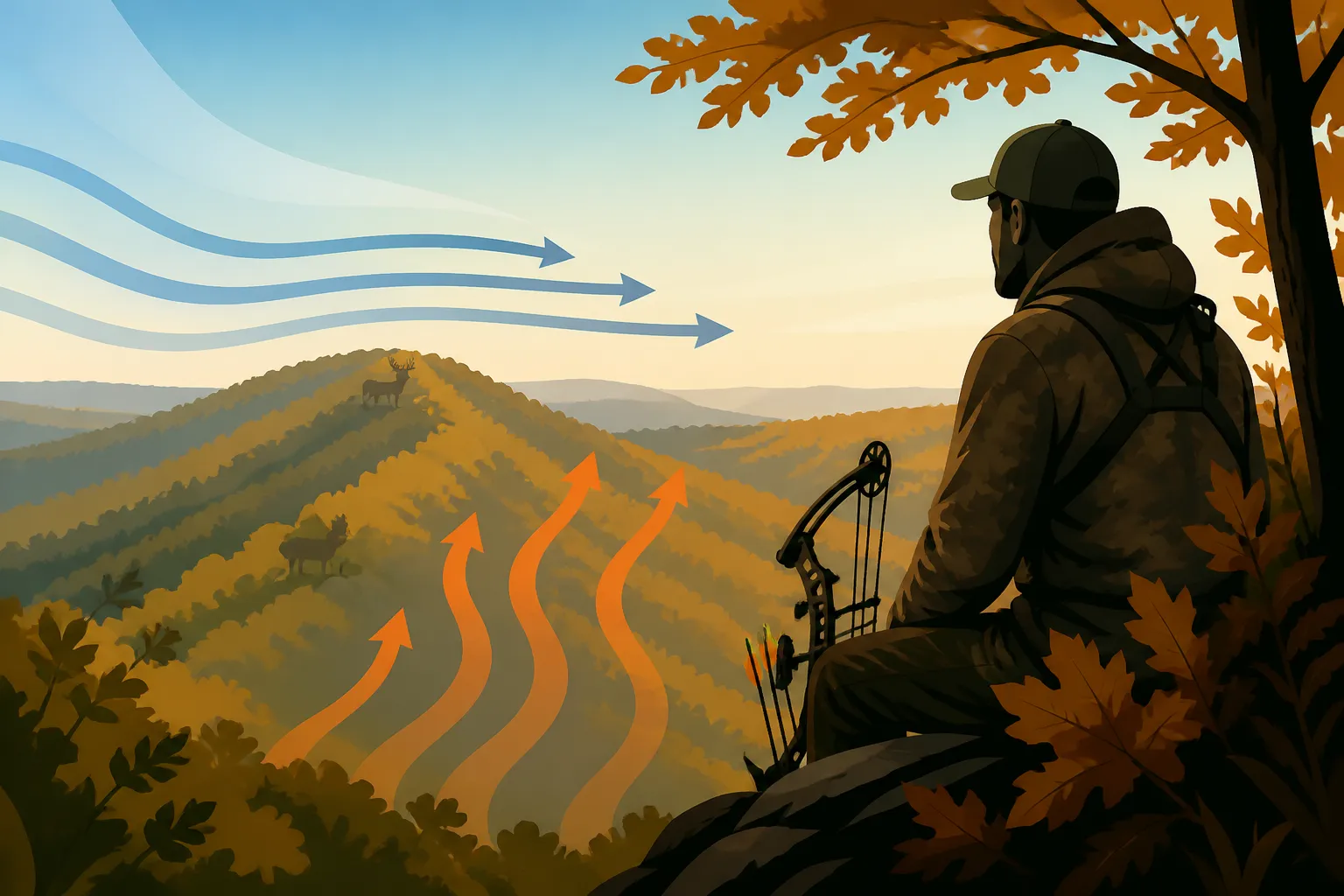
Thermals are essentially air currents driven by temperature changes. During the day, as the sun warms the earth, the ground heats up, and the air directly above it begins to warm and rise. On a ridge system, this warm air travels up the slopes. This phenomenon is known as an upslope thermal. If you're hunting in the morning, as the sun gets higher, the air will begin to rise from the valleys and draw bottoms, carrying your scent upward and over the ridge.
This means that if you're set up on a ridge top or higher up on a slope, your scent will be carried directly up and away from the valley floors where deer might be bedding or feeding early in the morning. This is often an ideal scenario for an ambush as deer move up from bedding areas. However, as the day progresses and the sun intensifies, these upslope thermals can become quite strong and unpredictable, especially in steep terrain. Understanding this upward movement is critical for setting your stands strategically to avoid being "winded" by deer below you.
Nighttime Thermal Behavior Downslope
Conversely, as evening approaches and the sun begins to set, the ground cools down. The air directly above the cooling ground becomes cooler and denser. This cool, dense air then begins to sink, traveling down the slopes into the valleys and draws. This is what we call a downslope thermal.
For an evening hunt, this means your scent will be carried downward, into the low-lying areas. If you're trying to catch deer moving from bedding areas on the ridge tops down to evening food sources in the bottoms, setting up on the lower third of a slope or near the valley floor can be a mistake if your scent is falling right into their path. Instead, you might want to position yourself higher up on the ridge, allowing your scent to fall behind any deer moving downslope or into a less trafficked area. These thermals often become most predictable right at dawn and dusk, during the transitions between heating and cooling.
Here's a quick reference table for thermal behavior:
| Condition | Time of Day | Air Movement | Ideal Stand Placement (Scent Management) | Deer Movement Context |
|---|---|---|---|---|
| Upslope Thermal | Mid-Morning to Afternoon | Air Rises Up Slopes | Higher on ridge, above deer's anticipated path. | Deer moving up from bottoms to bed on ridges. |
| Downslope Thermal | Late Evening to Early Morning | Air Sinks Down Slopes | Higher on ridge, allowing scent to fall into low areas behind deer. | Deer moving from ridges to feed in bottoms; also relevant for early morning exit. |
Reading the Terrain for Wind and Thermal Corridors
Southern Illinois terrain, with its rolling hills, deep hollows, and hardwood forests, creates a complex network of air currents. Learning to 'read' the landscape is like gaining a sixth sense for wind and thermals. It’s all about anticipating how the air will behave given specific topographic features. This intuitive understanding comes from hours spent in the woods, but also from deliberate scouting and analyzing maps.
Ridge Tops and Saddles
Ridge tops are often seen as prime spots for visibility and wider shooting lanes, and they can be, but they're also notorious for swirling winds. A true wind blowing across a ridge top can be unpredictable, creating eddies and unpredictable drafts on either side. However, during the midday, if the true wind is light, the upslope thermals can become quite dominant, pushing your scent clearly over the top.
Saddles, which are low points along a ridge, act like natural funnels for both deer and wind. When the prevailing wind blows perpendicular to the ridge, it often gets "squeezed" and accelerated through a saddle. This can make them excellent ambush points, but also incredibly tricky for scent management. A good strategy is to set up just downwind of the saddle itself, allowing the wind to carry your scent away from the funnel, or to position yourself slightly off to the side, where you can watch the saddle without being directly in its airflow. When you're trying to decide where to hang a stand on a southern Illinois ridge, always consider how a saddle will affect the localized air currents.
Draws and Valleys
Draws and valleys are the antithesis of ridge tops when it comes to air movement. They are natural conduits for thermals. In the morning, as the sun warms the valley floor, the air will rise up through the draws, creating distinct upslope currents. Deer often use these draws as travel corridors, moving from bedding areas on the higher slopes down into feeding areas, or vice-versa. Setting up in a draw can be a gamble; if your scent is rising, you might be fine, but if a deer comes in from above you, or if the thermal shifts, you’re busted.
Conversely, in the evening, these same draws and valleys become channels for the heavy, cool air sinking downslope. This creates a strong, predictable downdraft. This can be advantageous if you're above the deer's anticipated travel path, but deadly if you're below it. Always consider the sun's position and the time of day when hunting these low-lying areas. Understanding how to interpret maps, especially those that highlight topography, is key to predicting these movements, a skill often honed by frequent scouting Illinois public land before season.
Bench Hunting and Micro-Thermals
Benches are flat or slightly sloping areas that interrupt a steeper hillside. They are absolute goldmines for deer hunters because deer love to travel these horizontal contours. They offer easier walking than steep slopes and provide excellent vantage points for deer to observe below and above them. However, benches also introduce a whole new level of complexity to wind and thermals – micro-thermals.
Because benches are relatively flat compared to the surrounding steep terrain, they can create pockets where air flow behaves differently. A prevailing wind might blow over the top of a bench, while localized thermals can still carry scent up or down the slope directly beneath it. Deer often bed just off a bench on the downwind side. Your goal is to approach and set up where the air currents carry your scent over or away from these potential bedding locations and travel paths. This often means staying just below or above a bench, using the terrain to your advantage, and constantly checking wind with a powder bottle or milkweed seeds. Sometimes, treestand setups in Shawnee National Forest on a bench require careful planning, considering these subtle air movements.
Advanced Strategies for Hunting Southern Illinois Ridges
Once you've got a handle on the basic principles of wind and thermals, it's time to put that knowledge into action with some advanced strategies. This isn't just about avoiding detection; it's about using these atmospheric forces to your tactical advantage, funneling deer where you want them, and maximizing your opportunities.
Pre-Season Scouting with Wind in Mind
Effective scouting isn't just about finding rubs, scrapes, and bedding areas. It's about scouting those areas in relation to various wind directions and thermal patterns. Before the season even begins, take your time to visit potential stand sites during different times of day and in various wind conditions. Use a wind checker constantly. Watch how smoke from a small campfire or even a handful of dandelion seeds behaves. A powerful mapping tool, like GoHunt, allows you to mark potential stand locations and then overlay wind direction data, helping you visualize how scent will travel from that spot under various conditions.
Consider multiple access routes for each stand. Your approach and exit routes are just as critical as your stand location itself. An ideal route minimizes your chance of bumping deer and keeps your scent out of known travel corridors. For example, if you plan to hunt an evening thermal that drops into a valley, your entry route should be along a ridge top that keeps your scent out of the valley until you're in your stand. You might find several great spots when reading a ridge for Shawnee Forest deer, but only a few that offer scent-free access and a favorable wind.
In-Season Adjustments and Scent Control
No matter how well you scout, Mother Nature has a way of throwing curveballs. The wind forecast might change, a cold front might come through, or the thermals might be weaker or stronger than anticipated. Flexibility is key. Always carry a wind checker and use it frequently throughout your hunt. If the wind starts to swirl, or if you notice your scent isn't moving as predicted, don't be afraid to make a move. Sometimes, a slight adjustment – a different tree, or even just turning your body in the stand – can make all the difference.
Scent control becomes even more critical in these tricky conditions. While no product makes you truly scent-free, a diligent routine drastically reduces your human odor. This includes showering with scent-free soaps, washing hunting clothes in scent-free detergent, storing them in airtight bags, and wearing rubber boots to minimize ground scent. Even something as simple as a fresh layer of activated carbon clothing can help absorb some of those errant scent molecules that swirling winds love to pick up. When you're deep in the timber, trying to pinpoint where Shawnee National Forest bucks bed, every bit of scent reduction helps.
Utilizing Technology to Predict Conditions
Today's hunters have an incredible array of technological tools at their fingertips, and leveraging these can give you a significant edge in understanding wind and thermals. Many modern hunting apps, like those from GoHunt, integrate detailed wind forecasts with mapping overlays. You can often see real-time wind speeds, directions, and even visualize how scent might travel from your exact location. This is invaluable for pre-hunt planning, allowing you to select stand sites with the most favorable predicted conditions.
Beyond just wind, some apps also provide information on barometric pressure and temperature, which directly influence thermal activity. A rapidly dropping barometer might indicate an approaching front, leading to more erratic winds. Stable, high pressure often means more predictable thermals. Pairing these digital insights with your on-the-ground observations is the ultimate combination. Remember, technology is a tool, not a replacement for your own senses and knowledge. Use it to inform your decisions, but always verify with a physical wind checker once you're in the field.
Common Mistakes and How to Avoid Them
Even experienced hunters can fall prey to misjudging wind and thermals, especially in complex terrain. Avoiding these common pitfalls is essential for consistent success on southern Illinois ridges.
Ignoring Subtle Changes
One of the biggest mistakes hunters make is becoming complacent. They check the wind once at the truck, hike to their stand, and assume it will remain consistent. This is a recipe for disaster in hilly country. Wind and thermals are constantly in flux, changing with solar intensity, cloud cover, and even subtle shifts in the prevailing weather.
To avoid this, make it a habit to check your wind every 15-30 minutes, or whenever there's a significant change in light, temperature, or animal activity. A feather, milkweed fluff, or a small squeeze bottle of unscented powder are invaluable tools. Pay attention to how the trees are swaying, or if you feel a faint breeze on your neck. These subtle cues are your early warnings. If you're on a multi-day hunt, like those during Illinois's two firearm deer seasons, maintaining vigilance is paramount.
Hunting the Wrong Side of a Ridge
This is a classic thermal mistake, especially during the early morning or late evening. If you're hunting an evening thermal, and you set up too low on the downwind side of a ridge, your scent will fall right into the path of deer moving downslope to feed. Similarly, if you're trying to intercept deer moving upslope in the morning and you're too far down in the valley, your scent will rise directly to them.
The solution is often to hunt the "safe" side of the ridge. For morning hunts, consider setting up higher on the slope, allowing your scent to rise over the main travel corridor. For evening, consider setting up on a subtle micro-ridge or bench just off the main travel path, allowing your scent to fall into a less critical area. Sometimes, this means hunting the Illinois rut in early November from a slightly less direct approach, but with a much higher chance of success. Understanding hunting Shawnee Hills ridgelines effectively means learning to play the wind, not fight it.
Over-Reliance on Forecasts
While weather apps and online forecasts are incredibly useful for general planning, they can't predict the micro-climate of every specific hollow or knoll on a southern Illinois ridge. A forecast might say "NW at 5 mph," but deep in a secluded draw, you might experience a completely different scenario. The localized terrain features create their own mini-weather systems that often override or significantly alter the broader forecast.
Always use forecasts as a starting point, but trust your on-the-ground observations more. When you arrive at your chosen hunting spot, spend a few minutes actively observing the wind and thermals with your wind checker before committing to a setup. If the actual conditions differ significantly from the forecast, be prepared to adjust your plan. Sometimes, the best plan is to simply pick a different stand location that works with the actual wind you're experiencing, rather than sticking to a plan based on outdated or generalized information. This vigilance is particularly important when considering late-season food sources for Illinois whitetails, as colder temperatures can also impact thermal strength.
Disclaimer
The information provided in this guide is for informational purposes only and is not a substitute for official regulations, professional guidance, or personal experience. Always consult the latest Illinois Department of Natural Resources (IDNR) regulations before hunting. Hunting involves inherent risks, and safety should always be your top priority.