Hunting a Standing Soybean Field
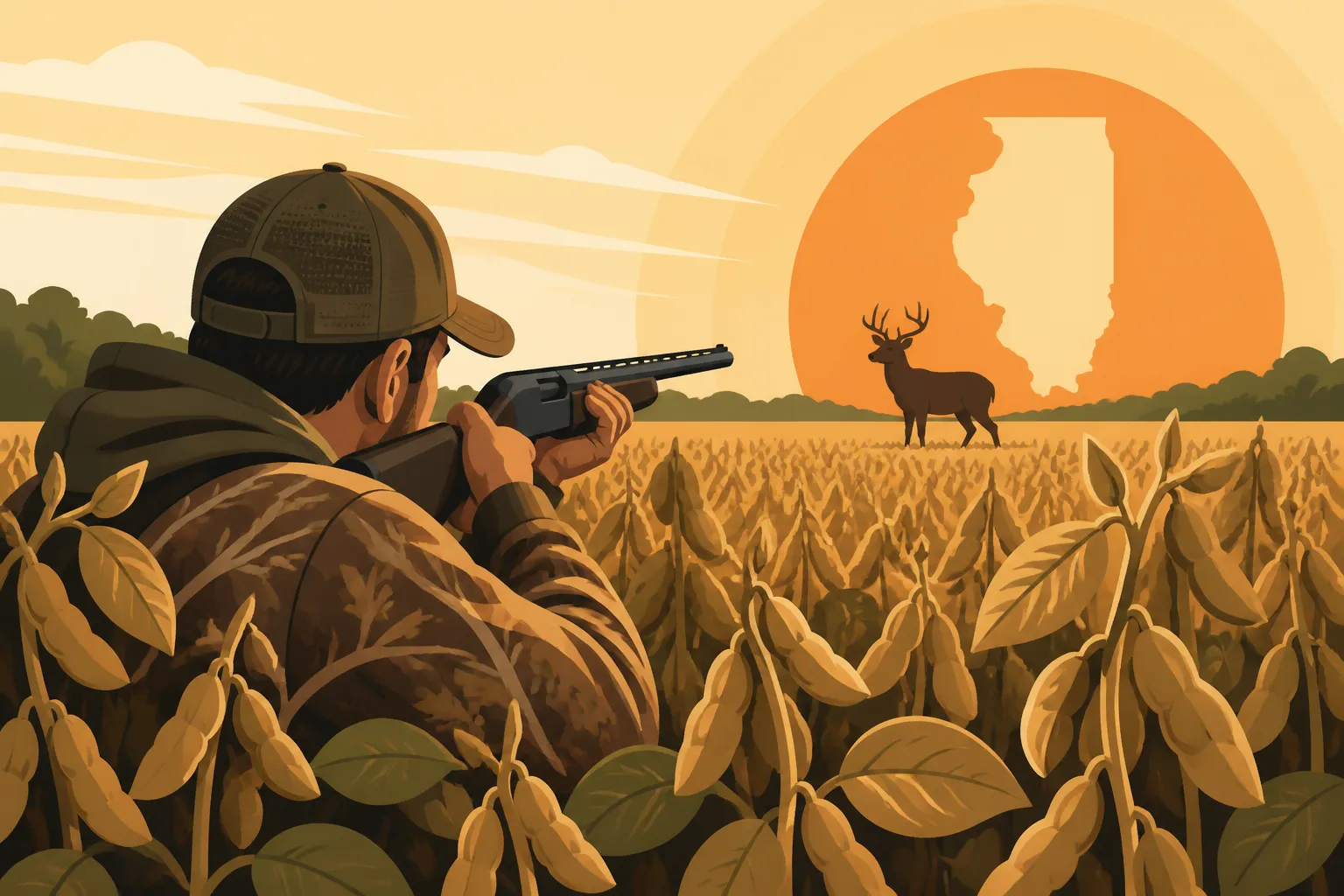
Hunting deer in standing soybean fields in Illinois can feel like a real puzzle. You know the deer are in there, often in huge numbers, seemingly vanishing into an ocean of green. It's frustrating when you've scouted the timber, hung your stand, and yet the deer are nowhere to be found, only to magically appear from the field just before dark. This guide is all about peeling back the layers of that mystery, helping you understand why deer use standing soybeans and, more importantly, how to effectively hunt them through the season.
Understanding Deer Behavior in Standing Soybeans
Those tall, lush green walls of soybeans aren't just a buffet for whitetails; they're a five-star hotel with all the amenities. Deer, being creatures of comfort and survival, find everything they need within these vast agricultural landscapes, making them notoriously challenging to hunt if you don't understand their patterns.
Why Deer Love Standing Beans
Imagine being a deer: you're constantly seeking food, cover from predators, and a comfortable place to bed down, especially when the sun is beating down or a cold wind is blowing. Standing soybeans offer all of this in spades. From late summer into the fall, as the beans mature, they provide an incredibly rich, high-protein food source that deer absolutely crave. This isn't just a snack; it's a critical part of their diet, especially for bucks packing on weight for the rut and does supporting fawns.
Beyond the nutrition, the sheer density and height of standing soybean plants create an almost impenetrable fortress. A mature soybean field can easily reach waist or even chest height, allowing deer to move, bed, and browse completely undetected. This cover offers thermal regulation too; on hot days, the shade of the canopy keeps them cool, and on windy days, it provides a buffer against the elements. It’s no wonder they spend so much time tucked away in there. It's safe, it's comfortable, and dinner is always served.
Daily Patterns and Movement Within the Beans
Deer aren't just randomly wandering through standing beans. They establish routines, just like they would in a thick timber block. Inside these fields, they create intricate networks of trails, forming what hunters often call "deer highways." These aren't always easy to spot from the outside, but they exist. Deer will bed deep within the field during daylight hours, often in dense patches where the plants are tallest or where there's a slight depression in the terrain. From these bedding areas, they'll make short forays to feed, always staying within the protective shroud of the beans.
As evening approaches, their movement often becomes more pronounced. They'll start pushing towards the edges, making their way to the perimeter of the field or transitioning into adjacent woodlots, creek bottoms, or fence rows. Conversely, in the morning, they'll often feed aggressively on the edges before the sun gets too high and then retreat back into the safety of the beans, sometimes not emerging until well after dark. Understanding these ingress and egress points, and the trails connecting them, is key to intercepting these elusive animals.
Scouting Strategies for Standing Soybean Fields
Scouting standing soybeans requires a slightly different approach than typical timber scouting. You can't just walk through them without disturbing deer, especially during hunting season. It demands patience, keen observation, and often, a reliance on technology to piece together the puzzle.
Glassing and Observation
This is your most powerful tool when dealing with standing beans. Early mornings and late evenings are prime times to observe deer activity. Find a vantage point that gives you a wide, unobstructed view of the field. This might be a nearby hill, a grain bin, or even a public road where you can safely pull over. Bring a good pair of binoculars or a spotting scope – the more magnification, the better. Look for movement along the field edges, especially where the soybeans meet a wood line, creek, or property boundary.
Pay close attention to where deer enter and exit the field. Are they using a specific corner? Is there a narrow pinch point where the field necks down? Do they seem to emerge from a particular dense section? These observations over several days can reveal consistent patterns. Sometimes, you'll spot deer browsing deeper within the field, giving away their general location. This is also a great time to evaluate the health of the deer herd you're hunting; are there many does and fawns, or are you seeing mature bucks?
Edge Scouting and Sign
While you can't easily scout the interior of a standing soybean field, the edges are fair game. Walk the perimeter of the field, looking for fresh tracks, rub lines, and scrape activity. Deer frequently use the transitional areas between the field and adjacent cover, such as a fencerow or a small woodlot, as travel corridors. Look for heavily used trails entering or exiting the beans. These trails will often be matted down, sometimes even forming tunnels through the lower branches of bordering vegetation.
Focus on corners, bottlenecks, and any irregular features of the field. A point where the woods juts out into the beans, or a low spot that holds water, can concentrate deer movement. Check the branches of trees along the edge for rubs, indicating bucks are working these boundaries. Fresh scrapes can be a goldmine, showing active buck presence. If you find multiple signs converging on a specific entry point into the beans, you’ve likely found a primary travel route. Just be mindful of your scent and disturbance when you’re on the ground scouting; a quick, focused walk is usually best.
Using Technology to Your Advantage
In today's hunting world, digital maps are invaluable, and they're particularly useful when you're trying to dissect a large, uniform standing soybean field. Platforms like GoHunt, for example, offer detailed aerial and topographic maps that can highlight subtle terrain changes, hidden waterways, or small pockets of timber that might otherwise go unnoticed. What looks like a flat, uniform field from the ground might reveal a slight ridge, a low-lying wet spot, or a finger of cover that extends into the beans on a satellite image. These features are often magnets for deer.
Use these maps to identify potential bedding areas deep within the field that are adjacent to thicker cover, or travel routes that parallel a creek. You can mark specific entry and exit points you've observed during glassing sessions, helping you visualize the deer's larger movement patterns. Look for isolated trees, old homesteads, or even standing water sources that might be hidden within the field – these can be focal points for deer activity. Overlaying different map layers, such as public vs. private land boundaries, can also help you understand how deer might be moving across different properties, especially if you're trying to gain access or avoid trespassing. Sometimes, a subtle dip in elevation visible on a topo map can indicate a natural drainage or swale that deer use as a hidden travel route, even through seemingly flat beans.
Effective Hunting Tactics for Standing Soybeans
Once you've done your scouting homework and understand the general movement patterns of deer in and around standing soybean fields, it's time to put those insights into action. The tactics you choose will largely depend on the specific features of the field, the surrounding cover, and, crucially, the wind direction.
Stand Placement for Field Edges
Hunting the edges of standing soybean fields is often the most successful strategy. Deer are creatures of the edge, and they rely on the security of the cover while still wanting access to the food. When setting up a treestand, focus on pinch points where deer movement is naturally funneled. This could be a narrow strip of woods between two fields, a fence row that terminates at a timber block, or a creek crossing that deer use to enter or exit the beans. Consider the sun's position – you don't want to be silhouetted or have the setting sun in your eyes.
Wind direction is paramount. Deer will almost always approach a feeding area with the wind in their favor, or quartering to them, allowing them to scent-check the area ahead. Position your stand so your scent cone blows away from where you expect deer to approach and feed. Often, this means setting up on the downwind side of a known entry point. Look for mature trees that offer good concealment and a clear shooting lane into the field and along the travel corridor. Being patient is key here; deer might emerge cautiously, browsing just inside the beans before fully committing to the open edge. For more specific guidance on this, you might find valuable information in our guide on Setting Up on a Central Illinois Field Edge.
Ground Blind Setups
Sometimes, a treestand just isn't feasible or practical. Maybe there aren't suitable trees, or the wind is constantly swirling, making an elevated position risky. This is where a well-placed ground blind can shine. The beauty of a ground blind is its versatility and the ability to set it up quickly, sometimes even deep within the standing soybeans if you can sneak in undetected. While hunting the interior of the beans is generally discouraged due to disturbance, a strategically placed blind along a deep finger of cover or a small island of timber within a large field can be incredibly effective.
When setting up a ground blind on the edge, brush it in thoroughly. Make it look like part of the natural landscape. You want deer to completely ignore it. Pay attention to shooting lanes; you'll need clear lines of sight through the vegetation. Inside the beans, consider setting it up along a known deer trail or near a subtle terrain feature. Again, wind is crucial. You'll be closer to the ground, so your scent will travel lower. Always play the wind. Ground blinds offer excellent concealment, making them ideal for new hunters or those who struggle with movement in a treestand. Learn more about effective concealment in our guide on Using a Ground Blind on Illinois Public Land.
Still-Hunting the Edges
While sitting and waiting is a popular tactic, still-hunting the edges of a standing soybean field can also be productive, especially during the middle of the day or if you're trying to locate a buck that seems to be bedding just out of sight. This requires extreme patience, stealth, and a thorough understanding of the wind. Walk slowly, taking a step or two, then pausing for several minutes to scan the field, the treeline, and any openings. Use your binoculars constantly. Look for horizontal lines (a deer's back) in a vertical world (the bean stalks).
Focus on areas where the field edge offers varied terrain or pockets of thicker cover. Deer might be bedded just inside the tree line, or in a small thicket that borders the beans. Your goal isn't to walk briskly, but to move so slowly and deliberately that you don't spook any deer, hoping to catch one unaware or spot one before it sees you. This tactic is particularly effective if you have a slight crosswind, allowing you to scent-check in front of you while your own scent drifts to the side. It's a challenging but rewarding way to hunt, demanding a hunter's full attention to every rustle and shadow.
Timing Your Hunt: When Soybeans are Most Productive
Knowing how to hunt soybeans is only half the battle; knowing when to hunt them is equally important. The attractiveness of standing soybeans to deer changes throughout the season, influenced by their maturity, harvest schedules, and weather patterns.
Early Season Opportunities
As Illinois's archery season kicks off, typically in October, standing soybeans are in their prime. The plants are tall, green, and lush, providing maximum cover and a readily available food source. This early season period can be incredibly productive, especially during the first few weeks before significant hunting pressure sets in. Deer are often less nocturnal, moving earlier in the afternoons and later in the mornings as they transition to and from their bean-field sanctuaries.
During this time, focusing on morning hunts can be very effective as deer are leaving the fields, heading back to their primary bedding areas in the timber. Evening hunts, conversely, are ideal for catching deer as they emerge from the beans to feed. Look for fields that are adjacent to dense bedding cover or water sources. The deer herd's behavior is often more consistent and predictable when the beans offer both food and security. Remember to keep an eye on the long-term forecast; a sudden cold snap can really get deer on their feet. If you’re planning your early season strategy, consider reading up on When Illinois's Archery Season Opens to align your efforts with the season's start.
Late Season and Harvest Dynamics
The late season brings significant changes to soybean fields. As November rolls into December, many farmers in Illinois will begin harvesting their crops. This is a game-changer for hunting standing beans. Once a field is cut, it instantly loses its primary function as dense cover. Deer that were once hidden deep within the field are now exposed and will quickly relocate to the nearest available security cover – timber blocks, CRP fields, creek bottoms, or thickets. However, the cut stubble still offers residual beans, making it a viable food source, particularly after a rain or light snow.
The period immediately after harvest can be excellent for hunting. Deer will be concentrated in the remaining cover, and they'll still visit the cut fields to glean any remaining soybeans. Your focus should shift to the edges of the cut fields and the dense cover surrounding them. This is also a fantastic time for scouting, as deer trails and activity, once hidden by the tall beans, become glaringly obvious in the bare stubble. You can identify historical travel routes, rub lines, and bedding areas that were previously invisible. For more on how food sources change, see our article on Late-Season Food Sources for Illinois Whitetails.
Weather Considerations
Weather plays a massive role in how deer use standing soybean fields. On hot, sunny days, deer will often bed deeper within the fields, seeking shade and cooler temperatures within the canopy. They might not emerge until well after sunset, making them difficult to hunt. During these conditions, focus your efforts on the coolest parts of the day – dawn and dusk – or try to identify shaded travel corridors leading to the beans.
Conversely, a cold front, especially one accompanied by precipitation, can really get deer moving. A light rain can mask your approach and dampen sound, making still-hunting more effective. A significant temperature drop will often stimulate deer to feed more aggressively, leading to increased movement both within and around the fields. Heavy winds, however, can make deer skittish and unpredictable. They often seek sheltered areas, so fields bordered by dense timber might see less activity, while those with deep, sheltered pockets within the beans might become preferred bedding sites. Always check the forecast and adjust your strategy accordingly. GoHunt's detailed weather forecasts can be extremely helpful for planning your hunt around these conditions.
| Season Phase | Soybean Status | Deer Behavior | Hunting Strategy Focus |
|---|---|---|---|
| Early Archery (Oct) | Green, lush, full canopy | Bedding & feeding deeply within; consistent edge movement | Edge stands for evening/morning transitions; glassing |
| Mid-Archery (Nov) | Yellowing, dropping leaves, some harvest begins | Still using for cover/food, but may transition to hard mast | Edge stands, focus on funnels to adjacent timber |
| Late Season (Dec/Jan) | Mostly harvested; stubble fields | Relocating bedding to dense cover; gleaning cut fields for remaining beans | Hunting adjacent thickets, pinch points, still-hunting cut field edges |
Hunting standing soybean fields requires patience, keen observation, and adaptability. Deer are incredibly adept at utilizing these agricultural resources for their survival, and understanding their patterns within these unique environments is the key to consistent success in Illinois.
Disclaimer
Hunting is an inherently dangerous activity. Always prioritize safety, understand and follow all local, state, and federal hunting regulations, and ensure you have the appropriate licenses and permits. The information provided in this guide is for educational purposes and should not replace proper hunter education or professional guidance. Be aware of your surroundings, know your target and what is beyond it, and never hunt without proper preparation and safety measures.