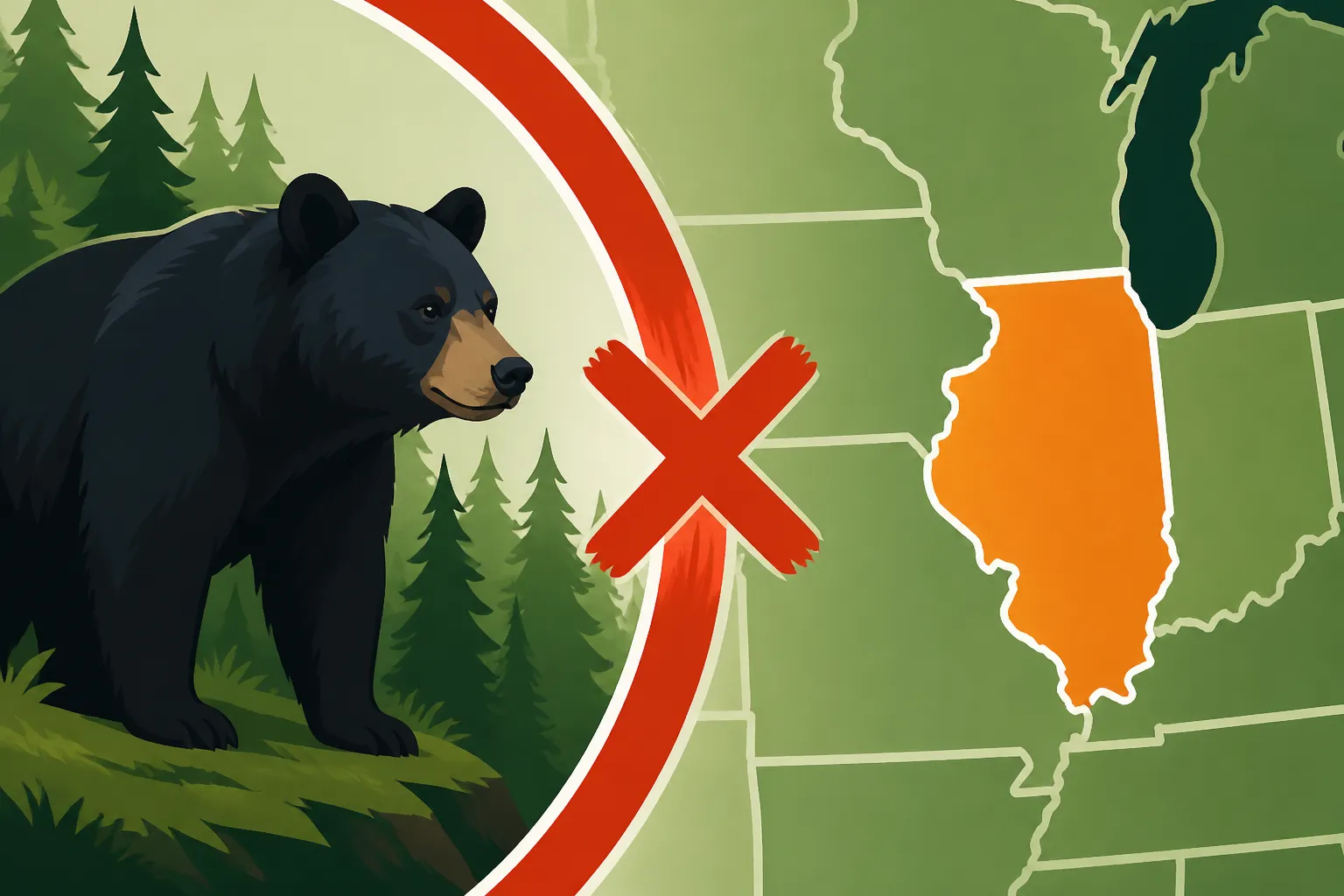
Why Black Bears Rarely Reach Illinois
It's a question many of us who spend countless hours in the Illinois woods have pondered: why don't we see black bears more often? There's a certain wild mystique to these magnificent creatures, and while we might catch glimpses of their cousins, the deer and turkey, on nearly every outing, a true bear sighting feels like an almost mythical event. The reality is, while black bears do occasionally wander into Illinois, they're not establishing a resident population, and it leaves many hunters and wildlife enthusiasts scratching their heads. This guide will dive deep into the fascinating history, ecological challenges, and current realities that explain why these majestic animals rarely make a permanent home in the Land of Lincoln.
Illinois's Bear History: A Look Back in Time
To truly understand why black bears are so scarce in Illinois today, we need to rewind the clock. Our state wasn't always the agricultural powerhouse it is now; it was once a vast expanse of prairie and dense forests, prime habitat for a diverse array of wildlife, including black bears.
Pre-Settlement Abundance
Before European settlement transformed the landscape, Illinois was home to a healthy population of black bears. Imagine the thick, untouched bottomlands along the Mississippi and Illinois Rivers, the expansive hardwood forests in what is now southern Illinois, and even scattered timber blocks across the central and northern prairies. These were ideal environments for black bears to thrive. They had abundant food sources—acorns, berries, roots, insects, and small game—and plenty of dense cover for denning and raising cubs. Historical accounts from early explorers and settlers often mention encounters with bears, a testament to their presence throughout the state. It was a different Illinois, a wilder Illinois, teeming with species that have long since vanished or become rare within our borders.
Extirpation and Habitat Loss
The story of the black bear in Illinois is, unfortunately, a familiar one for many large North American mammals. As settlers moved in, they brought with them a drastic transformation of the land. Forests were cleared for agriculture, prairies were plowed under, and wetlands were drained. This rapid habitat destruction was the primary driver of the black bear's decline. Bears need large, contiguous tracts of wilderness to roam, feed, and reproduce without constant human interaction. Illinois's conversion to a largely agricultural state, with fragmented woodlots and intense farming practices, simply eliminated the vast, undisturbed habitat they required.
Beyond habitat loss, direct persecution played a significant role. Bears were often seen as a threat to livestock and crops, and hunting them was unregulated and often encouraged. Between the loss of their homes and relentless hunting pressure, black bear populations dwindled rapidly. By the late 1800s, black bears were effectively extirpated from Illinois—meaning they no longer existed as a breeding population within the state. This wasn't a slow fade; it was a dramatic disappearance that reshaped the natural heritage of our state. The landscape we know today, dominated by corn and soybean fields, is a far cry from the wild forests where bears once roamed freely.
The Modern Illinois Landscape: Not Bear-Friendly Anymore
Even with some areas of reforestation and wildlife management efforts, modern Illinois simply isn't conducive to a thriving black bear population. The challenges they face here are fundamental, rooted in the very structure of our environment and human presence.
Habitat Fragmentation and Human Density
Imagine being a bear, trying to find a home. You need space, privacy, and a sense of security. In Illinois, finding such a place is incredibly difficult. Our state is one of the most intensely farmed regions in the world, with vast stretches of cropland broken up by towns, roads, and scattered woodlots. This creates what biologists call "habitat fragmentation." For a bear, this means that even if a nice patch of woods exists, getting to it safely often requires crossing miles of open fields, highways, or even suburban areas.
These journeys are perilous. Roads pose a huge threat, leading to vehicle collisions that are often fatal for large animals. Human density also presents a problem. While bears can and do adapt to living near people in some areas, the sheer number of houses, farms, and human activities in much of Illinois means constant potential for conflict. A bear seeking food might wander into a backyard, causing alarm and often leading to its removal or relocation. The ability to move freely and find undisturbed denning sites is paramount for bears, and Illinois, unfortunately, offers precious little of that. Even large public lands like the Shawnee National Forest Hunting in southern Illinois, while invaluable, are often surrounded by private land and intersected by roads, making them less isolated than a bear might prefer for long-term residency.
Food Sources and Denning Sites
While Illinois certainly has food, it's not always the right kind or distribution for a self-sustaining bear population. Bears are omnivores, meaning they eat a wide variety of foods. Their natural diet includes acorns, hickory nuts, berries, roots, insects, honey, and sometimes carrion or small mammals. Illinois has many of these, especially in our wooded river bottoms and hill country. However, the sheer quantity and consistent availability of these natural food sources in large, undisturbed areas are often lacking.
Agricultural crops, like corn and soybeans, might seem like an endless buffet, but relying on them can lead to problems. First, they are seasonal. Second, feeding on crops brings bears into direct conflict with farmers, resulting in damage complaints and potentially lethal deterrents.
Crucially, bears also need secure denning sites for their winter slumber and for sows to give birth and raise cubs. This means large hollow logs, dense brush piles, rock crevices, or undisturbed underground burrows. In highly managed or fragmented woodlands, these natural denning opportunities can be scarce. A bear might find a temporary den, but a female needs a safe, secluded spot to successfully raise cubs, and the consistency of such sites across the state is simply not there. Without adequate, consistently available natural food sources and safe denning locations, it's incredibly challenging for bears to establish a breeding population, even if individual wanderers do make it into the state.
Where Do Visiting Bears Come From: Neighboring State Populations
Despite the inhospitable nature of Illinois for a resident bear population, we do occasionally see bears. These animals are almost always "transient" individuals, meaning they are passing through, often young males dispersing from established populations in neighboring states. Understanding where these bears originate helps us grasp the dynamics of their rare visits.
Missouri's Expanding Bear Population
Perhaps the most significant source of black bear wanderers into Illinois is our neighbor to the southwest, Missouri. The Missouri Department of Conservation (MDC) has documented a remarkable resurgence of black bears in the southern part of their state, primarily in the Ozark Mountains. These bears are descendants of animals that survived in remote areas of Missouri and Arkansas. Their population has been steadily growing and expanding its range, which is fantastic news for wildlife in that region.
As bear populations grow, young male bears, in particular, will naturally disperse to find new territories, mates, and food sources. This dispersal often leads them north and east. The Mississippi River, which forms Illinois's western border, can act as both a highway and a barrier. While swimming a wide river is a significant feat, it's not impossible for a determined bear. When a bear crosses the Mississippi from Missouri into western Illinois, it's often a young male seeking its fortune, unwittingly entering a landscape far different from its Ozark home. These individuals are often the ones reported in counties like Calhoun, Pike, or Adams, making headlines before they either turn back, move on, or unfortunately, succumb to a vehicle collision.
Wisconsin's Established Northwoods Bears
To our north, Wisconsin boasts a healthy and well-established black bear population, primarily concentrated in the northern forests. While it's a longer and more challenging journey, bears from Wisconsin have also been known to wander south. Their dispersal routes typically follow timbered corridors and river systems.
A bear traveling from Wisconsin into Illinois would likely traverse northern Illinois, an area that, while having some significant natural areas, is also highly populated and agriculturally intensive. This makes such a journey incredibly difficult and dangerous for the bear. The further south they go, the more fragmented the habitat becomes, increasing the likelihood of human encounters and road fatalities. While less frequent than incursions from Missouri, a northern Illinois bear sighting could potentially trace its origins back to the Badger State's robust population. These travels highlight the incredible resilience and exploratory nature of black bears, even when faced with daunting challenges.
Indiana's Occasional Visitors
East of Illinois, Indiana also experiences occasional black bear sightings, though it does not have a resident breeding population either. Most of Indiana's bear sightings are believed to be individuals dispersing from Michigan's Lower Peninsula or, less commonly, from Kentucky or Ohio.
The likelihood of a bear from Indiana successfully crossing the heavily fragmented and urbanized Illinois-Indiana border, and then traversing the breadth of Illinois, is even lower than those from Missouri or Wisconsin. However, it's not entirely out of the question. Bears are opportunistic and can cover vast distances. While most of our occasional sightings come from the Missouri or Wisconsin direction, the possibility of an eastern wanderer underscores that Illinois's Occasional Black Bear Wanderers are truly unique individuals on incredible journeys. These scattered sightings from all directions simply reinforce that Illinois is on the periphery of existing bear ranges, not within a core habitat.
The Journey to Illinois: Challenges and Corridors
For a black bear to reach Illinois, it undertakes a truly epic journey, often fraught with danger. Understanding these travel routes and the obstacles involved helps paint a clearer picture of why these sightings are so rare.
River Systems as Travel Routes
Rivers are often described as "wildlife highways," and for black bears, this can certainly be true. The Mississippi River, in particular, acts as a significant potential corridor for bears dispersing from Missouri. Bears are excellent swimmers, and crossing a river, even one as mighty as the Mississippi, is well within their capabilities. Once on the Illinois side, these bears might continue to follow the timbered river bottoms, moving deeper into the state. The Illinois River system, another major waterway with associated woodlands, could also theoretically serve as a travel path, albeit further removed from established bear populations.
These river corridors offer some of the most continuous patches of habitat in an otherwise fragmented landscape. They provide cover, some natural food sources, and access to water. For a bear navigating a strange territory, sticking to these linear features makes intuitive sense. However, even these corridors are not pristine wilderness. They are often bordered by farms, intersected by roads, and dotted with small towns. A bear following a river bottom might suddenly find itself at a bridge, a lock and dam, or a crowded recreation area, presenting significant challenges and increasing the risk of detection or conflict. While rivers facilitate travel, they don't guarantee safe passage. We've seen how important river systems are for other species, such as Illinois Waterfowl on the Mississippi Flyway, but bears have different, more restrictive needs for continuous habitat.
Navigating Agricultural Land and Roads
Once a dispersing bear leaves the immediate cover of a river bottom, it enters the quintessential Illinois landscape: vast stretches of agricultural fields. For a large, shy animal like a black bear, this is a daunting environment. Open fields offer no cover from human detection, no escape routes, and no significant natural food sources. A bear attempting to cross these areas is exposed, vulnerable to detection by farmers, and at high risk of vehicle collisions on the numerous roads that crisscross the state.
The patchwork nature of Illinois's remaining woodlands means that a bear traveling any significant distance will inevitably have to cross these open, human-dominated landscapes. This exposure is perhaps the biggest deterrent to bears establishing a permanent presence. Even if a bear manages to navigate one large field, it then faces another, and another, interspersed with towns and highways. This constant gauntlet of human activity makes it incredibly difficult for a bear to find the continuous solitude and safety it requires. It's why most sightings are isolated incidents, with bears either quickly moving on, turning back, or unfortunately, being struck by vehicles. The challenges of moving through such a landscape are immense, and for most bears, it's a journey too dangerous to complete successfully for long-term survival. For hunters using tools like GoHunt to scout for deer, they might identify fragmented woodlots, but for a bear, these small islands of cover are often too isolated.
Illinois's Wildlife Management Stance on Bears
Given the occasional sightings, the Illinois Department of Natural Resources (IDNR) does have a protocol for managing black bears. Their approach is rooted in conservation, public safety, and an understanding of the bear's status in the state.
No Open Season and Protective Status
It's crucial for every hunter and outdoor enthusiast in Illinois to understand that black bears are a protected species in our state. This means there is absolutely Why Illinois Bears Have No Open Season, and taking or harming a black bear is illegal and carries significant penalties, as outlined in discussions about Illinois Wildlife Violation Penalties. While some neighboring states have hunting seasons, Illinois does not, and that's largely due to their rarity and their non-resident status.
The IDNR treats black bears as a state-threatened or endangered species, even if they aren't officially listed as such in all categories. This protective stance reflects their extirpated status and the fact that any bear in Illinois is likely a transient, not part of a stable, breeding population. The focus is on allowing these wanderers to move through unimpeded, unless they pose a direct threat to human safety or property. This policy aims to minimize human-bear conflict while recognizing the bear's vulnerable status in the state. For hunters, knowing this is a key part of our Illinois Hunter Education Requirements – respecting all wildlife and understanding the laws that protect certain species.
Monitoring and Public Safety Protocols
When a black bear is sighted in Illinois, the IDNR actively monitors the situation. This isn't just about curiosity; it's a critical part of ensuring public safety and the bear's welfare. IDNR wildlife biologists and conservation police will investigate credible sightings. They collect data on the bear's location, movement, and behavior. This monitoring helps them understand potential travel corridors and assess any risks.
The primary concern is always public safety. While black bears are generally shy and avoid humans, any large wild animal can be dangerous if habituated to human food or if feeling threatened. If a bear becomes a nuisance—repeatedly getting into garbage, approaching homes, or showing aggressive behavior—the IDNR may intervene. This intervention could involve hazing the bear to encourage it to move on, trapping and relocating it to a more suitable, less populated area, or in very rare and extreme cases where public safety is at immediate risk, euthanasia. The goal is always to encourage the bear to move out of human-dominated areas and back into more wild spaces, if possible. The monitoring efforts are similar in principle to how the IDNR works to How IDNR Counts the Illinois Deer Herd, albeit on a much smaller scale due to the rarity of bears.
What to Do If You Spot a Bear in Illinois
A black bear sighting in Illinois is a rare and exciting event, but it's important to react appropriately to ensure both your safety and the bear's well-being. Panic or inappropriate actions can lead to negative outcomes for everyone involved.
Safety First: Observing From a Distance
If you are lucky enough to encounter a black bear in Illinois, the absolute first rule is to keep your distance. Do not approach the bear, even if it appears calm or small. Black bears are wild animals, and their behavior can be unpredictable. Maintain a safe distance, generally at least 100 yards (the length of a football field), and never get between a sow and her cubs.
When observing, make yourself known by talking in a calm voice. If the bear hasn't seen you, back away slowly while continuing to speak. If the bear notices you, stand your ground, make yourself look as large as possible (wave your arms, open your jacket), and continue to speak firmly. Do not run, as this can trigger a chase response. Most black bears will be more afraid of you than you are of them and will likely retreat. Keep pets on a leash and under control, and never allow them to approach or harass a bear. Remember, the goal is to allow the bear to move on undisturbed, without becoming habituated to human presence or perceiving a threat. This is sound advice for any unexpected wildlife encounter, whether it's a bear or any other large animal.
Reporting Sightings to IDNR
After ensuring your safety and observing the bear from a distance, the next critical step is to report the sighting to the Illinois Department of Natural Resources (IDNR). This information is incredibly valuable for their monitoring efforts and helps them track these rare wanderers.
When reporting, provide as much detail as possible: the exact location (cross streets, landmarks, GPS coordinates if you have them), the time of day, a description of the bear (size, color, any distinguishing marks), its behavior (what it was doing), and its direction of travel. If you can safely take a photo or video from a distance, that can be extremely helpful for verification, but never compromise your safety for a picture. You can typically find contact information for the IDNR on their website or by calling local conservation police. Reporting helps state wildlife officials understand bear movements and allows them to assess if any public safety measures need to be taken. It's similar to reporting a sick or injured animal through the Reporting a Sick Animal in Illinois protocol, where accurate information is key to proper response.
Could Bears Return to Illinois Permanently?
It's a question many ask, especially as we see species like the Illinois River Otter Recovery making a comeback: could black bears ever re-establish a breeding population in Illinois? It's a complex issue with no easy answers.
Habitat Restoration and Connectivity Challenges
For black bears to return and thrive in Illinois, they would need significant, contiguous tracts of suitable habitat. This means large forests with diverse food sources and denning sites, all far removed from intense human development. While Illinois has made great strides in some areas of conservation and habitat restoration, particularly along our major rivers and in our southern hill country, creating truly vast, interconnected wilderness areas on a scale large enough for bears is an immense challenge.
Consider the ongoing efforts to manage challenges like Illinois's Chronic Wasting Disease Zone in our deer herd, which requires extensive land management and monitoring. Re-establishing habitat for bears would be an even larger undertaking. The fragmentation of our landscape, with agricultural lands and urban sprawl, makes it incredibly difficult to connect existing patches of woods into the kind of expansive range a bear needs. Land values are high, and the economic pressures to maintain agriculture are strong. While efforts to improve habitat for deer, turkey, and other species indirectly benefit bears, these improvements often don't address the scale or connectivity issues fundamental to a bear's needs. The idea of large-scale rewilding or creation of vast, protected corridors faces significant social, economic, and political hurdles.
Natural Dispersal Versus Reintroduction
So, if habitat is the issue, what about the bears themselves? Could a natural return happen, or would it require human intervention? Currently, the IDNR's stance is to allow natural dispersal. If bears can make it here on their own and find suitable habitat to establish a breeding population, that's preferred. The occasional wanderers we see are proof that natural dispersal is indeed happening from neighboring states.
However, for a breeding population to take hold, more than just a few individuals are needed. You need both males and females, and they need to find each other and establish territories without encountering insurmountable obstacles. This is where the sheer difficulty lies. While Missouri and Wisconsin's populations are expanding, the intervening landscapes of Iowa, northern Illinois, and central Illinois are formidable barriers.
A formal reintroduction program, where bears are deliberately trapped and released into Illinois, is not currently on the IDNR's agenda. Such programs are incredibly complex, expensive, and require extensive public buy-in, as they would inevitably lead to increased human-bear interactions and potential conflicts. For now, Illinois remains a state where black bears are rare, fascinating visitors, rather than permanent residents. While the dream of seeing a wild bear become a common sight in Illinois might remain just that for many of us, understanding their challenges helps us appreciate the truly wild spirit of these incredible animals when they do venture into our unique landscape. Perhaps one day, with continued conservation efforts and shifting land use, the balance might change.
Table: Illinois vs. Ideal Black Bear Habitat
To illustrate the challenges, here's a quick comparison of what black bears ideally need versus what much of Illinois currently offers:
| Habitat Feature | Ideal Black Bear Habitat | Illinois's Current Landscape (General) | Impact on Bear Presence |
|---|---|---|---|
| Forest Cover | Vast, contiguous, undisturbed forests (deciduous, mixed) | Fragmented woodlots, riverine timber, largely surrounded by fields | Limited safe travel, lack of deep seclusion, increased exposure |
| Food Sources | Abundant, diverse natural mast crops (acorns, berries), insects, seasonal fruits | Abundant agricultural crops (seasonal, conflict-prone), some natural mast | Reliance on human-derived food leads to conflicts; natural foods inconsistent over large areas |
| Denning Sites | Hollow logs, dense thickets, rock caves, brush piles in remote areas | Scarce in large, undisturbed quantities, limited natural features | Difficulty finding safe, secluded wintering and cub-rearing spots |
| Human Density | Low population density, minimal human infrastructure | High population density, extensive roads, farms, and towns | High potential for human-bear conflict, road mortality, disturbance |
| Water Sources | Plentiful streams, rivers, wetlands | Abundant, but often flanked by human activity and development | Can serve as travel corridors, but also points of conflict/exposure |
| Connectivity | Extensive, unbroken natural corridors for dispersal | Heavily fragmented by agriculture, roads, and urban areas | Severely limits successful dispersal and establishment of breeding populations |
This table clearly highlights the fundamental discrepancies between what bears need and what Illinois predominantly provides, making it evident why their presence is so rare.
Disclaimer
This article is for general informational purposes only and does not constitute professional advice. Laws, prices and regulations vary by location and change over time. Consult a qualified professional for guidance on your specific situation.