Setting Decoys on a Farm Pond
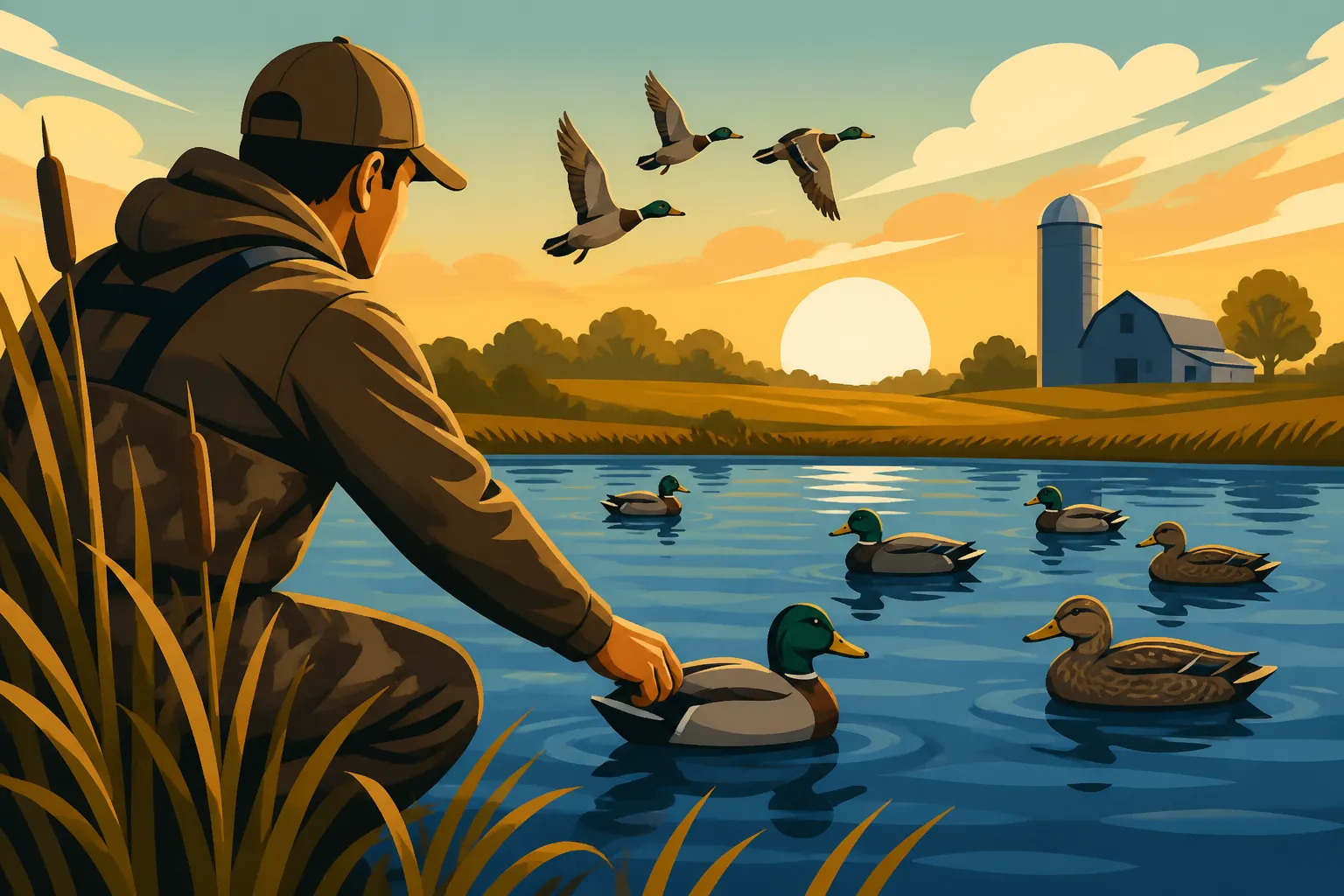
It’s a classic scenario: you’ve woken up before dawn, braved the cold, and meticulously placed your spread on a local farm pond, only to watch ducks flare off without a second glance. It’s enough to make you wonder if those decoys are just expensive lawn ornaments. The truth is, hunting ducks on farm ponds in Illinois presents unique challenges compared to larger bodies of water. This guide will dive deep into effective decoy strategies, helping you understand duck behavior, optimal spread patterns, and critical factors for success that will have those birds dropping in.
Understanding Farm Pond Dynamics and Duck Behavior
Hunting ducks on farm ponds isn't just about throwing out some blocks; it’s about understanding the specific dynamics of these smaller, often overlooked water bodies and how ducks interact with them. Farm ponds offer a different kind of sanctuary and sustenance than sprawling rivers or massive wetlands, and recognizing these nuances is your first step to a successful hunt.
Why Farm Ponds Attract Ducks
Farm ponds, despite their modest size, can be absolute magnets for waterfowl, particularly dabbling ducks like Mallards and Wood Ducks. Often, these ponds are nestled right in the middle of agricultural fields—corn, soybeans, or wheat—providing readily available waste grain for energetic birds. This proximity to food sources makes them ideal spots for ducks to loaf, feed, and rest without expending much energy on long flights. They also provide crucial shelter from strong winds that can buffet larger, more exposed water bodies, offering a calm haven during inclement weather. For a hunter, this means ducks using these ponds are often looking for comfort and food, which your decoy spread needs to reflect.
Beyond food and shelter, farm ponds can serve as important roosting spots, particularly in the morning or evening, or as a mid-day refuge. These smaller, often isolated ponds experience less hunting pressure than the major waterfowl highways like the Illinois River Valley, making them feel safer for wary birds. If you're seeing consistent duck activity on a particular pond, it's usually because it offers a combination of these critical elements, providing exactly what the birds need to survive and thrive during their migration through Illinois.
Reading the Water and the Wind
Successfully setting decoys on a farm pond hinges on your ability to read both the water itself and the prevailing wind conditions. Ducks, almost without exception, land into the wind. This fundamental behavior dictates your entire setup. You need to identify where ducks will naturally approach and land, creating a safe, inviting landing zone where they feel comfortable dropping in. If the wind is blowing from the north, for example, ducks will approach from the south and land facing north. Your blind should be positioned downwind of your decoy spread, with the landing zone upwind, ensuring incoming birds have their backs to you as they commit.
Beyond wind, consider the water depth and clarity. Farm ponds can vary wildly; some might have steep drop-offs, while others are uniformly shallow. Ducks won't land in extremely shallow water if they prefer deeper spots, and vice-versa. Clearer water means ducks might be more cautious if your decoys look unnatural, while turbid water can hide minor imperfections but also reduce visibility. Look for areas where ducks naturally dabble or loaf—these subtle clues often point to optimal decoy placement. Understanding these local conditions is far more effective than just dropping decoys wherever it's convenient. For more general insights into water conditions, you might find Reading a River Bottom Slough for a Morning Flight helpful, even if the scale is different.
Common Duck Species on Illinois Farm Ponds
Knowing which duck species are most likely to visit your Illinois farm pond helps you tailor your decoy spread for maximum appeal. Throughout much of Illinois, farm ponds are primarily frequented by dabbling ducks. Mallards are the kings of these waters, ubiquitous and often less wary than divers on smaller ponds. You’ll also commonly see Wood Ducks, especially in ponds with surrounding timber or wooded edges, as they often prefer these habitats. Early in the season, you might encounter various species of Teal, like Blue-winged and Green-winged Teal, making quick stops on their southward journey.
While less common, some farm ponds might attract small numbers of diving ducks like Ring-necked Ducks or Buffleheads, especially if the pond is deeper and larger. However, these are typically exceptions rather than the rule. Your decoy strategy should prioritize the species you're most likely to encounter. A spread dominated by Mallard and Wood Duck decoys, perhaps with a few teal mixed in during early season, will typically yield the best results. Having the right types of decoys creates a more convincing scene for the ducks you're actually trying to lure. If you're curious about broader migratory patterns, checking out Illinois Waterfowl Zones and Seasons can give you a better idea of what species you might encounter when.
Essential Decoy Spreads and Placement Strategies
Once you understand the basics of pond dynamics and duck behavior, it's time to put that knowledge into action with effective decoy spreads. The goal isn't just to have decoys floating; it's to create an illusion of safety, food, and social activity that ducks can’t resist joining.
The J-Hook or U-Shape Spread
The "J-hook" or "U-shape" spread is arguably the most versatile and effective pattern for hunting ducks on smaller farm ponds. The fundamental idea behind this spread is to create a clear, inviting "landing zone" for incoming ducks, positioning it directly in front of your blind, within comfortable shooting range. Ducks naturally want to land into the wind, so your "hook" or "U" should open up into the wind, guiding them right into that sweet spot.
Imagine the curve of the "J" or "U" forming a natural funnel. Your decoys create the "arms" of this funnel, with the bend of the hook or the base of the "U" being the farthest upwind point. As ducks approach, they see this open water as a safe, uncrowded area to descend. Place the bulk of your decoys along the downwind side of the landing zone, closest to your blind, with a few stragglers extending upwind to make the spread look natural and dynamic. This setup ensures that when birds commit and drop their feet, they are perfectly positioned for a clean shot. The density of decoys in the "J" or "U" can vary, but remember not to overcrowd a small pond; a less dense, natural-looking spread is often more convincing.
The Social Cluster or Loafing Spread
Sometimes, ducks aren't looking for a bustling feed; they're looking for a quiet place to rest, preen, and just be ducks. This is where the "social cluster" or "loafing spread" shines, particularly on pressured ponds or during the mid-day hours when feeding activity might be lower. This spread aims to mimic a group of contented ducks simply enjoying their surroundings, creating an atmosphere of safety and relaxation.
To set up a social cluster, place a handful of decoys (usually 6-12) in tight, natural-looking groups, rather than spreading them out widely. You might put three or four decoys near one bank, another small group a bit further out, and maybe a single "lone wolf" decoy off to the side, as if it's casually looking around. For added realism, incorporate feeder butt decoys or decoys with resting head positions. These subtle touches suggest that the ducks are comfortable and not on high alert. This spread works exceptionally well when you're targeting birds that have been wary from other hunting pressure or simply want a break from active foraging. It’s all about selling the illusion of a peaceful sanctuary, and for a smaller farm pond, this intimate setup can be incredibly effective.
Numbers Game: How Many Decoys Do You Really Need?
When it comes to farm ponds, many hunters make the mistake of thinking "more is always better" with decoys. On small water, however, this often isn't the case. Overcrowding a small pond with too many decoys can look unnatural and actually deter wary ducks. The "numbers game" for farm ponds is usually about quality over quantity, and striking the right balance for the size of the water you're hunting.
For typical Illinois farm ponds, which might range from a quarter-acre to a few acres, you'll rarely need more than a dozen decoys. In fact, often 6-8 well-placed decoys are far more effective than 24 haphazardly thrown out. A handful of realistic Mallard and Wood Duck decoys can create a much more convincing scene than a giant blob of cheap plastic. Think about what a natural group of ducks looks like on that specific pond; they aren’t typically packed in shoulder-to-shoulder unless it's a massive staging area. If you're dealing with a larger farm pond, say 5-10 acres, you might be able to stretch to 12-18 decoys, but always err on the side of looking natural. Brands like Avian-X or Dakota Decoy offer exceptional realism, with flocked heads and lifelike paint schemes that make a huge difference, especially on smaller, intimate waters where ducks get a closer look.
Here's a quick guideline for decoy numbers on Illinois farm ponds:
| Pond Size (Approx.) | Recommended Decoy Count | Primary Species Focus | Notes |
|---|---|---|---|
| Less than 1 acre | 4-8 | Mallard, Wood Duck | Focus on realism, tight groups, minimal motion. |
| 1-3 acres | 6-12 | Mallard, Wood Duck | J-hook/U-shape, incorporate a feeder or resting decoy. |
| 3-5 acres | 10-18 | Mallard, Wood Duck | Can add a few Teal, consider a subtle motion decoy on calm days. |
| 5+ acres | 15-24 | Mallard, Mixed Dabblers | Spread out slightly more, but maintain clear landing zones. |
Remember, the goal is to make your spread look like live ducks that are comfortable and safe. Too many decoys in a small space can make the pond look "full" or pressured, sending wary birds straight over the top.
Adding Realism and Movement to Your Pond Spread
Static decoy spreads can work, especially on a windy day when natural ripples provide movement. However, adding an element of realism and motion to your setup can be the difference between ducks flaring and ducks cupping their wings for a landing. On a small farm pond, this realism is even more critical, as ducks often get a closer, more scrutinizing look.
The Power of Motion Decoys
Motion decoys are game-changers, especially on calm days when your static blocks just sit there lifelessly. However, on a small farm pond, you need to use them judiciously. A full-speed spinning wing decoy might be perfect for attracting birds from a distance on a huge marsh, but on a 2-acre pond, it can look unnatural and spook wary ducks up close. Think subtle, natural movement rather than flashy theatrics.
Spinner Decoys: Brands like Mojo Outdoors and Lucky Duck make excellent spinning wing decoys. For farm ponds, consider models with adjustable speeds or even just using them intermittently. Sometimes, a spinner run for just a few minutes every 15-20 minutes is enough to catch attention without overdoing it. A single spinner positioned upwind of your landing zone can create a flash that draws distant birds, but be ready to turn it off as they get close.
Jerk Strings: These are a fantastic, cost-effective option for farm ponds. A simple cord rigged to a few decoys allows you to create realistic ripples and subtle head movement with a gentle tug from your blind. This movement mimics dabbling ducks, adding life to your spread without being overly aggressive.
Feeding Motion Decoys: These decoys simulate ducks actively feeding, dipping their heads into the water. They are incredibly realistic for dabblers and add a powerful visual cue that the spot is safe and food-rich. Brands like Rig'Em Right offer realistic floater and feeder decoys that enhance this effect.
The key is to create enough movement to suggest life without making the scene look like a disco party. A little goes a long way on smaller water, and natural-looking ripples often trump aggressive spinning wings.
Blending In: Blind Placement and Concealment
Even the most perfect decoy spread will fail if you're not properly concealed. On a farm pond, which often has less natural cover than larger wetlands, blind placement and meticulous concealment are absolutely critical. Ducks are incredibly perceptive, and any unnatural silhouette or glint will send them packing.
Your primary goal is to disappear into the landscape. Look for existing natural cover: stands of cattails, willow thickets, fencerows, or even large clumps of grass. If you're using a portable blind, like a pop-up ground blind or a layout blind (which is particularly effective in open fields near ponds, as discussed in Layout Blind Hunting Illinois Farm Fields), it is imperative to brush it in thoroughly. Don't just set it up; weave local vegetation into the blind material. Use corn stalks, dead weeds, tall grasses, whatever matches your surroundings. The more natural you look, the more confident ducks will be to commit.
Consider the sun angle: position your blind so that the sun is either at your back or to your side, preventing it from glinting off your face or gun. Also, be mindful of shadows. A prominent shadow cast across the water can be just as alarming to ducks as an uncamouflaged hunter. Scout your location during different times of the day to understand how light and shadows play out. Your ability to become invisible is just as important as your decoy spread in converting those high flyers into landing ducks.
Scouting is Key: Pre-Season and In-Season Observations
You wouldn't hunt deer without scouting, and the same goes for ducks on a farm pond. Pre-season and in-season scouting are paramount to success. Ducks are creatures of habit, and understanding their specific patterns on your pond will inform every decision you make about decoy placement and blind location.
Before the season even opens, take time to observe the pond. Where do ducks typically enter the pond? What are their preferred loafing areas? Do they favor a certain bank for feeding? Are there specific flight paths they consistently use to approach or depart? Tools like GoHunt can be incredibly valuable here, allowing you to mark observations on satellite maps, identify potential blind locations, and analyze surrounding habitat, such as cut cornfields or standing timber, that might influence duck behavior. You can pinpoint access routes that minimize disturbance to the pond.
Once the season starts, continue your observations. Duck behavior can change with weather, pressure, and food availability. A spread that worked perfectly last week might be ignored this week if a new cold front has pushed different birds through, or if hunting pressure has shifted their patterns. If ducks are consistently flaring at a certain spot, or if they’re landing just outside your decoys, it's a clear sign that your setup needs adjustment. Don’t be afraid to change your spread, move your blind slightly, or even pack up and try a different pond if the birds just aren't cooperating. This adaptability, honed through diligent scouting, is what separates consistently successful duck hunters from those who just hope for the best. For general scouting strategies, Scouting Illinois Public Land Before Season provides excellent foundational advice applicable to any hunting scenario.
Advanced Tips for Maximizing Pond Hunting Success
Beyond the fundamentals, there are always those extra layers of strategy that can really make your farm pond hunts sing. These advanced tips focus on finessing your approach, adapting to real-time conditions, and always prioritizing safety and legality.
Calling Techniques for Farm Ponds
Calling ducks effectively on a farm pond is a nuanced art, quite different from the aggressive, high-volume calling often heard on larger rivers or vast marshes. On small water, less is often more, and realism trumps raw decibel levels. The goal is to sound like a small, contented group of ducks, not a screaming flock trying to attract attention from miles away.
Start with soft, inviting greeting calls. A few subtle quacks, a chuckle, or a contented murmur can do wonders. If birds respond, you might offer a slightly louder comeback call, but avoid blowing long, drawn-out highballs unless ducks are very distant and high. The most effective calls on a pond are often feeding chuckles and soft, reassuring quacks that suggest everything is calm and safe. If ducks are committed and circling, often the best call is no call at all. Let your realistic decoy spread and natural movement do the final convincing. Overcalling can be a major mistake on a farm pond, making pressured birds suspicious and leading them to flare. Remember, these birds are often already close; you're just providing a final confidence boost, not trying to pull them out of another county.
Dealing with Changing Conditions
The weather in Illinois, especially during hunting season, is notoriously fickle. One morning can be calm and clear, the next brings driving rain or a sudden wind shift. Being able to adapt your strategy to these changing conditions is a hallmark of an experienced hunter. On a farm pond, these shifts can instantly render your carefully planned spread useless.
A sudden change in wind direction, for example, means your carefully crafted landing zone is now misaligned. Ducks will still land into the new wind, which might put them out of range or behind your blind. You need to be prepared to quickly adjust your decoy spread, even moving decoys mid-hunt if necessary, to re-establish an optimal landing zone. Similarly, if the pond becomes glassy-calm, consider activating your motion decoys more frequently or using a jerk string to create ripples that suggest life. Conversely, on very windy days, too much motion (like a fast-spinning spinner) can look unnatural, so you might opt for less mechanical movement and rely on the natural chop to move your floaters. A good practice is to always have a few extra decoy cords and weights handy, along with a pair of waders, so you can make quick adjustments. Understanding weather patterns, especially how a cold front can affect waterfowl movement, will give you an edge.
Legal Considerations and Safety
As with any hunting activity in Illinois, safety and adherence to regulations are paramount. Before you even set foot near a farm pond with your decoys, ensure you understand all applicable state and local laws, especially regarding waterfowl hunting. This includes possession of the necessary Illinois Hunting Licenses and What They Cost, including a valid hunting license, state habitat stamp, and federal duck stamp, as well as being HIP-certified for migratory birds.
Always identify your shooting lanes and be absolutely sure of your target and what lies beyond it. On small ponds, ducks often come in fast and low, so be acutely aware of your surroundings, especially if there are homes, roads, or livestock nearby. If you are hunting on private land, ensure you have explicit permission from the landowner. Trespassing laws in Illinois are strictly enforced. Remember that non-toxic shot is required for all waterfowl hunting, so double-check your ammunition. While blaze orange isn't typically required for waterfowl hunting in Illinois, it's always a good idea to wear it when moving to and from your blind for visibility to other hunters or landowners, especially during overlapping seasons. Knowing the Illinois Duck and Goose Bag Limits and season dates for your zone is also crucial to avoid any legal issues and ensure a responsible hunt.
Disclaimer
The information provided in this guide is for informational purposes only and is not a substitute for professional advice. Hunting regulations, seasons, and requirements can change. Always consult the most current Illinois Department of Natural Resources (IDNR) regulations and local ordinances before engaging in any hunting activities. Safety should always be your top priority.