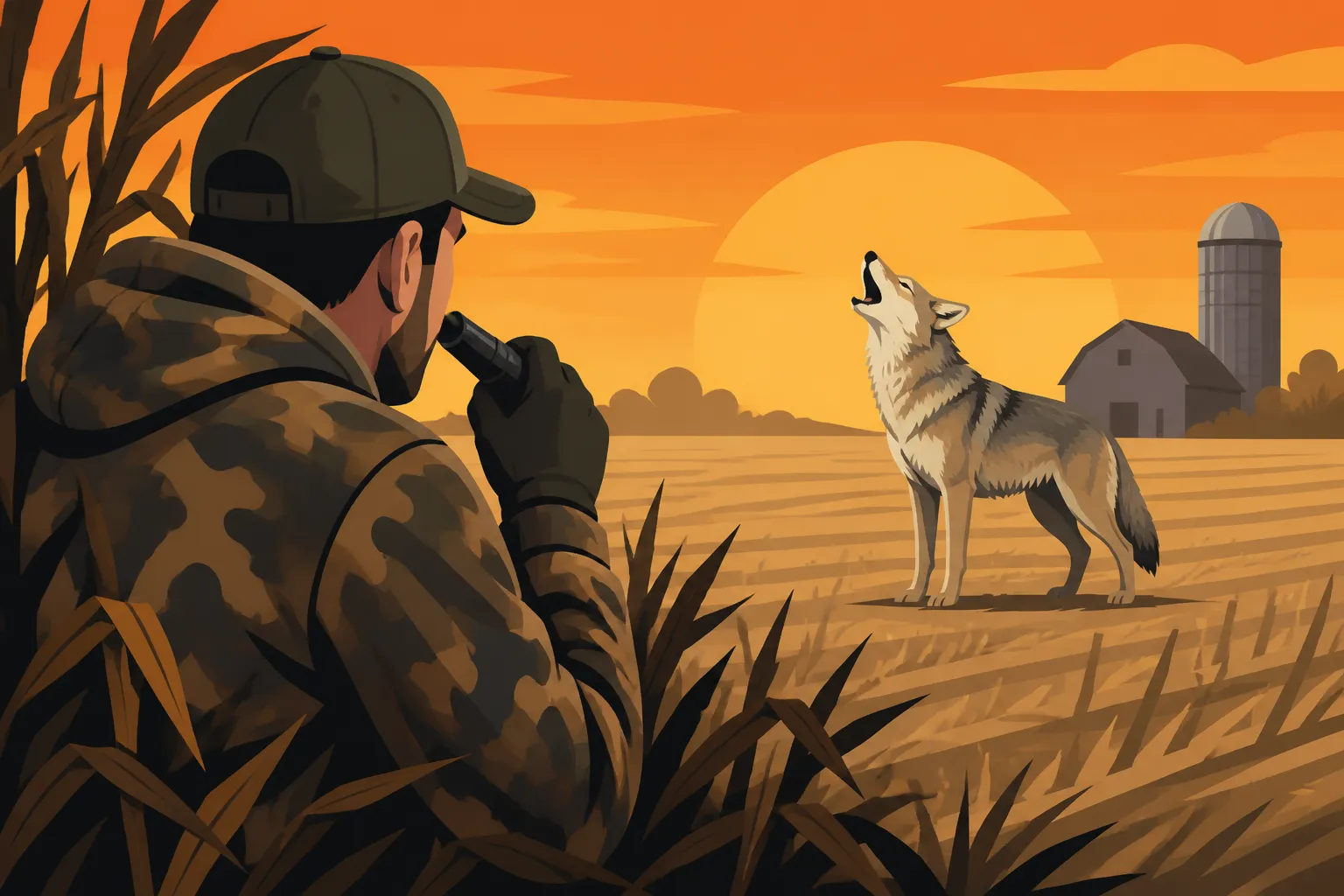
Coyote Calling in Illinois Farm Country
The persistent presence of coyotes in Illinois farm country can be a real headache for landowners, livestock producers, and even hunters focused on deer or turkeys. These intelligent predators are incredibly adaptable, and their numbers seem to be booming, leading to concerns about declining small game populations, depredation on domestic animals, and just a general feeling of them being everywhere. Trying to control them can feel like a game of chess against a master strategist, leaving many hunters frustrated and wondering how to even start. This comprehensive guide is designed to cut through that frustration, providing you with battle-tested strategies, gear insights, and behavioral knowledge specifically tailored for effective coyote calling in the vast, open, and often challenging landscapes of Illinois farm country.
Understanding the Illinois Farm Country Coyote
Coyotes are not just wilderness dwellers; they are incredibly well-adapted to fragmented agricultural landscapes. In Illinois, they thrive in areas where farms blend with small woodlots, dense fencerows, winding drainages, CRP fields, and even the cover provided by standing crops. These varied habitats offer them everything they need: ample cover for travel and denning, and a diverse pantry of prey, from abundant rodents and rabbits to deer fawns and even leftover grain. It's a prime environment for them, and they've learned to exploit it masterfully.
Unlike their western counterparts that might range across vast, open plains, Illinois farm coyotes often have smaller, yet incredibly productive, home ranges. They become acutely aware of human activity, farm machinery schedules, and the regular movements of livestock. This makes them exceptionally wary and quick to adapt to pressure. You might think you're hunting an empty field, but a coyote often knows you're there long before you even see a flicker of movement. Their intelligence is often underestimated, as they learn patterns quickly, recognizing vehicles, human silhouettes, and even specific sounds associated with danger. This adaptability is precisely why consistent, varied calling tactics are so crucial; they're not just looking for a meal, they're constantly evaluating threats and opportunities within their territory.
Seasonal Movements and Prey Preferences
Coyote activity and diet shift dramatically with the changing seasons, and understanding these patterns is fundamental to successful calling. In late winter and early spring, pairs are establishing den sites and preparing for the arrival of pups. This is when territorial howls and barks can be particularly effective, as dominant coyotes will aggressively respond to perceived intruders in their chosen breeding grounds. Prey during this time might include vulnerable fawns or weak adult deer if present, as well as rodents exposed by melting snow. The drive to protect their territory and secure food for the upcoming litter makes them particularly responsive.
As spring progresses into summer, pups are born, and the adult coyotes' focus shifts entirely to providing sustenance for their growing family. This makes distress calls – particularly rabbit or fawn distress – incredibly potent, as adults are desperate to bring food back to the den. Pups also become more active, and you might see entire family groups ranging together. Fall sees the pups dispersing from the family unit, and all coyotes are trying to put on weight in preparation for the leaner winter months. During this time, they become more opportunistic in their hunting, often targeting smaller game like rabbits and squirrels, and even scavenging crop leftovers from recently harvested fields.
Winter brings a lean period, making coyotes bolder in their search for food. They often work together to take down larger prey, and their movements are often more visible against snow-covered landscapes. This can be a prime time for calling, as hunger frequently overrides caution. They'll readily respond to distress calls, but also howls, as they try to locate other coyotes or potential mates. Understanding these seasonal shifts, which you can often track through resources like the Illinois Department of Natural Resources (DNR) app, is key to tailoring your approach and maximizing your success.
Essential Gear for Coyote Calling
Having the right equipment is just as important as knowing how to use it. From the calls themselves to what you're shooting and how you're concealing yourself, every piece of gear plays a vital role in bringing those wary coyotes into range.
Calls: Electronic vs. Mouth Calls
When it comes to calls, hunters generally choose between electronic units or traditional mouth calls, each with distinct advantages. For many, especially those new to calling, an electronic call is the ultimate tool for consistency and variety. Brands like Foxpro, Primos, and offerings from companies like GoHunt, provide a huge library of sounds—everything from various rabbit distress sounds and fawn bleats to coyote howls and pup whimpers. The major advantage of an electronic call is the realism it can achieve and the ability to project sound at varying volumes and distances, all while keeping the caller stationary and perfectly concealed. You can place the speaker away from your position, often 50-100 yards out, effectively drawing the coyote's attention away from your actual hiding spot. The remote control allows for quick sound changes, which is crucial for adapting to how a coyote is responding in real-time.
However, electronic calls aren't foolproof. Batteries can die at the worst possible moment, and some units can be quite expensive. They also require careful management of sound libraries and an understanding of which sounds are appropriate for different situations. A good strategy is to start with common prey distress sounds, then move to coyote vocalizations if the initial calls don't produce results. The sheer volume of options can be overwhelming, so focusing on a few proven sounds and mastering their deployment is often better than trying to command every sound imaginable.
Mouth calls, while requiring more skill and practice, offer an incredible level of nuance and realism that can sometimes fool even the wariest coyotes. They're lightweight, inexpensive, and never run out of batteries. There are open-reed calls, closed-reed calls, and howler calls, each designed to produce distinct sounds. An open-reed call, like those from Primos or Crit'R Calls, allows for a wide range of distress sounds, from a high-pitched rabbit squeal to a deep, raspy deer fawn bleat. Howler calls are specifically designed to mimic various coyote vocalizations, from lone howls to territorial barks.
The primary challenge with mouth calls is generating consistent, realistic sounds, especially under the pressure of an approaching coyote. Practice is paramount; you'll need to spend time mimicking the sounds to develop consistency and realism. You also need to control your breathing and movement to avoid giving away your position, as the sound originates directly from you. Many experienced callers prefer mouth calls for their ability to react instantly to a coyote's response, or for subtle close-in work where an electronic call might be too loud or artificial. Carrying a variety of mouth calls (e.g., a rabbit distress call and a separate howler) gives you versatility without the bulk of an e-caller.
Optics and Firearm Considerations
Your ability to see and accurately shoot a coyote is just as important as your calling technique. Binoculars are non-negotiable for coyote hunting. Coyotes are masters of deception, often circling downwind or approaching silently, using every bit of cover available. High-quality binoculars, such as those from Vortex or Leupold, will help you spot them before they spot you, especially in the broken cover of fencerows or distant woodlots. A good rifle scope is equally important, allowing for precise shot placement on an animal that can be small, fast-moving, and often partially obscured. Variable power scopes (e.g., 3-9x or 4-12x) are versatile enough for both close-range and longer shots, which are common in open farm country.
When hunting larger farm fields or wide-open areas, a spotting scope can be incredibly useful for scanning distant edges or spotting approaching coyotes far out. Even with the best optics, scanning effectively is a skill you need to develop. Don't just stare aimlessly; systematically grid your hunting area, paying close attention to shadows, subtle movements, and anything that looks "out of place." Coyotes are often just a patch of tan or grey that suddenly appears.
For firearms, a flat-shooting, accurate rifle is often preferred for coyotes in Illinois farm country. Common calibers include .223 Remington (5.56 NATO), .22-250 Remington, or .204 Ruger. These calibers offer high velocity, minimal recoil, and the ability to make clean, humane kills at typical calling distances, which can range from 50 to 300 yards. Shotguns loaded with buckshot (e.g., #4 buck or BB shot) can be effective in very thick cover or for close-range encounters, though they have significantly limited range compared to a rifle. Always check local regulations, especially if hunting near populated areas or on public land where specific firearms might be restricted. For instance, some areas might have rules similar to those for Legal Weapons During Illinois Firearm Season, so always verify.
Suppressors, where legal in Illinois, can be a game-changer for coyote hunting. They significantly reduce noise pollution, making the experience more comfortable for the shooter and less disruptive to nearby residents. They can also potentially allow for follow-up shots without completely spooking other coyotes in the area, or even nearby deer and turkeys. Accuracy is paramount, regardless of your chosen firearm. Practice shooting from various positions—sitting, kneeling, and prone—as you might not always have a perfect bench rest in the field. Choose bullets designed for varmints, which typically expand rapidly to minimize ricochets and ensure quick, humane kills.
Concealment and Scent Control
Coyotes have incredible eyesight and can pick up on the slightest movement. Therefore, full camouflage, including face masks and gloves, is essential. Breaking up your silhouette against the background is critical, whether you're tucked against a treeline, a brush pile, or even a standing cornfield. Using natural cover, like a thick fencerow or a patch of tall weeds, is always better than standing in the open. A good ground blind can also be invaluable, especially in open country where natural cover is sparse, offering excellent concealment and some protection from the elements.
The key is to blend in completely. Position yourself where your background effectively breaks up your outline and where you have good shooting lanes without exposing yourself. Think about shadows and the sun's position – you want the sun at your back, not in your eyes, and you certainly don't want to cast a long shadow that alerts an incoming coyote. Stay absolutely still once you start calling. Even a slight twitch of your hand or head can send a wary coyote backtracking into cover.
A coyote's nose is legendary; they can smell a human from hundreds of yards away, especially downwind. Scent control isn't just about using special sprays; it's a holistic approach. Shower with scent-free soap, wash your hunting clothes in scent-free detergent, and store them in airtight bags or containers, away from household odors. Avoid strong deodorants, colognes, or even the lingering smell of gasoline on your boots. Rubber boots can help reduce scent transfer as you walk to your stand, preventing your scent from being left on the ground.
While you can never completely eliminate human odor, minimizing it is crucial for success. Always approach your calling stand from downwind, or at least crosswind, to prevent your scent from drifting into the area you expect coyotes to approach from. If a coyote gets downwind of you and catches your scent, your hunt is almost certainly over before it even began. Consider using an ozone generator like those from Scent Crusher for your clothing and gear, though they should always be used cautiously and according to manufacturer instructions. Some hunters even spray natural cover scents like skunk essence or fox urine around their stand, though opinions vary on their overall effectiveness. The ultimate goal is to make your presence as undetectable as humanly possible.
Strategic Setup and Calling Sequences
Calling coyotes is as much about where you set up and how you present your calls as it is about the calls themselves. Intelligent setup can make or break your hunt.
Locating Prime Calling Stands in Farmland
Finding the right spot is truly half the battle when coyote calling in Illinois farm country. Look for "edges" – these are areas where two different types of habitat meet, and they are prime travel corridors and hunting grounds for coyotes. This could be where a woodlot meets a soybean field, a thick fencerow bordering a CRP field, a drainage ditch winding through corn stubble, or even a grassy waterway. Use aerial maps, like those available through apps such as GoHunt, to identify pinch points, funnels, and isolated patches of cover that coyotes might use. Pay close attention to past observations or reports of coyote activity in specific areas.
Always consider locations that offer good visibility downwind, allowing you to spot circling coyotes before they wind you. Coyotes are masters of using the wind to their advantage, and they will almost always try to approach from downwind to get a scent check. Therefore, having a clear line of sight in that critical direction is crucial. Always plan your approach and exit routes to minimize scent and disturbance; you don't want to alert coyotes to your presence before you even begin calling. A slight elevation can give you an advantage in terms of visibility, but avoid skylining yourself against the horizon, which will make you stand out. Look for areas with existing sign – fresh tracks, scat, or even den sites – which confirm active coyote presence. Often, finding a good stand means spending dedicated time scouting, just like you would for Scouting Illinois Public Land Before Season, even if you're hunting on private ground.
Ideal stands often offer a natural backdrop that effectively breaks up your silhouette, such as a dense treeline, a large brush pile, or even tall standing crops. You want to be able to see a good distance in the direction you expect coyotes to approach, but equally important is being aware of your downwind side. Setting up where you have an open shooting lane for 100-200 yards in the primary approach direction, while still being protected from the wind, is an excellent starting point. Remember, coyotes are smart; they'll often try to use the wind to their advantage, circling around your setup.
Effective Calling Strategies: Distress, Howls, and Barks
Once you're set up, knowing which calls to use and when is paramount. Distress calls are the bread and butter of coyote calling, tapping directly into a coyote's predatory instinct. Mimicking a rabbit, fawn, or even a bird in distress can be incredibly effective. Start with softer, intermittent calls, then gradually increase volume and urgency, painting a picture of a creature genuinely struggling. Think about a rabbit squealing after being caught by a hawk, not just a monotonous sound. If nothing responds after 5-10 minutes, try switching to a different distress sound or increasing the intensity and realism of your current call. Varying the pitch and rhythm makes it sound more authentic and less like a recorded loop.
Fawn distress calls are incredibly effective during late spring and summer when fawns are young and vulnerable. Bird distress sounds can also be good, especially if you know there are ground-nesting birds in the area. The key is to make the call sound genuinely injured, vulnerable, and accessible. Don't be afraid to experiment; sometimes a non-traditional distress call, like a raccoon or even a chicken, can pique a coyote's curiosity if they're used to hearing common rabbit calls repeatedly.
Howls serve several purposes: locating coyotes, challenging a dominant male, or attracting a curious loner. A lone howl can be used as an "icebreaker" to gauge activity in an area; if you hear a response, you know coyotes are present. Challenge howls are more aggressive and can draw in territorial coyotes looking to defend their turf from a perceived intruder. Pack howls, designed to sound like multiple coyotes, can sometimes stimulate responses from groups.
Use howls judiciously. Too many howls can make you sound like a threat, causing coyotes to avoid rather than approach. Start with a single, authentic-sounding howl, listen carefully for a response, and then decide on your next step. Combining howls with distress calls can be very effective: start with a series of howls to get their attention and make them curious, then switch to a distress call once you've got them moving in your general direction.
Barks and chirps are generally used for shorter ranges or to elicit a final response from a hesitant coyote. Alarm barks and challenge barks can be used to stop a moving coyote for a shot or to anger a territorial animal. Pup barks and whimpers can draw in protective adult coyotes, especially during the denning season. A short, sharp bark can often stop a coyote dead in its tracks as it tries to figure out what's going on, giving you a quick shot opportunity.
Don't overuse barks, as they can sometimes signal danger to the coyotes. They are best deployed when you've spotted a coyote and need it to pause, or if you suspect coyotes are very close and you're trying to coax them into clear view. Integrating these more subtle vocalizations into your calling sequence can add a layer of realism and persuasion that brings a wary coyote those last few yards, especially if they are hanging up just out of range.
Wind Direction and Approach
The wind is your most critical ally or your worst enemy when calling coyotes. Coyotes will almost always circle downwind of a call to get a scent check before committing to the source of the sound. This means you must always set up so that the prevailing wind carries your scent away from where you expect the coyote to approach, and ideally, towards an area you can see and shoot into. If the wind is blowing your scent into the area you're calling, a coyote will likely pick up your odor and vanish before you ever see it.
Never let the wind blow directly into the area you're calling. If a coyote gets downwind of you and catches your scent, your hunt is over. Use wind checkers to confirm direction, and adjust your stand location accordingly. This might mean walking further or changing your initial planned setup, but it's absolutely essential for success. For example, if the wind is out of the west, set up on the eastern edge of a woodlot, calling into the open field to your west, while ensuring you have clear shooting lanes to the south and north where a coyote might circle to get downwind.
Your approach to the calling stand must be as stealthy and scent-free as possible. Walk slowly, paying attention to noise, and stay out of sight as much as you can. Avoid walking through areas where coyotes are likely to be bedding or traveling. Just as you consider entry and exit for deer hunting when Hunting Central Illinois Farmland Deer, the same meticulous planning applies here. The moment you step out of your vehicle, you should be in "hunt mode," paying attention to every detail of the wind and terrain that might betray your presence.
If you must cross open ground, do it quickly and quietly during periods of low light or when coyotes are less active. Use terrain features like ditches, tall crops, or treelines to mask your movement. Minimize talking and metallic noises from your gear. The less a coyote knows you're there before you start calling, the better your chances of bringing them in close.
Advanced Tactics and Troubleshooting
Even with the right gear and basic strategy, coyotes can be incredibly challenging. Sometimes you need to dig deeper into the bag of tricks, especially when dealing with pressured animals.
Decoys and Their Role in Coyote Calling
Decoys can be incredibly effective, especially for drawing in wary or pressured coyotes that might hang up at a distance. A visual stimulus can often be the final convincing factor that makes a hesitant coyote commit to the call. Motion decoys, like a simple piece of fur on a stake that twitches or spins, are particularly good at grabbing attention, especially from a distance. Full-body coyote or rabbit decoys can also work, either simulating a competing coyote or a vulnerable prey animal.
Position your decoy 20-50 yards in front of your calling position, slightly off to the side, and clearly visible from where you expect coyotes to approach. This placement draws their attention away from you, allowing you to move subtly for a shot. For example, a "critter" or "fur" motion decoy can make an incoming coyote focus intently on that movement, rather than scrutinizing your camouflaged position and potentially spotting you. Brands like Lucky Duck offer various motion decoys that can be very convincing.
The type of decoy you use should ideally depend on your calling strategy. If you're primarily using distress calls, a rabbit or fawn decoy makes perfect sense. If you're challenging with howls and trying to evoke a territorial response, a coyote decoy can be very effective, especially if you're trying to simulate a rival. Always ensure the decoy is placed in an open area where it's easily visible but not silhouetted against the sky, which can make it look unnatural. One common mistake is placing the decoy too close to the caller. Remember, you want the coyote to focus on the decoy, not you. Place it at a distance where the coyote will naturally approach it, giving you a comfortable shooting range before it gets too close to your hiding spot. Also, always be mindful of potential target identification issues if other hunters are in the area; make sure your decoy isn't mistaken for a real animal, or at least use it in a safe and controlled environment.
Dealing with Call-Shy or Pressured Coyotes
In areas with heavy hunting pressure, coyotes quickly learn to associate common distress calls with danger. They become "call-shy" and will often circle widely, hang up out of range, or simply ignore calls they've heard too many times. To combat this, you need to be unpredictable and think outside the box.
One key strategy is to vary your sounds. Don't stick to the same rabbit distress call every time. Experiment with different prey animals (rodent, bird, fawn, woodpecker) or even less common vocalizations like pup whimpers, challenge howls, or even the sound of a crow fight, which can pique their curiosity. Electronic calls, especially those from companies like Foxpro, are excellent for this, with their vast and diverse sound libraries. Another crucial adjustment is to change your tempo and volume. Instead of a continuous, aggressive calling sequence, try quieter, more intermittent calls with longer pauses. Sometimes, barely audible sounds on a calm day can be far more effective than blasting loud calls, as they sound more natural and less alarming.
Move frequently. If a stand isn't producing after a good 15-20 minute setup, don't dwell. Move to a new stand quickly and quietly, ideally targeting areas where coyotes haven't been pressured recently. The goal is to hit them where they least expect it. Consider hunting less obvious locations or going deeper into dense cover that others might avoid. Just like deer become wary after Opening Weekend Crowds on Illinois Public Land, coyotes quickly learn to avoid areas of high human presence and predictable calling. Furthermore, try to hunt the wind differently. Instead of a direct crosswind, try to set up where the coyote has to come directly into the wind to get your scent, putting it in your shooting lane for a longer period before it can get a full scent check.
Night Hunting Considerations in Illinois Farm Country
Night hunting for coyotes is legal in Illinois, but it comes with specific regulations and requires specialized gear and strict safety protocols. Coyotes are often more active and less wary at night, making it a potentially very effective method to control their populations. However, safety is paramount. Always be absolutely sure of your target and, crucially, what's beyond it.
Before heading out, thoroughly review Illinois's specific regulations for night hunting coyotes, especially concerning legal light sources, firearm restrictions, and any potential county-specific rules. Generally, night hunting is permitted year-round on private land with proper landowner permission, and it often requires the use of lights. For public lands, rules can vary significantly, so always check with the specific site superintendent for the most current regulations. You can find up-to-date information on general rules through resources like Night Hunting Rules for Illinois Coyotes.
Specialized gear is a must for night hunting. Thermal optics or night vision scopes are a game-changer, allowing you to spot coyotes (and other animals) in complete darkness. Red or green hunting lights, either mounted on your scope or head-mounted, are also commonly used, as coyotes often react less to these colors than to traditional white light. A good electronic call with a remote is almost essential, as it allows you to stay stationary and hidden while projecting sound away from your position.
A sturdy shooting rest or tripod is also critical, as precise aiming in the dark is challenging. Having a hunting partner, with one person calling and scanning with optics while the other is ready to shoot, can significantly improve safety and success rates. Communication between partners is key. Always use extreme caution with firearms at night, ensuring you have a clear backstop and positive target identification before taking any shot.
Seasonal Calling Strategies
Just as coyotes change their behavior with the seasons, so too should your calling strategies. Adapting to the time of year can significantly boost your success rates.
Fall and Winter Tactics
As fall sets in, pups are dispersing from their family units, and coyotes are generally more independent. They are also actively trying to put on weight in preparation for winter. This makes fall a great time to use a variety of calls. Start with distress calls (rabbit, fawn, rodent) to appeal to their constant hunger drive. If you don't get a response, try a challenge howl to see if you can stir up a resident male. The cooler temperatures also mean your scent isn't as easily carried as in summer, but it's still a significant factor to manage.
During fall, look for coyotes along fencerows, timber edges, and standing cornfields where they're actively hunting small game. As crops come out of the fields, more cover is exposed, making coyotes more visible but also potentially more wary due to increased human activity. Scouting for fresh tracks and scat is very important this time of year to confirm their presence and active travel routes. Be patient; fall coyotes can be a bit more cautious than their winter counterparts, having learned some lessons from earlier encounters with hunters.
Winter is arguably the prime time for coyote calling in Illinois. Food sources are scarce, and coyotes are often hungry and bold, willing to travel further for a meal. Their fur coats are also at their thickest and most beautiful, making for desirable pelts for those who trap or sell fur. Snow cover can make tracking easier, revealing travel routes and recent activity. Distress calls, especially rabbit and rodent squeals, are incredibly effective due to the scarcity of food. Howls can also work well to locate or challenge dominant coyotes, as they become more vocal during breeding season in late winter.
Pay close attention to recent snowfall or severe cold snaps. Coyotes will be driven by hunger to respond to any perceived easy meal. Look for them holding up in thick cedars, dense brush piles, or on south-facing slopes that offer some warmth and protection from the elements. Calling into open, snow-covered fields with good visibility can yield great results, as coyotes will stand out against the white background. When Cold-Weather Sitting Strategy in Illinois applies to deer, it certainly applies to coyotes: dress warmly in layers, use insulated ground pads, and maintain absolute stealth to prevent alerting them to your presence.
Spring and Summer Considerations
Early spring, leading into the denning season (typically late February to April), can be a fantastic time to call coyotes. Breeding pairs are very territorial and will often respond aggressively to howls or intruder vocalizations, viewing them as a threat to their den site. Pup distress calls can also be highly effective during this period, as adults will be fiercely protective of their young. However, be mindful of new deer fawns and turkey poults; avoid calling in areas where these vulnerable animals might be disturbed or put at risk by attracting a predator.
As temperatures rise and vegetation thickens throughout late spring and summer, visibility decreases significantly, making calling more challenging. Coyotes will use the dense cover to their advantage, often moving more stealthily. Focus on calling early in the morning or late in the evening when activity is highest and temperatures are cooler. Be aware that during spring and early summer, coyotes might be more focused on denning and raising pups than on actively hunting every distress call, so patience is key.
Summer can generally be a tougher time for consistent coyote calling in Illinois farm country. Dense vegetation severely limits visibility, and coyotes are often less active during the heat of the day, preferring to bed down in shady, cool spots. Their coats are also thin, and they are generally less pressured by hunters during this time. However, there are still opportunities. Fawn distress calls can be extremely effective if you know deer are fawning in the area, appealing to a coyote's instinct for an easy meal. Pup vocalizations can also draw in protective adults, especially if you can mimic the sounds of pups in distress or separation calls.
During summer, focus on the cooler parts of the day, like early morning or late evening. Call near water sources or dense shade where coyotes might seek refuge from the heat. Don't be surprised if coyotes respond but don't commit; the thick cover allows them to observe from a distance without fully exposing themselves. Be extra vigilant with scent control and concealment, as the dense foliage can also hold human odor more effectively, making it harder to escape detection.
Safety and Ethical Considerations
Hunting coyotes, like any hunting, comes with significant responsibilities regarding safety and ethics. Adhering to these principles ensures a positive experience for everyone and maintains the integrity of the sport.
Public vs. Private Land and Permission
Hunting coyotes in Illinois, whether during the day or at night, absolutely requires you to know exactly where you are and have the proper permissions. Most Illinois farm country is privately owned. Never assume access. Always obtain explicit permission from the landowner before stepping foot on their property, even if you're just scouting or retrieving a downed animal. This often involves a simple, polite conversation, but many hunters find it beneficial to use more formalized methods like those outlined in Getting Private Land Permission in Illinois. A good relationship with landowners is invaluable for long-term access.
If you're hunting private land, make sure you understand the exact boundaries. Apps like GoHunt or OnX Hunt are invaluable tools for clearly defining property lines and avoiding unintentional trespassing. Building a good relationship with landowners is key to continued access. Offer to help with chores, share your harvest, or simply be a respectful guest who cleans up after themselves. Remember, Illinois law is strict on trespass, so ensuring you have clear, preferably written, permission is always the safest bet.
Public land hunting for coyotes is permitted in many Illinois State Fish and Wildlife Areas and National Forests (like parts of Shawnee National Forest Hunting), but rules can vary significantly by site. Some public lands might have specific seasons, weapon restrictions, or even require special permits for night hunting. Always check the Illinois DNR website or contact the site superintendent directly for the most current regulations for the specific public land you intend to hunt. Regulations can and do change, so verify annually.
Public land can also see higher pressure from other hunters, hikers, or outdoor enthusiasts, especially during firearm deer or turkey seasons. Always be aware of your surroundings, wear blaze orange when required (often during firearm deer seasons), and practice extreme caution with firearms. Respect other users of the land and always leave no trace of your presence behind.
Responsible Hunting Practices
Target identification and background are paramount in all hunting, but especially critical when hunting coyotes, which can be small, fast-moving, and often in areas with fluctuating visibility, or at night. Positively identify your target as a coyote before taking a shot. Be absolutely certain of your background and what lies beyond your target. In flat Illinois farm country, a bullet can travel for miles, so avoiding shooting towards roads, buildings, or livestock is not just a suggestion, it's a critical safety rule.
The presence of other animals, like domestic dogs or even protected species such as bobcats in Illinois, makes proper identification critical. In low light or when using thermal optics, it can be easy to misidentify. If there's any doubt whatsoever, do not shoot. Always know what's legal to hunt; for example, while you're focused on coyotes, remember that other furbearers like raccoons might be present, and Illinois Raccoon Season Dates might not align with your coyote hunt, meaning they are not legal to harvest at that specific time.
As hunters, we have an ethical responsibility to ensure a quick, humane kill. This means using appropriate calibers for coyotes, knowing your personal shooting limitations, and practicing good shot placement. If you wound an animal, make every effort to track and recover it, even if it means searching after dark or returning the next morning. It's our duty to minimize suffering.
After a successful call and shot, approach the downed coyote cautiously. They can sometimes be playing dead, so ensure the animal is expired before handling it. If you plan to harvest the fur, do so respectfully and humanely. If not, consider field dressing it and taking it to an appropriate disposal location, or burying it where it won't attract scavengers or cause issues for landowners. Participating in predator management efforts and events, sometimes promoted by the Illinois Department of Natural Resources (IDNR) or local hunting groups, can help promote a positive image of responsible predator management and conservation.
Table: Common Coyote Calls and Their Best Uses
| Call Type | Primary Sound | Best Used When… | Advantages | Disadvantages |
|---|---|---|---|---|
| Rabbit Distress | High-pitched squeals | Coyotes are hungry (winter, summer), general calling | Universal appeal, triggers strong prey drive | Can be overused in pressured areas; may sound unnatural if poorly executed |
| Fawn Distress | Bleating, whimpering | Spring/early summer (fawning season), dense cover | Highly effective for protective adults | Less effective outside of fawning season; may draw other predators |
| Rodent Squeak | Short, high-frequency | Close-range, subtle calling, finishing a wary coyote | Sounds natural, good for cold weather | Limited range; requires quiet conditions; coyotes may not travel far for it |
| Lone Howl | Single, drawn-out howl | Locating coyotes, "icebreaker" call | Identifies presence, less aggressive | May not draw them in directly; can spook some coyotes |
| Challenge Howl | Aggressive, barking howl | Challenging dominant males, territorial defense | Can draw in aggressive, dominant coyotes quickly | Can spook timid coyotes; needs careful timing and realism |
| Pup Distress | Whimpers, yelps | Spring/early summer (pups in den), protective adults | Appeals to protective parental instincts | Less effective in fall/winter; can sometimes attract other predators (e.g., foxes) |
| Coyote Barks | Sharp, authoritative | Stopping a moving coyote, close-range situations | Instant stop, sounds like a threat/warning | Can cause coyotes to bolt if overused or sounds too artificial |
| Bird Distress | Chirps, squawks | Any time, especially in areas with ground birds | Unique sound, can surprise wary coyotes | May not be as universally effective as rabbit distress |
Disclaimer
Hunting is an inherently dangerous activity. Always prioritize safety, follow all local, state, and federal regulations, and practice responsible firearm handling. The information provided in this guide is for informational purposes only and should not be taken as legal advice. Always verify current regulations with the Illinois Department of Natural Resources (IDNR) or other relevant authorities before engaging in any hunting activities.