Hunting Illinois River Bottom Funnels
The tangled, often unforgiving landscape of Illinois River bottomland can feel like a maze, swallowing up deer hunters who aren't prepared to decode its secrets. Many of us have spent countless hours trudging through knee-deep mud, battling mosquitos, and scratching our heads trying to understand where the deer actually move in these watery labyrinths. This comprehensive guide is designed to cut through that confusion, helping you identify, scout, and effectively hunt the natural funnels that make these challenging areas some of the most productive whitetail hotspots in the state.
Understanding River Bottom Dynamics
Hunting river bottoms in Illinois offers a unique set of challenges and immense rewards. These dynamic ecosystems are constantly changing, shaped by the ebb and flow of water, making them both frustrating and incredibly appealing for the savvy deer hunter. Unlike upland timber or open agricultural fields, the bottomland demands a different approach, one rooted in understanding how deer use these complex environments to their advantage.
The Allure and Challenges of Bottomland Hunting
There's something truly special about hunting the river bottoms. The air is often heavy with the scent of damp earth and decaying leaves, the timber can be ancient and towering, and the feeling of isolation is profound. Deer in these areas often grow larger, feeling secure in the dense cover and abundant food sources. However, this same environment presents significant hurdles. Fluctuating water levels can drown out access points or alter deer patterns overnight. The thick tangles of briars, multiflora rose, and downed timber can make walking a nightmare, and visibility can be severely limited. It’s a love-hate relationship for many of us, where the sheer difficulty often makes success all the sweeter.
It’s easy to get discouraged when you’re pushing through what feels like impenetrable jungle, only to find sparse sign or patterns that seem to defy logic. The deer seem to vanish into thin air, and you wonder if you’re even in the right place. But the secret isn't just about finding deer; it's about finding their highways and choke points in this sprawling terrain. Patience and persistence are absolutely crucial when exploring these unique habitats, as the rewards can be truly exceptional for those willing to put in the work.
Waterways as Natural Barriers and Highways
In river bottoms, water isn't just a nuisance; it's a fundamental element shaping deer movement. The main river channel, along with its numerous oxbows, sloughs, and smaller creeks, acts as both a barrier and a highway. Deer are naturally inclined to avoid swimming unnecessary distances, especially if easier crossings exist. This instinct creates predictable travel corridors. Think of a major river as an interstate highway – deer aren't going to cross it just anywhere. They'll look for bridges, underpasses, or narrow points. In the bottomland, these "bridges" are often subtle ridges, dry streambeds, or narrow land bridges that connect higher ground across watery expanses.
Smaller sloughs and flooded timber, while presenting barriers, can also act as natural funnels. Deer will skirt the edges of these water bodies, using the drier ground between them to travel. These edges, especially where they constrict or bottleneck, become prime areas for ambush. Understanding how these water features dictate movement is the first step to unlocking the secrets of the bottomland and helps you pinpoint the most likely spots for a deer encounter.
Seasonal Influences on Deer Movement
Deer movement in Illinois River bottoms isn't static; it shifts dramatically with the seasons. Early season, when leaves are thick and temperatures are warm, deer might be more nocturnal, sticking to the densest cover. Food sources like soft mast (persimmons, wild grapes) or early season browse dictate their patterns. As the season progresses into fall, especially during the peak of the rut in early November, bucks become far more active, cruising these funnels looking for does. During this time, they often become less cautious, making these funnels even more effective.
Once late season arrives, and temperatures drop, food becomes the primary driver. Any remaining standing crops bordering the river bottom, or persistent mast like acorns, will draw deer. The bare timber allows for better visibility, but cold weather can also push deer to seek thermal cover in dense evergreen thickets or sheltered leeward slopes. Water levels also play a huge role, as frozen sloughs can open up new travel lanes that were previously impassable, while high water can completely change the landscape. Adapting your strategy to these seasonal shifts is critical for consistent success.
Identifying Key Funnels in River Bottoms
Identifying funnels in river bottoms requires a keen eye and a deep understanding of deer behavior. These aren't always obvious pinch points like a fence crossing in open country; sometimes they are subtle shifts in terrain or vegetation that guide deer naturally. Learning to read the landscape, both from above and on the ground, will dramatically increase your success rate.
Hard Funnels: Choke Points and Pinches
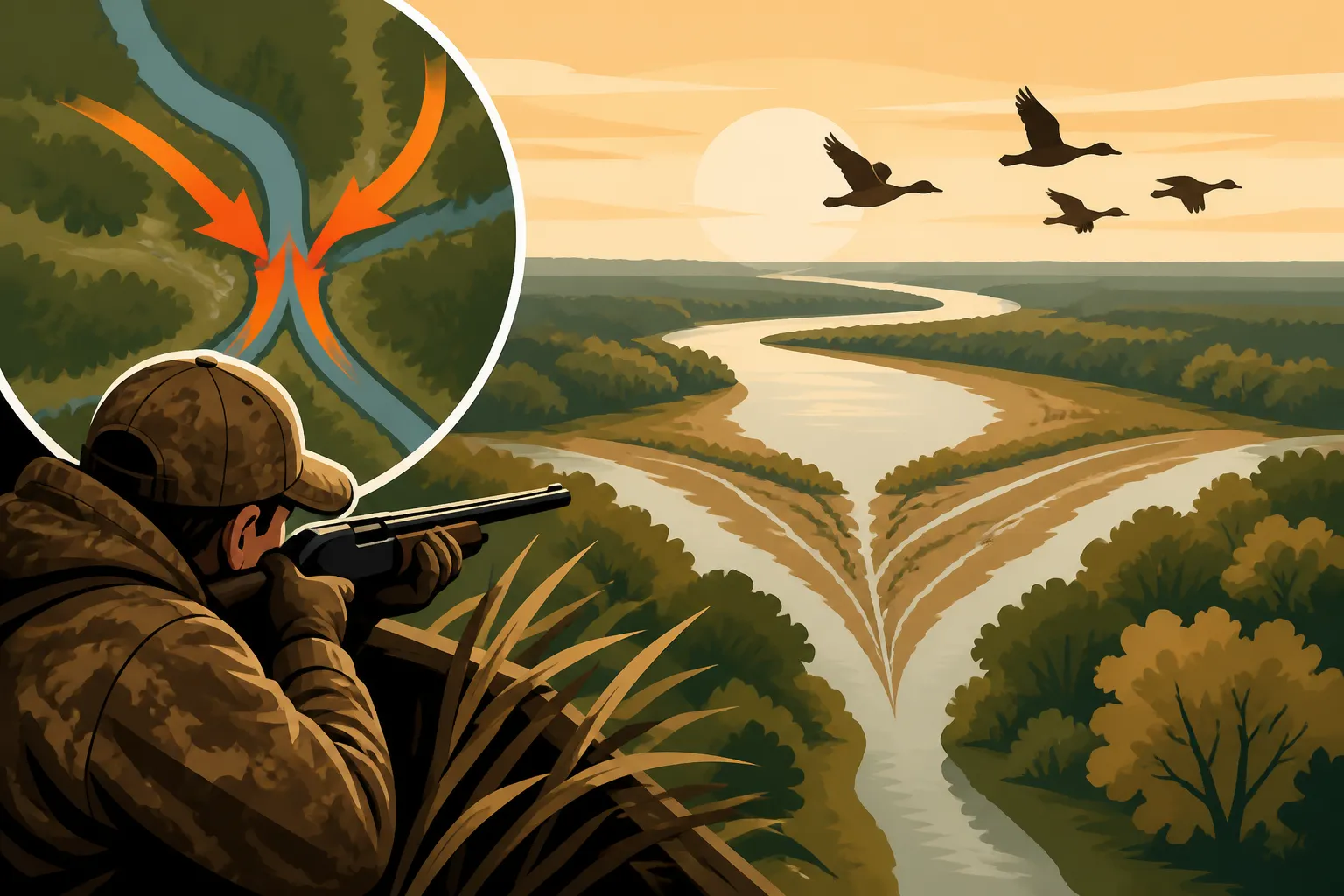
Hard funnels are the classic bottlenecks that concentrate deer movement. In river bottoms, these often manifest as narrow strips of dry ground between two large water bodies, like two sloughs or an oxbow and the main river. Imagine a small peninsula of timber extending into a flooded area – deer will naturally use the neck of that peninsula to travel. Another common hard funnel is a significant elevation change, even just a few feet, that creates a dry ridge through an otherwise low, wet area.
These choke points can also be formed by human-made structures, such as old logging roads or levees that run parallel to the river. While deer might avoid heavy human activity, they often adapt to using these slightly elevated and drier paths, especially during periods of high water. When you find these clear bottlenecks, you've found a goldmine. Deer have few other options but to pass through these confined areas, making them ideal ambush points. Don't be afraid to utilize mapping tools like GoHunt to mark potential hard funnels from your couch, then confirm them on the ground.
Soft Funnels: Habitat Transitions and Subtle Edges
Soft funnels are more nuanced and often overlooked, but just as effective. These are areas where different habitat types meet, creating natural travel lanes. Think of the edge where thick, unhuntable briar patches meet more open, mature timber. Deer will often skirt this edge, using the dense cover for security while still being able to move efficiently. The transition zone between flooded timber and higher, drier ground is another excellent example of a soft funnel. Deer don't want to wade through water if they don't have to, so they'll stick to the dry "rim" around the flooded area.
Even subtle changes in vegetation density can create soft funnels. A narrow strip of slightly less dense undergrowth within an otherwise impenetrable thicket can serve as a travel corridor. These areas often require more intense scouting to identify, but once found, they can be highly productive, especially since they may receive less hunting pressure. Paying attention to these subtle transitions is key to unlocking the full potential of river bottom hunting.
Oxbows, Sloughs, and Backwater Connections
The Illinois River system is famous for its oxbow lakes, sloughs, and vast backwater areas. These features are not just picturesque; they are critical components of river bottom funnels. Oxbows, created when a meandering river cuts off a bend, often become isolated lakes or wetlands that deer will travel around. The narrow necks of land connecting these oxbows to higher ground or the main river system are absolute magnets for deer. Similarly, long, winding sloughs create natural barriers, forcing deer to use the land bridges or high banks that separate them.
These backwater connections are especially important for Hunting Illinois River Valley Diving Ducks and other waterfowl, but for deer, they are often primary routes to food, water, and bedding areas. A small, dry rise that allows deer to cross between two large sloughs, or a narrow strip of timber separating a flooded field from a dense bedding thicket, are classic examples. Always look for areas where these water features force deer into predictable patterns.
Scouting Strategies for Illinois River Bottoms
Effective scouting is paramount in river bottoms, where conditions can change rapidly and deer sign can be subtle. You can't just walk in blindly; you need a strategic approach that combines aerial reconnaissance with diligent boots-on-the-ground investigation.
Pre-Season Aerial and Topo Map Analysis
Before you ever set foot in the mud, spend significant time studying aerial imagery and topographic maps. Tools like GoHunt or other digital mapping platforms are invaluable here. Look for the main river channel, but then zoom in to identify every oxbow, slough, and tributary creek. Pay close attention to subtle elevation changes – even a slight contour line can indicate a dry ridge in an otherwise wet environment. Look for areas where dense cover bottlenecks between water features or where agricultural fields meet the timbered bottom. Mark these potential funnels as waypoints.
Beyond water features, identify different timber types. Are there areas of dense cedar thickets offering thermal cover? Are there open mature hardwoods with potential mast crops? How do these different habitat types connect? Note any old logging roads, power lines, or levees that could serve as travel corridors. This initial digital scouting allows you to eliminate vast tracts of less productive ground and focus your physical scouting efforts on high-probability areas. It’s like getting a cheat sheet for the maze before you even enter it.
Boots-on-the-Ground Reconnaissance
Once you've identified potential funnels from your maps, it's time for boots-on-the-ground reconnaissance. This is where you confirm your theories and find the hard evidence. During the off-season or before the hunting pressure begins, walk those marked funnels. Look for fresh deer sign: tracks in the mud, rub lines along narrow strips of timber, and well-used deer trails. Pay particular attention to how the trails merge and consolidate in the funnels. If you find multiple distinct trails converging into one, you've found a major travel corridor.
Beyond fresh sign, look for older indicators. Shed antlers can confirm wintering areas, and old rubs can indicate traditional buck travel routes. Don't be afraid to get a little uncomfortable – some of the best funnels are in the densest, most difficult-to-access areas. These are often the places that see the least hunting pressure. If you're willing to push through the briars and muck, you'll often find undisturbed deer activity. Remember to also consider Scouting Illinois Public Land Before Season to get a clear picture of how much competition you might face.
Utilizing Trail Cameras in Funnel Locations
Trail cameras are your eyes in the woods when you can't be there, and they are especially effective in river bottom funnels. Once you've identified a likely funnel on the ground, place a camera on the most active trail within it. Position cameras to cover the main trail and any secondary trails that feed into it. Use scent-free practices when deploying and checking cameras to avoid alarming deer. Running multiple cameras in a funnel can give you a better understanding of deer movement patterns, including time of day, sex ratios, and specific bucks using the area.
Keep an eye on weather patterns and water levels between camera checks. A significant rain event or a period of freezing temperatures can drastically alter how deer use the funnel. Your camera data, combined with this environmental awareness, will help you determine the best times to hunt. Remember that you can learn a lot about how deer are using these areas by analyzing the timing of their movements, which can inform your own entry and exit strategies.
Stand Placement and Setup in River Bottoms
Once you've done your homework and identified those prime funnels, the next critical step is proper stand placement. This isn't just about finding a tree; it's about optimizing your visibility, controlling your scent, and making sure your setup aligns with how deer will approach the funnel.
Elevated Stands for Visibility and Scent Control
Elevated stands, whether treestands or ladder stands, are often the go-to for river bottom funnels. The primary advantage is getting above a deer's line of sight and their primary scent cone. In dense river bottom cover, elevating yourself can provide those precious extra yards of visibility you need to make an ethical shot. Look for sturdy, healthy trees that offer good cover for your silhouette, such as a large oak or a cluster of smaller trees. Consider the prevailing winds, but also local thermals that often swirl in river bottoms. Your stand should be set up downwind of the anticipated deer approach.
Accessibility is another factor. Can you get to and from your stand without spooking deer? Consider your entry and exit routes, making sure they are as discreet as possible. If the funnel is tight, sometimes placing your stand just outside the densest part, overlooking the funnel itself, can be more effective than being right in the middle, which might blow your cover. Remember, it's not just about what you see, but what the deer don't see or smell.
Ground Blinds for Concealment and Flexibility
While treestands are popular, ground blinds can be incredibly effective in certain river bottom scenarios, especially in areas with limited suitable trees or extremely dense cover. They offer superior concealment, allowing you to move subtly and offering protection from the elements. This can be a huge advantage during periods of cold, wet weather that often accompany late-season hunting in Illinois. A well-brushed-in pop-up blind or a natural ground blind built from downed timber and brush can virtually disappear into the environment.
Ground blinds are also excellent for areas where the funnel is wider or offers multiple crossing points that might be difficult to cover from a single treestand. You have more flexibility in adjusting your shooting lanes. They also shine in situations where you might be Hunting a Funnel Between Two Woodlots that are relatively open but still funnel deer. Just be extremely mindful of wind direction, as ground blinds don't offer the same scent-control advantage as elevated stands. Position your blind so that deer approach from downwind, or at least crosswind, to minimize detection.
Considering Wind and Thermals in Bottomland
Wind and thermals are perhaps the most critical, and often misunderstood, factors in river bottom hunting. Unlike upland areas where wind can be more consistent, river bottoms are notorious for swirling winds, especially in the early morning and late afternoon as temperatures change. Cold air sinks, pulling your scent downhill into creek beds and low-lying areas. As the sun warms the air, it rises, carrying your scent upward. This dynamic often means scent will flow downhill in the morning and uphill in the evening.
Always check a reliable weather app before heading out, but be prepared for localized micro-thermals. A small creek or ditch can act like a chimney, pulling scent directly downwind from your position even if the general wind is blowing differently. Use a milkweed or powder bottle constantly to monitor these subtle shifts. If you can only hunt a specific funnel during a certain wind, then be disciplined and only hunt it when conditions are favorable. Hunting with the wrong wind is a surefire way to educate mature bucks and make them nocturnal in your area. This is especially true when setting up near waterways, as the water itself can influence airflow in unpredictable ways.
| Funnel Type | Description | Ideal Stand Type | Key Considerations |
|---|---|---|---|
| Hard Funnel | Narrow land bridges, dry ridges between water, man-made levees. | Treestand or Ground Blind | Strict wind adherence, discreet entry/exit. |
| Soft Funnel | Habitat edges (thick cover to open timber), dry rim around flooded areas. | Treestand (for visibility) | Identify subtle travel routes, quiet approach. |
| Oxbow/Slough Connection | Necks of land connecting these water bodies to higher ground. | Treestand | Monitor water levels, long-range visibility possible. |
| Creek Crossing | Shallow, often narrow points where deer will cross a creek. | Ground Blind or Treestand | Approach/exit from high bank, thermals can be tricky. |
| Ag Field Edge | Transition where crops (corn/beans) meet timbered river bottom. | Treestand or Ground Blind | Food source dependent, hunt during feeding times. |
Hunting Tactics and Timing in River Bottoms
Knowing where the funnels are is only half the battle; knowing when and how to hunt them effectively is crucial. River bottom deer can be wary, but during certain times and with the right tactics, these funnels become highly productive.
Rut Hunting in River Bottoms
The rut transforms river bottom funnels into high-traffic highways for deer. As bucks become more mobile and less cautious in their pursuit of does, they often use these natural corridors to efficiently cover ground and check for estrous females. Focusing on funnels during the peak of the rut, generally from late October through mid-November in Illinois, can be incredibly rewarding. Bucks will cruise these areas, often scent-checking every track and rub, making them susceptible to calling and decoying.
During this time, consider longer sits, as deer activity can occur at any point in the day. Bucks might be pushing does, chasing them through dense cover, or simply scent-checking known doe bedding and feeding areas connected by the funnel. Setting up a mock scrape along a primary travel route within the funnel can also draw in curious bucks. Remember that during the rut, deer will sometimes move into less secure areas, including more open sections of the bottom, as their guard is down. This can be an excellent opportunity for Hunting the Illinois Rut in Early November.
Early Season and Late Season Considerations
While the rut is a prime time, river bottom funnels can be productive throughout the season with adjusted tactics. In the early season, deer are often still patterned around food and water. Look for funnels that connect dense bedding cover to preferred early-season food sources like acorn flats or persimmon trees, or direct routes to fresh water during dry spells. Early season hunters might consider using lighter, more portable stands to quickly adapt to where deer are feeding.
The late season presents its own unique challenges and opportunities. After crop harvest, Late-Season Food Sources for Illinois Whitetails become paramount. Funnels connecting dense thermal cover, such as thick cedar swamps or brushy clear-cuts, to remaining food sources like standing beans or corn stubble fields will be hot. Deer are focused on survival and conserving energy, so they'll use the most efficient, low-impact routes. During bitterly cold periods, deer will also seek out dense cover for thermal regulation, and funnels leading to these sanctuaries can be dynamite. Water levels can also play a huge role; frozen sloughs create new, often quieter, travel lanes.
Calling and Decoying Strategies
River bottom funnels are excellent locations to incorporate calling and decoying into your hunting strategy. During the rut, rattling and grunt calls can be highly effective in drawing a cruising buck into shooting range. The dense cover and confined nature of many funnels can make these calls sound incredibly realistic, mimicking a real fight or a buck vocalizing close by. Start with soft grunts and light rattling, then escalate if there's no response.
For decoying, consider a single doe decoy (or a buck and a doe combo during the peak chase phase) placed visible from the main funnel trail. A decoy can draw a curious or territorial buck closer, giving you a shot opportunity. Ensure your decoy is placed in a spot that offers a clear shooting lane and allows deer to approach naturally. Always be mindful of other hunters, especially on public land, and position your decoy safely. It's often best to position a decoy downwind of your stand, allowing any approaching buck to circle to get your scent, bringing them closer to you.
Challenges and Solutions in River Bottom Hunting
River bottom hunting isn't for the faint of heart, and seasoned hunters know that these areas come with their own set of unique frustrations. However, with the right mindset and preparation, these challenges can be overcome.
Dealing with Water Fluctuations and Access
One of the biggest headaches in river bottom hunting is the unpredictable nature of water. Heavy rains can cause the Illinois River to swell, flooding vast tracts of timber and cutting off access to once-dry funnels. What was a perfect pinch point one week might be an impassable lake the next. This means you need to be adaptable and have backup plans. Always monitor river gauges and local weather forecasts. A long-term forecast showing significant rain might mean you need to shift your focus to higher ground or different funnels that aren't as susceptible to flooding.
Access points are also critical. Many river bottom funnels are deep within vast tracts of public land, requiring long walks or even canoe/kayak access. If you're using a boat, ensure you have a plan for securing it and that you're familiar with the waterways. For foot access, investing in good quality, knee-high rubber boots or waders is non-negotiable. Be prepared to get wet and muddy. Sometimes the hardest-to-reach funnels are the most productive precisely because they deter other hunters. For further insights on reaching remote areas, consider strategies for Hunting Illinois River Bottom Funnels.
Managing Hunting Pressure and Human Intrusion
Public river bottom lands, like many popular hunting spots in Illinois, can experience significant hunting pressure. Deer quickly learn to avoid areas with heavy human intrusion, becoming nocturnal or shifting their patterns entirely. The key to success here is to find funnels that other hunters overlook or are unwilling to access. This might mean walking an extra mile, crossing a small creek, or navigating a particularly nasty briar thicket. Look for small, isolated pockets of habitat that are surrounded by water or difficult terrain – these often act as sanctuaries and, consequently, as exceptional funnels for deer traveling in and out.
When you do find a promising spot, minimize your intrusion. Use stealthy entry and exit routes, preferably under the cover of darkness. Avoid leaving excessive scent, and only visit your stands when conditions are optimal. If you notice increasing pressure in a specific funnel, be willing to move. There's a fine line between a productive funnel and a burned-out spot, and knowing when to back off is crucial. Scouting for Hunting Pressure on Illinois Public Land can also help you identify less-traveled areas.
Navigating Thick Cover and Mosquitos
River bottoms are synonymous with thick cover – briars, honeysuckle, multiflora rose, and dense saplings create a formidable barrier. This dense vegetation is fantastic for deer security, but a nightmare for hunters. Invest in durable hunting clothing that can withstand thorns and snags. A good pair of waterproof, insulated boots is also essential. A sturdy pair of pruning shears or a folding saw can also be invaluable for clearing shooting lanes or making a path to your stand, but be mindful of minimal impact on public lands.
And then there are the mosquitos. Especially in the early season or during warm spells, river bottoms can be swarming with these tiny vampires. A head net, bug spray (scent-free if hunting), and long sleeves/pants are absolutely necessary. The distraction and discomfort caused by bugs can ruin a hunt faster than almost anything else. Don't let them deter you from these prime locations; come prepared with the right gear, and you'll be able to focus on the hunt, not the bites.
Disclaimer
Hunting is an inherently dangerous activity. Always prioritize safety, adhere to all local, state, and federal hunting regulations, and ensure you have proper training and licensing before heading afield. The information provided in this guide is for informational purposes only and should not replace professional guidance or your own due diligence.