Nest Predation and Illinois Turkey Hatches
There's nothing quite like the sound of a spring gobbler tearing up the woods with his morning serenade, but lately, many Illinois turkey hunters have been hearing less of that thrilling music. It's a frustrating trend, leaving us scratching our heads about where the birds have gone. This guide dives deep into two major culprits behind fluctuating turkey populations: nest predation and the success, or failure, of Illinois turkey hatches, offering insights into how these factors shape our hunting seasons.
Understanding Wild Turkey Nesting in Illinois
For wild turkeys to thrive, they first need to successfully bring new life into the world. That means hens laying eggs, incubating them, and those eggs hatching into healthy, vibrant poults. It sounds simple enough, but the reality is a high-stakes game where many things can go wrong.
The Critical Period of Nesting
In Illinois, the magic window for turkey nesting typically opens in early to mid-April, though it can vary a bit depending on how early or late spring decides to arrive. A hen will meticulously choose a spot, often a secluded area with dense cover, to build her nest. She'll lay, on average, 10 to 12 eggs over a period of about two weeks, laying one egg every day or so. Once the clutch is complete, she'll begin the arduous 28-day incubation period, sitting tight on her nest, only leaving for short periods to feed and drink. This month-long commitment is a true testament to her dedication, but it's also a time of immense vulnerability for her and her unborn poults. The longer she's on the nest, the higher the risk of something going wrong.
Factors Influencing Nest Site Selection
A hen's choice of nest site isn't random; it's a matter of survival. She's looking for a place that offers excellent concealment from above and on the ground, making it difficult for predators to spot her. This often means dense, overhead canopy combined with thick understory, such as brushy fencerows, heavy briar patches, regenerating clear-cuts, or areas of native warm-season grasses. Proximity to water and reliable food sources is also important, allowing her to quickly forage during her brief breaks from incubation. The ideal spot provides a balance of cover, resources, and relative seclusion. However, in many parts of Illinois, finding truly undisturbed areas, especially as agricultural fields push right up against timber edges, becomes a significant challenge for these wary birds.
The Gauntlet of Nest Predation
Even the most perfectly chosen nest site can fall victim to the relentless pursuit of predators. It's a harsh reality of the wild, and it plays a huge role in why some years see booming turkey numbers and others leave hunters wondering where all the birds have gone. It's not just one type of animal; a whole cast of characters is always on the lookout for an easy meal, and a turkey nest, unfortunately, fits the bill perfectly.
Who Are the Main Culprits?
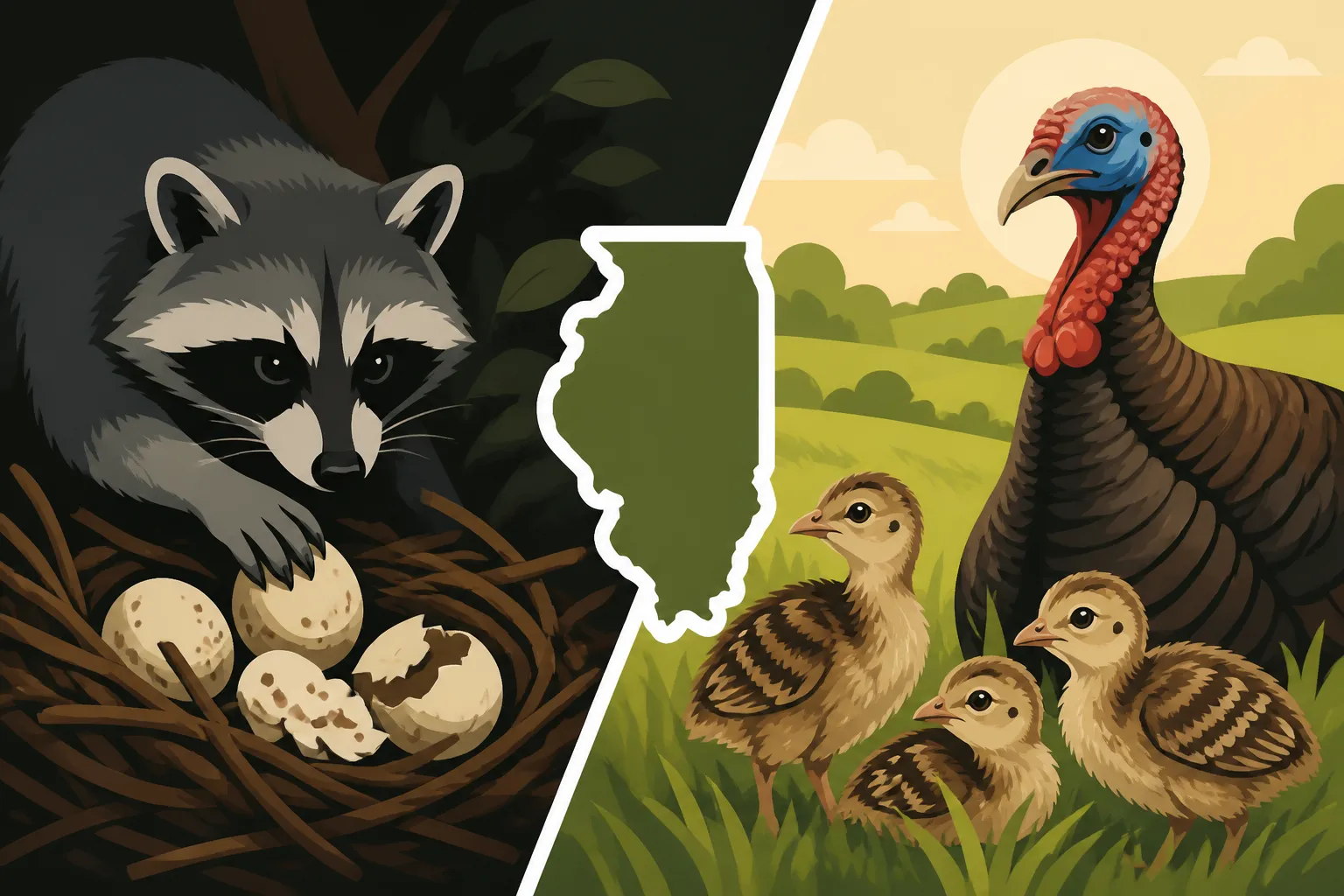
When it comes to devouring turkey eggs, the list of usual suspects in Illinois is quite long. Raccoons are arguably public enemy number one. Their incredibly dexterous paws, keen sense of smell, and intelligent problem-solving abilities make them expert nest raiders. They're common across the state, from suburban fringes to deep timber, and they'll quickly clean out a nest. Opossums are another highly opportunistic predator. Though not as clever as raccoons, their widespread presence and willingness to eat just about anything mean they often stumble upon nests. Skunks, with their powerful digging claws and potent defense mechanism, also contribute significantly to nest loss, particularly if a nest is in softer soil or close to burrows.
Then we have the more agile and stealthy predators. Coyotes are always on the prowl, and a sitting hen or a fresh nest scent is an invitation for them. Their intelligence and ability to cover large areas make them formidable threats. We also have to consider snakes, particularly larger species like black rat snakes, which can swallow an entire clutch of eggs, one by one. While perhaps not impacting populations on the same scale as mammals, they are certainly a factor. Finally, corvids like crows and blue jays, with their sharp eyesight and ability to fly, can spot nests from above, especially if a hen flushes prematurely. It's a tough world out there for a turkey hen, and the sheer number of predators makes successful hatching a statistical battle. Knowing your local Illinois Coyote Range and Density can help you anticipate some of these threats.
How Predators Find Nests
It’s often said that a turkey hen on her nest is virtually invisible, and while she does a remarkable job of camouflaging herself, predators have a distinct advantage: their senses. The primary way mammalian predators like raccoons, opossums, and coyotes locate nests is through scent. The hen herself carries a scent, and the eggs, especially as they develop, also emit a subtle odor that can be picked up by a sensitive nose. If a hen has left the nest to feed and returned, she may inadvertently create a scent trail leading directly to her clutch. Even human scent from scouting or disturbance can linger and attract curious predators.
Visual cues are another important factor. If a hen is startled and flushes from her nest, even for a moment, the sudden movement can draw attention. A predator might observe her return to the nest site, marking it for a later visit. Similarly, if the nesting cover isn't dense enough, or if it's been disturbed by wind or other animals, the nest or the hen herself might become visually exposed. Auditory cues are less common but can play a role if a hen makes alarm calls near her nest or if poults peep shortly before hatching. It’s a constant cat-and-mouse game, and unfortunately for the turkeys, the odds are often stacked against them.
The Role of Habitat in Nesting Success
Habitat isn't just where turkeys live; it's their entire defense system, their pantry, and their nursery. For wild turkey hens trying to hatch a brood in Illinois, the quality and availability of suitable habitat can make all the difference between a successful hatch and a lost clutch. It's truly the foundation upon which strong turkey populations are built, and understanding its nuances is key to appreciating the challenges our feathered friends face.
Quality Habitat as a Defense
Imagine trying to hide something precious in a wide-open field versus a dense, thorny thicket. That's essentially the choice a turkey hen faces when selecting a nest site. Quality habitat provides layers of defense. Dense, diverse cover, such as thick stands of native warm-season grasses (switchgrass, indiangrass), briar patches, or regenerating timber, offers both overhead and lateral concealment. This makes it incredibly difficult for aerial predators like hawks or crows to spot the nest, and equally challenging for ground predators to scent or visually locate the hen. Furthermore, good nesting habitat often extends into brood-rearing cover, providing immediate protection for newly hatched poults, which are incredibly vulnerable to everything from cold rain to raptors. This is directly tied to a robust Illinois Turkey Population Estimate. The more quality nesting habitat available, the better the chances for successful reproduction.
Habitat Fragmentation and Its Impact
Unfortunately, across much of Illinois, prime turkey habitat isn't always continuous. Instead, it's often broken up, or "fragmented," by agricultural fields, roads, and human development. This fragmentation creates what we call "edge effects." Edges—the transition zones between different habitat types, like where a woodlot meets a cornfield—are often highways for predators. Raccoons, opossums, and coyotes frequently travel these edges, increasing their chances of stumbling upon a turkey nest. Think of it like a buffet line for them. When nesting cover is confined to small, isolated patches surrounded by open land, hens have fewer safe places to choose from, and predators can more easily patrol and exploit these limited options. The loss of large, unbroken blocks of timber and dense understory has a significant negative impact on the overall Illinois Turkey Population Trends by making hens and their nests more susceptible to predation.
Best Practices for Habitat Improvement
The good news is that we, as hunters and conservationists, can actively work to improve habitat for wild turkeys. One of the most effective strategies is planting native warm-season grasses. These grasses grow tall and dense, providing excellent nesting and brood-rearing cover that stands up well to wind and snow. Creating brush piles from downed limbs and trees offers instant hiding spots for hens and poults, as well as crucial escape cover. Properly managed controlled burns, when timed outside the nesting season, can invigorate native plant growth, reduce invasive species, and create a mosaic of healthy habitat patches. Even strategic food plots, planted with species that offer structure and cover, can provide dual benefits. Landowners can also delay mowing until after the nesting season to protect ground-nesting birds. Organizations like GoHunt provide valuable tools for landowners to map and manage their properties, helping identify areas where these habitat improvements can have the biggest impact. Investing in these practices is investing in the future of Spring Turkey Hunting in Illinois.
Weather's Influence on Hatch Survival
While predation often steals the spotlight, Mother Nature herself plays a pivotal, and sometimes devastating, role in the success of turkey hatches. Even if a hen manages to keep her eggs safe from predators, the conditions immediately following the hatch can be just as critical for the fragile poults. Illinois weather can be notoriously fickle, swinging from mild to extreme in a matter of days, and these shifts can spell disaster for a new brood.
Cold and Wet: A Poult's Worst Enemy
Young turkey poults are incredibly delicate. When they first hatch, they lack the fully developed feathers and insulating fat layers needed to regulate their body temperature effectively. This makes them highly susceptible to hypothermia, especially during prolonged periods of cold rain or unseasonably low temperatures. A hen will try her best to brood them, keeping them tucked under her wings for warmth, but she can only do so much against persistent cold and dampness.
Beyond the direct threat of hypothermia, cold, wet weather also has a cascading effect on their food supply. Poults primarily feed on insects during their first few weeks of life, needing a high-protein diet for rapid growth and feather development. Cold, wet conditions suppress insect activity, making it much harder for poults to find the abundant food they desperately need. This combination of cold stress and nutritional deficit can lead to high mortality rates, even in clutches that successfully hatched. This is often reflected in poor Poult-to-Hen Ratios and What They Mean later in the summer.
Drought and Extreme Heat
On the flip side, excessively dry and hot conditions can also be detrimental, though typically less immediately fatal than cold, wet spells. During prolonged droughts, water sources can become scarce, stressing hens and making them more vulnerable. Extreme heat can also impact a hen's ability to effectively incubate eggs or can stress newly hatched poults, especially if quality brooding cover is lacking.
Just like with cold weather, drought severely impacts insect populations. Many insects rely on moisture for their life cycles, and dry conditions can drastically reduce their numbers. If poults can't find enough protein-rich insects, their growth can be stunted, making them weaker and more vulnerable to diseases or other environmental stressors. While not as dramatic as a sudden cold snap, sustained drought can slowly but surely chip away at a year's turkey hatch, impacting subsequent Hunting Illinois's Fall Turkey Zones as well.
Hunter and Landowner Actions to Help Turkey Hatches
It's easy to feel helpless when discussing natural challenges like nest predation and adverse weather, but we're not just spectators in this grand play. Hunters, landowners, and conservation enthusiasts have a crucial role to play in supporting healthy wild turkey populations in Illinois. By understanding the challenges, we can implement strategies that give these birds a fighting chance, leading to more successful hatches and, ultimately, more robust hunting opportunities.
Predator Management Strategies
While we can't eliminate every predator from the landscape, strategic predator management can make a difference, especially in localized areas with high turkey nesting potential. Trapping efforts, particularly for common nest predators like raccoons, opossums, and skunks, can reduce their numbers during critical nesting periods. Illinois offers opportunities for Trapping Illinois Furbearers, and focusing these efforts in spring before nesting begins or during fall and winter can help ease pressure on turkey nests. It's not about eradication, but about balancing predator populations to give ground-nesting birds a better chance.
Another often-overlooked aspect is the control of domestic animals. Feral cats are incredibly efficient killers of birds, including poults, and can easily find nests. Domestic dogs allowed to roam freely can also disturb nests or even kill hens. Educating neighbors and ensuring responsible pet ownership around prime turkey habitat is a simple yet impactful step. For those engaged in Predator Hunting in Illinois, understanding the impact of various species on turkey hatches can help focus efforts where they are most beneficial for conservation goals.
Creating and Protecting Nesting Cover
Perhaps the most direct and impactful action we can take is improving and protecting the actual nesting habitat. As discussed, dense, diverse cover is a turkey hen's best defense. Landowners can plant native warm-season grasses, which provide excellent concealment and bugging habitat. Allowing fencerows and field edges to grow into brushy thickets rather than mowing them clean provides critical nesting and brood-rearing cover. Delaying hay mowing until after the typical nesting and early brood-rearing period (often mid-July) can save countless poults from being killed by farm equipment.
Working with conservation programs offered by state and federal agencies can provide technical assistance and even financial incentives for creating and maintaining ideal turkey habitat. These programs can help fund projects like tree planting, native grassland establishment, and prescribed burning. Tools like those from GoHunt can help landowners visualize their property and identify areas where these improvements will have the greatest benefit, helping to bring back the turkey numbers we saw when How Turkeys Were Restored to Illinois was a conservation success story. Even small acts, like leaving brush piles, can create vital microhabitats.
Minimizing Disturbance
Human presence, even unintentional, can sometimes contribute to nest failure. During the spring turkey season, hunters are naturally out in the woods. While ethical hunters are respectful, simply walking through dense cover in known nesting areas can inadvertently flush a hen, potentially exposing her nest to predators. It's wise to be mindful of heavy cover areas, especially during late spring, and try to minimize unnecessary travel through them if you suspect hens might be nesting.
For landowners, this means thoughtful planning of activities like timber stand improvement or recreational use. Keeping pets leashed when near sensitive areas during nesting season is also crucial. Every little bit of reduced pressure helps. By giving hens the space and peace they need during this critical time, we increase their chances of bringing a new generation of turkeys into the Illinois woods. Supporting efforts that maintain and expand areas like those funded by the Illinois State Habitat Stamp directly contributes to this goal.
Key Factors Influencing Illinois Turkey Hatches
Understanding the complex interplay of factors affecting Illinois turkey hatches can seem overwhelming. To summarize, successful hatches depend on a delicate balance of robust hen health, ample quality nesting habitat, manageable predator populations, and favorable weather conditions. Here's a quick look at the main elements:
| Factor | Impact on Turkey Hatches | Mitigation/Improvement |
|---|---|---|
| Nest Predation | Direct loss of eggs/hens, reduced overall hatch success | Targeted trapping, habitat improvements, control of feral animals |
| Habitat Quality | Determines nest site availability, concealment, and poult survival | Planting native grasses, creating brush piles, prescribed burns |
| Habitat Fragmentation | Increases predator access to nests, limits safe nesting areas | Consolidating habitat, creating buffer zones, reducing edge effects |
| Cold/Wet Weather | Leads to poult hypothermia, reduced insect availability | Enhance brooding cover, ensure access to dense thermal refuge |
| Drought/Heat | Stresses hens, reduces insect populations, limited water access | Maintain diverse habitat with varying canopy cover, water sources |
| Human Disturbance | Can cause hens to flush, exposing nests to predators | Minimize activity in nesting areas, responsible pet ownership |
Disclaimer
This article is for general informational purposes only and does not constitute professional advice. Laws, prices and regulations vary by location and change over time. Consult a qualified professional for guidance on your specific situation.